Ancient Romepax deorumPontifex MaximusVestal Virginsinterpretatio graeca

Ancient Roman Religion and the Integration of State Power

Faith and Power: Understanding Religion in Ancient Rome For the people of ancient Rome, religion was not a private matter of personal belief, but a fundamental pillar of public life and s...

Faith and Power: Understanding Religion in Ancient Rome

For the people of ancient Rome, religion was not a private matter of personal belief, but a fundamental pillar of public life and state survival. The Romans viewed themselves as a deeply religious people, attributing their rise as a global superpower to their pietas—a collective piety and commitment to maintaining a harmonious relationship with the gods.

This complex spiritual landscape was shaped by a blend of indigenous Italian beliefs, heavy influences from the Greeks and Etruscans, and the eventual absorption of diverse cults from across the expanding empire. At its heart was the mos maiorum, or "the way of the ancestors," a traditional code of conduct that linked religious practice directly to Roman identity.

Key Facts
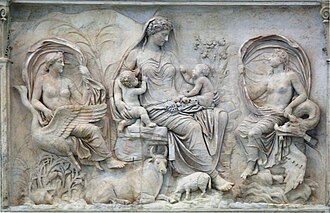
Three goddesses on a panel of the Augustan Ara Pacis, consecrated in 9 BC; the iconography is open to multiple interpretations
  • Polytheism: Rome honored a vast array of deities, often merging their own gods with Greek counterparts through a process called interpretatio graeca.
  • State Integration: Religious offices were often political, with the state overseeing public divination and sacrifices to ensure divine favor.
  • Divination: The Romans used augury (observing birds) and haruspicy (examining entrails) to ascertain the will of the gods.
  • Domestic Cults: Every home had its own spiritual life, centered around the lararium (household shrine) and the worship of ancestral spirits.
  • Religious Transition: Rome shifted from a polytheistic state to a Christian hegemony following the reign of Emperor Constantine.

Foundations and Divine Destiny

Roman religious institutions were traditionally traced back to the city's founders. Legend credits Numa Pompilius, the second king of Rome, with negotiating directly with the gods to establish the city's early religious framework. These foundations created a sense of divine destiny, often illustrated through myths involving Aeneas and the divine lineage of the Roman people.
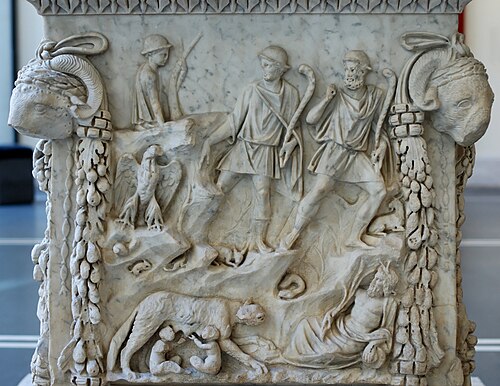
Relief panel from an altar to Venus and Mars depicting Romulus and Remus suckling the she-wolf, and gods representing Roman topography such as the Tiber and Palatine Hill
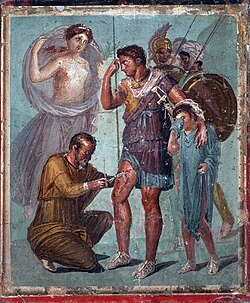
Pompeian fresco; Iapyx removing an arrowhead from Aeneas' thigh, watched by Venus Velificans (veiled)

The Romans were highly adaptive. They adopted the cultus (system of worship) of Apollo from the Greeks and integrated Etruscan practices, particularly in the realm of divination. This synthesis allowed Rome to incorporate the gods of conquered peoples, ensuring that the empire's spiritual growth mirrored its territorial expansion.

Aeneas urged by the Penates to continue his journey to found Rome (4th century AD illustration)[13]

The Roman Pantheon and Deities

The Roman religious system was polytheistic, featuring a hierarchy of gods who oversaw every aspect of existence. The Di Consentes represented the twelve principal deities of the Roman state. Through interpretatio graeca, the Romans identified their major gods with Greek ones—for example, Jupiter with Zeus and Juno with Hera.
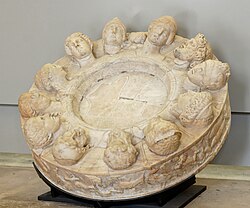
Twelve principal deities (Di Consentes) corresponding to those honoured at the lectisternium of 217 BC, represented on a 1st-century altar from Gabii that is rimmed by the zodiac.
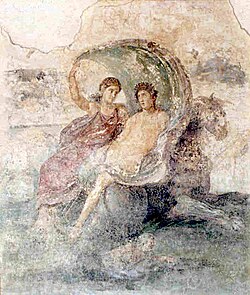
Bacchus, or Liber, and Ceres, mounted on a leopard. Fresco in Stabiae, 1st century
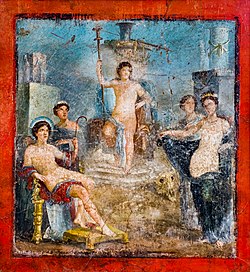
Dionysus (Bacchus) with long torch sitting on a throne, with Helios (Sol), Aphrodite (Venus) and other gods. Wall-painting from Pompeii, Italy
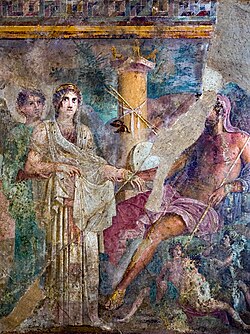
Wedding of Jupiter King of the Gods, and Juno, Queen of Heaven and goddess of marriage, and women. Fresco in Pompeii
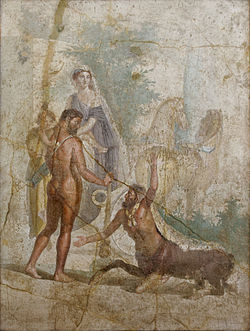
A fresco from Pompeii depicting Hercules, Hyllus, Deianira, and the centaur Nessus from Greco-Roman mythology, 30–45 AD
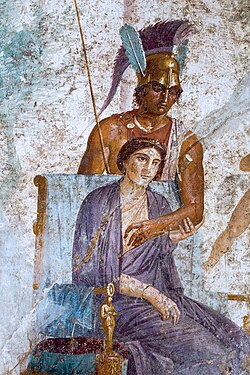
Mars caresses Venus enthroned. Wall-painting in Pompeii, c. 20 BC – 50s AD
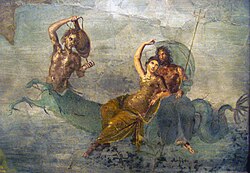
Fresco of Neptune and Salacia, Pompeii
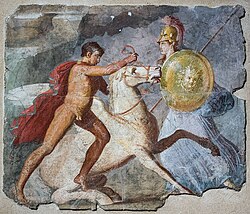
Bellerophon, Pegasus, and Athena (Minerva), fresco of the 3rd style from Pompeii, first half of the 1st century

Beyond the major Olympian-style gods, the Romans honored a variety of specialized deities, including those representing the topography of Rome, such as the Tiber River and the Palatine Hill.

Public Worship: Temples, Festivals, and Sacrifice

Public religion was designed to maintain the pax deorum (peace of the gods). This was achieved through a rigorous schedule of holidays and festivals, such as the Compitalia, where the community gathered for ritual celebrations.
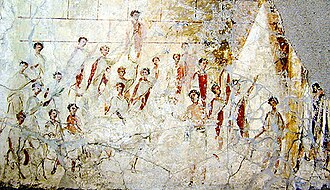
This fresco from outside Pompeii shows Roman men celebrating a religious festival, probably the Compitalia.

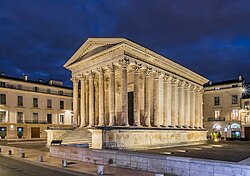
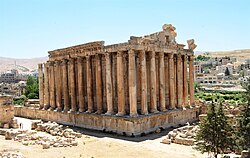
Temples served as the earthly homes of the gods, housing cult statues. These structures, such as the well-preserved Maison Carrée, were central to the urban landscape and the Imperial cult, which venerated the emperors.
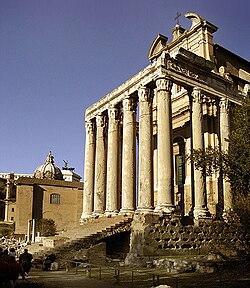
Portico of the Temple of Antoninus and Faustina, later incorporated into a church
Temple of Bacchus ("Temple of the Sun"), c. 150 AD
The Maison Carrée in Nîmes, one of the best-preserved Roman temples. It is a mid-sized Augustan provincial temple of the Imperial cult.

The most critical act of public worship was sacrifice. This involved libations (liquid offerings) and the slaughter of animals at flaming altars. The process was highly formalized, often involving a victimarius who carried the sacrificial axe to ensure the ritual was performed correctly.
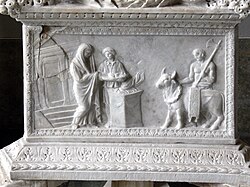
Roman relief depicting a scene of sacrifice, with libations at a flaming altar and the victimarius carrying the sacrificial axe

The Architecture of State Priesthoods

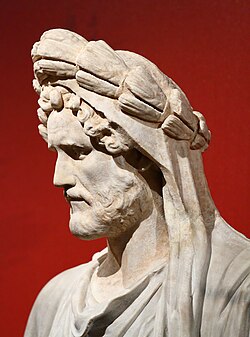
Religion and politics were inextricably linked. The Pontifex Maximus was the highest priest in Rome, a role that eventually became held by the emperors to consolidate their power.
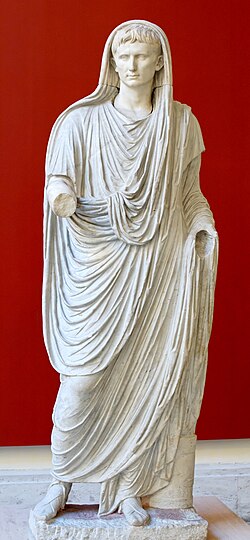
Augustus as Pontifex Maximus (Via Labicana Augustus)
Portrait of the emperor Antoninus Pius (reigned 138–161 AD) in ritual attire as an Arval Brother

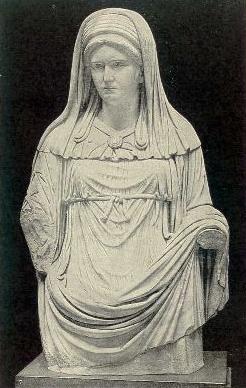
Other vital roles included the flamines (priests dedicated to specific deities) and the Vestal Virgins. The Vestals were uniquely important, tasked with maintaining the sacred fire of Vesta, which symbolized the eternity of the Roman state.
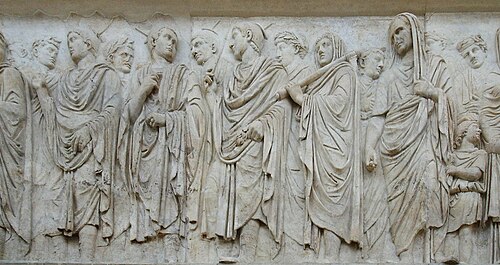
Three flamines in their distinctive pointed headgear, grouped to the centre of a panel from the Ara Pacis
A Roman sculpture depicting a Vestal

The state also employed official divination to guide political and military decisions. Augury involved interpreting the flight of birds, while haruspicy—an Etruscan import—involved the examination of animal livers to detect omens.

The bronze Liver of Piacenza is an Etruscan artifact that probably served as an instructional model for the haruspex

When unusual or terrifying events occurred, they were labeled as prodigies. These were seen as signs of divine displeasure that required urgent placatory rituals to resolve.
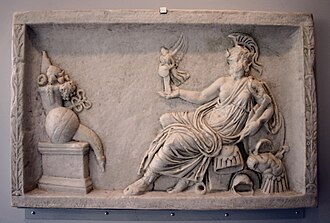
Defaced Dea Roma holding Victory and regarding an altar with a cornucopia and other offerings, copy of a relief panel from an altar or statue base

Domestic and Private Spirituality

While the state focused on the "big gods," Roman individuals focused on the domestic cult. Every household maintained a lararium, a shrine where they worshipped the Lares (guardian spirits of the location) and Penates (spirits of the pantry/household).
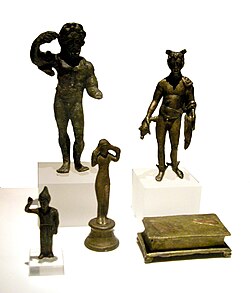
Small bronze statues of gods for a lararium (1st to 3rd century AD, Vindobona)

Families also recognized the Genius, the divine spark or guiding spirit of the head of the household. In the military, this extended to the "genius of the legion," ensuring the soldiers remained under divine protection during campaigns.

A genius of the legion (2nd–3rd century CE)
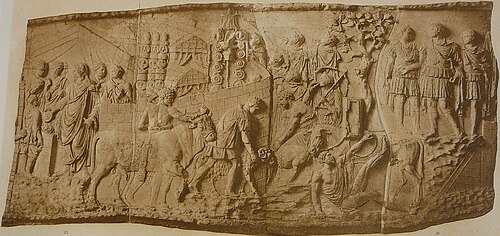
Panel from Trajan's Column depicting the lustral procession of the suovetaurilia victims under military standards

Mystery Religions and External Influences

As Rome expanded, "Mystery Religions" became popular. These were secretive cults that offered personal salvation and a more emotional connection to the divine, contrasting with the formal, contractual nature of state religion. Examples include the cults of Cybele, Mithras, and Bacchus.
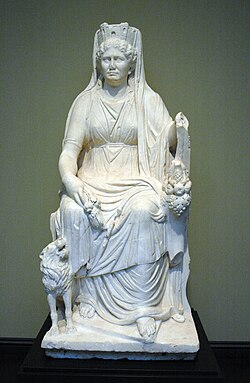
Cybele enthroned, with lion, cornucopia and Mural crown. Roman marble, c. 50 AD (Getty Museum)
Female figure, veiled and seemingly alarmed, from a wall-painting usually described as a narrative from Dionysiac/Bacchic mystery cult, which might also involve Ariadne and a marriage. There is "almost no agreement about how it works in detail". From Pompeii's "Villa of the Mysteries"[95]
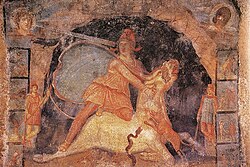
Mithras in a Roman wall painting

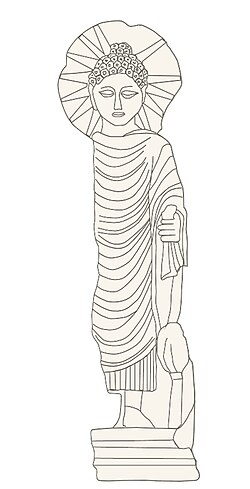
The empire also encountered Eastern faiths. Evidence of Buddhism has been found in Egypt (the Berenike Buddha), and Jewish communities established a presence in Rome, though their customs were sometimes viewed with suspicion or mockery by the Roman elite.
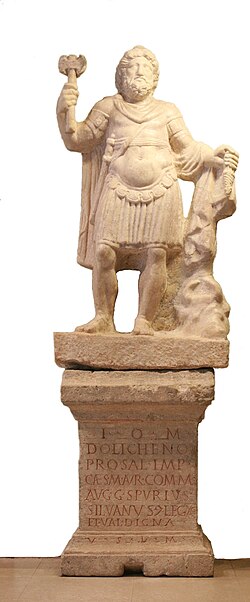
A votive statue of Jupiter Dolichenus dedicated by a centurion for the wellbeing of the emperor (Carnuntum, 3rd century)
The Berenike Buddha, discovered in Berenice, Egypt, in 2022.
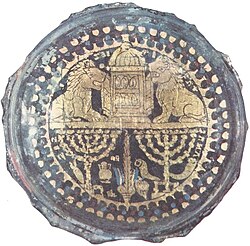
Jewish ritual objects in 2nd-century gold glass from Rome

Superstitio and Magic

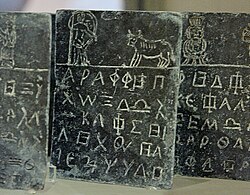
The Romans distinguished between religio (sanctioned worship) and superstitio (excessive or improper belief). Magic, astrology, and private divination were often viewed as subversive. Astrologers and magicians were periodically expelled from Rome, particularly when their predictions threatened the emperor.
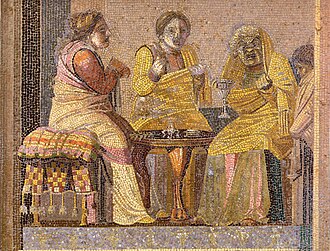
Mosaic from Pompeii depicting masked characters in a scene from a play: two women consult a witch
Bound tablets with magic inscriptions from late antiquity

The Rise of Christianity

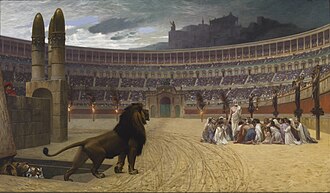
Christianity initially struggled within the Roman Empire, often viewed as a subversive foreign cult. Early Christians faced periods of intense persecution, particularly under emperors like Valerian and Diocletian, who viewed the refusal to sacrifice to traditional gods as treason.
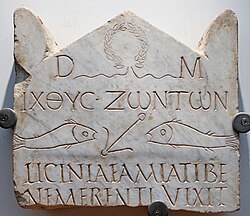
This funerary stele, one of the earliest Christian inscriptions (3rd century), combines the traditional abbreviation D. M., for Dis Manibus, "to the Manes," with the Christian motto Ikhthus zōntōn ("fish of the living") in Greek; the deceased's name is in Latin.
The Christian Martyrs' Last Prayer, by Jean-Léon Gérôme (1883)
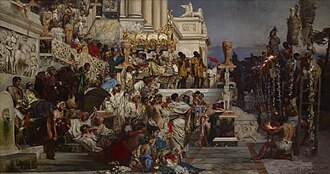
Nero's Torches, by Henryk Siemiradzki (1876). According to Tacitus, Nero used Christians as human torches
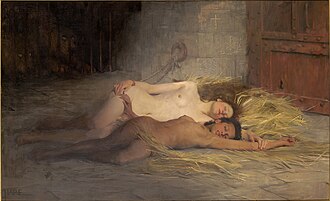
The Victory of Faith, by Saint George Hare, depicts two Christians in the eve of their damnatio ad bestias

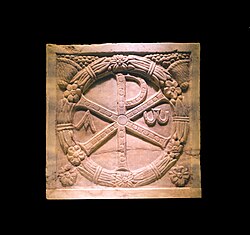
The trajectory of the faith changed with Emperor Constantine, who moved the empire toward Christian hegemony. By the 4th century, the Chi Rho (the monogram of Christ) became a symbol of imperial power, and the state's resources were redirected toward the construction of churches.
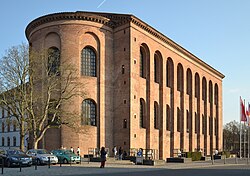
The Aula Palatina of Trier, Germany (then part of the Roman province of Gallia Belgica), built during the reign of Constantine I (r. 306-337 AD)
Monogramme of Christ (the Chi Rho) on a plaque of a marble sarcophagus, 4th century CE (Musei Vaticani, here in a temporary exhibition at the Colosseum in Rome, Italy)

The Persistence of Paganism

The transition to Christianity was not instantaneous. Archaeological evidence from the Crypta Balbi in Rome shows that domestic ritual objects and amulets continued to be used into the 6th and 7th centuries. In isolated regions, such as the Mani Peninsula in Greece, pagan beliefs persisted well into the 11th century.

In the modern era, some have attempted to revive these ancient rituals for cultural or political reasons, reflecting the enduring fascination with the Roman spiritual world.
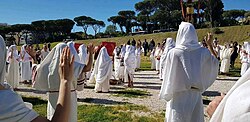
Rituals to the Tutelary Numen of Rome, for the 2777th Natale di Roma. Carried out by Pietas Comunità Gentile

Summary of Roman Religious Elements

Comparison of Roman Religious Spheres
Sphere Primary Focus Key Figures/Tools Goal
State Religion Public Order & Empire Pontifex Maximus, Vestals, Temples Pax Deorum (Peace of the Gods)
Domestic Cult Family & Home Lararium, Penates, Genius Household Protection
Divination Divine Will Augurs, Haruspices, Livers Guidance for State Action
Mystery Cults Personal Salvation Mithras, Cybele, Bacchus Individual Spiritual Connection

Frequently Asked Questions

What is the difference between religio and superstitio?

Religio referred to the traditional, state-sanctioned religious practices that maintained the relationship between Rome and its gods. Superstitio referred to beliefs or practices that were considered excessive, improper, or subversive, such as illicit magic or unauthorized astrology.

Who were the Vestal Virgins?

The Vestal Virgins were a college of priestesses dedicated to Vesta, the goddess of the hearth. Their primary duty was to keep the sacred fire of Rome burning; if the fire went out, it was seen as a dire omen for the safety of the city.

How did the Romans incorporate foreign gods?

Through a process called interpretatio graeca, Romans identified foreign deities with their own. If a foreign god had similar attributes to a Roman god (e.g., a god of thunder), the Romans would simply view them as different names for the same divine entity.

Why was Christianity persecuted in the early Empire?

Christianity was often viewed as subversive because its followers refused to participate in the imperial cult and sacrifice to the traditional Roman gods. This refusal was interpreted by the state not as a religious choice, but as political disloyalty and treason.

What was the role of the Pontifex Maximus?

The Pontifex Maximus was the chief priest of the Roman state. The role involved overseeing the various priesthoods, managing the religious calendar, and ensuring that all state rituals were performed correctly to avoid divine wrath.

References

  1. Jörg Rüpke (2007). "Roman Religion – Religions of Rome". In A Companion to Roman Religion. Blackwell,. p. 4.
  2. Apuleius, Florides 1.1; John Scheid, "Sacrifices for Gods and Ancestors" in A Companion to Roman Religion (Blackwell, 2007), p. 279.
  3. Syme, Ronald (10 November 2016), "Caesar as Pontifex Maximus", in Santangelo, Federico (ed.), Approaching the Roman Revolution (1 ed.), Oxford University PressOxford, pp. 186–195, doi:10.1093/acprof:oso/9780198767060.003.0021, ISBN 978-0-19-876706-0, retrieved 3 November 2025
  4. "This mentality," notes John T. Koch, "lay at the core of the genius of cultural assimilation which made the Roman Empire possible"; entry on "Interpretatio romana" in Celtic Culture: A Historical Encyclopedia (ABC-Clio, 2006), p. 974.
  5. Rüpke, "Roman Religion – Religions of Rome", p. 4; Benjamin H. Isaac, The Invention of Racism in Classical Antiquity (Princeton University Press, 2004, 2006), p. 449; W.H.C. Frend, Martyrdom and Persecution in the Early Church: A Study of Conflict from the Maccabees to Donatus (Doubleday, 1967), p. 106.