Roman Legions: Evolution, Structure, and Life of the Imperial Army
The Roman legion (Latin: legiō) served as the primary military unit of ancient Rome, composed of citizen-soldiers known as legionaries. Over several centuries, the legion evolved from a tribal militia into a professional war machine that enabled Rome to dominate the Mediterranean world. This transformation was not merely one of scale, but of sophisticated organization and tactical flexibility.
From the early days of the Republic to the final years of the Western Empire, the legion adapted to meet new threats, shifting from the rigid lines of the manipular system to the versatile cohorts of the Imperial era, and eventually to smaller, more mobile units in the late Empire.
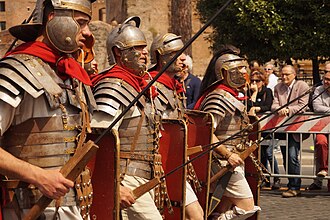
Key Facts
- Composition: Primarily Roman citizens serving as heavy infantry, supported by a small cavalry unit (ala).
- Size Variation: Ranged from approximately 4,200 men in the mid-Republic to 5,500 in the Imperial period, eventually shrinking to 1,000–1,500 men by the 4th century AD.
- Core Unit: The century served as the basic building block, though the cohort became the primary tactical unit during the Empire.
- Professionalism: Soldiers served terms of 25 years or more, receiving a base wage and a retirement bonus (praemia).
- Leadership: Led by a Roman Imperial Legate during the Empire, with centurions acting as the professional backbone of daily operations.
The Evolution of Legionary Structure
The Mid-Republic Manipular Legion
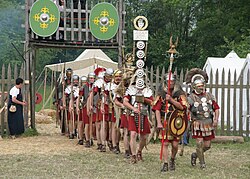
During the middle Republic (509–107 BC), the legion utilized a manipular system, likely influenced by the Greek and Macedonian phalanx. A typical legion consisted of roughly 4,500 men, divided into three lines of infantry based on experience and wealth, and ten maniples (tactical units consisting of two centuries).
The infantry was split into the hastati (youngest), principes (prime age), and triarii (veterans). Supporting them were the velites (light infantry) and approximately 300 equites (cavalry), who were drawn from the wealthier classes and provided their own equipment.

The Late Republic and Early Empire
By the late Republic and the era of Julius Caesar, the legion restructured around 10 cohorts. A standard Imperial legion grew to about 5,280 men plus 120 auxiliaries. The first cohort was double-strength (approximately 800 men), while the remaining nine cohorts contained about 480 men each.
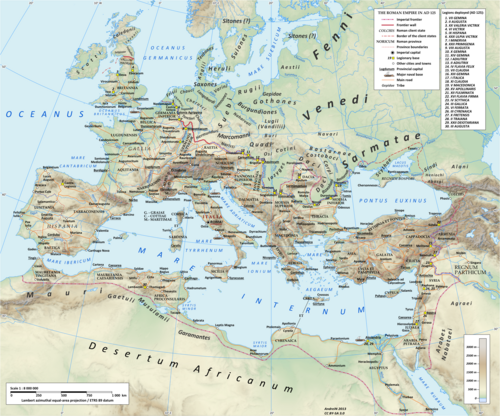
During the Pax Romana, the standing army consisted of roughly 30 legions. When combined with an equal number of auxiliary troops, a legion commander could control a force of up to 11,000 men, though some prestigious border units reached 15,000–16,000 soldiers.
The Later Empire
Starting in the 4th century AD, the Roman military underwent a drastic shift. To cover more territory and improve provisioning, the massive legions were broken down into smaller units of 1,000 to 1,500 men. These included the elite palatini, comitatenses, and the limitanei (border guards). While the size of individual units decreased, the total number of legions increased.
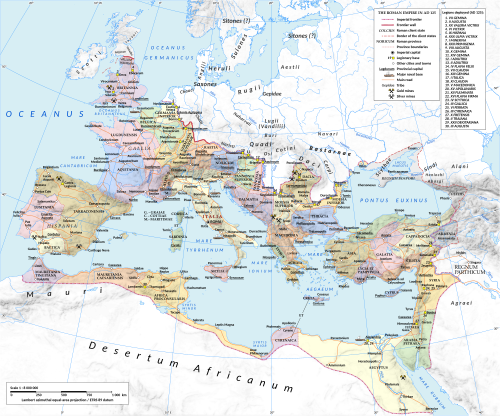
![Map of Roman legions by 212 AD[14]](/images/01/78/0178eeb78e573554918e5950ce043a9038dc053ad2753a9bc69e15d819438710.jpg)
Rank, Pay, and Discipline
The Officer Class
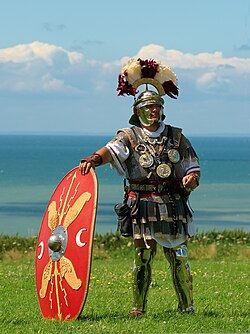
The centurions were the professional heart of the legion. Each legion had 59 or 60 centurions who managed day-to-day discipline and field commands. They were typically promoted from the ranks and earned ten times the basic wage of a standard soldier.
Compensation and Benefits
A standard legionary (caligati) earned 225 denarii per year, a sum increased to 300 by Domitian and later to 500 by Septimius Severus. However, the state deducted taxes for food and clothing from this pay. Soldiers supplemented their income through war booty and the sale of prisoners of war.
Upon completing 25 years of service, veterans received a praemia. Under Augustus, this was 3,000 denarii, later increased to 5,000 under Caracalla, often accompanied by a plot of farmland to help secure frontier regions.
Military Discipline
Discipline was strictly enforced through a hierarchy of punishments. Minor infractions resulted in castigatio (beating with a staff), reduction in rations (eating barley instead of grain), or fines. Major offenses could lead to gradus deiectio (reduction in rank) or missio ignominiosa (dishonorable discharge).
Legionary Strength Summary
| Period | Approx. Strength | Primary Organization | Key Feature |
|---|---|---|---|
| Mid-Republic | 4,200 - 4,500 | Maniples | Three-line infantry system |
| Early Empire | 5,200 - 5,500 | Cohorts | Double-strength 1st Cohort |
| Later Empire | 1,000 - 1,500 | Smaller Legions | Increased mobility and number of units |
Frequently Asked Questions
Who was allowed to serve as a legionary?
Legionaries were required to be Roman citizens. Non-citizens served in auxiliary units, which provided specialized skills like archery or cavalry support.
How long was a typical term of service?
A standard term of service for a Roman legionary was 25 years or more before they became eligible for retirement benefits.
What was the role of the centurion?
Centurions were career officers who served as the backbone of the army, responsible for the daily administration, training, and tactical leadership of the centuries.
How did the legion's size change in the 4th century?
The legion transitioned from a large formation of over 5,000 men to much smaller units of 1,000 to 1,500 men to allow for better surveillance and easier provisioning across the empire's vast borders.
What were the different pay grades for soldiers?
The standard pay grade was known as caligati, while those in the sesquiplicarii grade received one and a half times the standard pay.