Roman Citizenship: Legal Status, Rights, and Evolution
In the ancient world, civitas (citizenship) in Rome was far more than a mere label of origin; it was a privileged political and legal status. This status governed an individual's relationship with the law, their right to own property, and their role in governance. Far from being a simple binary of "citizen" or "non-citizen," Roman citizenship was a complex hierarchy shaped by gender, social class, and political affiliation, evolving significantly from the early Republic to the height of the Empire.
The foundation of these rights was rooted in law and tradition. The earliest known record of these privileges is the Twelve Tables, ratified around 449 BC. These laws, once displayed publicly in the Roman Forum, established the rules for court proceedings, inheritance, and property. To maintain this status, the state conducted a census every five years to track citizens and their households, a practice that expanded as Rome grew.Key Facts
- Civitas provided legal protections, voting rights, and property ownership privileges.
- The Twelve Tables (c. 449 BC) served as the earliest formal documentation of citizen rights.
- The Edict of Caracalla (AD 212) granted full citizenship to almost all free men and women in the Empire.
- Citizenship could be acquired by birth, public service (such as in the auxiliary forces), or through specific legal grants to cities.
- Romanization used the gradual granting of citizenship as a political tool to ensure loyalty among conquered peoples.
The Hierarchy of Citizenship

Roman society utilized various grades of citizenship to manage its vast territories and diverse populations. These classifications determined the level of legal protection and political power an individual possessed.
Cives Romani (Full Citizens)
The cives Romani enjoyed the highest level of legal protection. They were further divided into two groups: those with non optimo iure, who held rights to property (ius commercii) and marriage (ius conubii), and those with optimo iure, who additionally held the right to vote (ius suffragii) and hold public office (ius honorum).
Latini (Latin Rights)
The Latini held ius Latii, which included the right to trade and migrate (ius migrationis), but not the right to a lawful Roman marriage. Originally referring to the Latin League, this became a legal status often granted to freedmen or colonial settlers.
Socii and Provinciales
The socii (or foederati) were allies bound by treaty. They received certain legal rights in exchange for providing military manpower. However, dissatisfaction with this limited status led to the Social War (91–87 BC), resulting in the Lex Julia of 90 BC, which extended full citizenship to most Italian allies. Below them were the provinciales, who lacked treaty rights and were governed by ius gentium—the general laws common to all nations under Roman rule.

Rights, Duties, and Social Class
Citizenship came with both privileges and obligations. Men were expected to perform munera publica (public duties), including military service. Failure to do so could result in the loss of voting rights. In contrast, women were exempt from military service and direct taxation.
Legal Protections and Family Law
Full citizens were protected from torture and whipping under the Porcian Laws and could commute death sentences to exile, except in cases of treason. Within the family, the pater familias (male head of household) held ius vitae necisque, the legal right of life and death over his children.
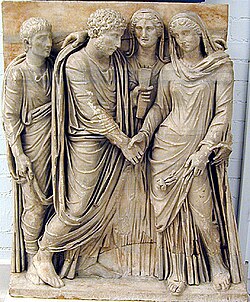
Women's rights evolved over time. While they could not vote or hold office, they could own property, conduct business, and obtain divorces. Early manus marriages transferred a woman's property to her husband, but this practice declined by the time of Augustus, allowing women to remain under their father's protection or become sui iuris (legally independent) upon his death.
Freedmen and Slaves
Slaves were considered property without legal personhood, though some gained freedom through manumission. Once freed, these freedmen could not hold high executive office, but their children were born as full free citizens.
The Edict of Caracalla and Romanization
By AD 212, Emperor Caracalla issued the Constitutio Antoniniana, commonly known as the Edict of Caracalla. This decree granted full Roman citizenship to all free men and women in the Empire, excluding only freed slaves and the dediticii (those who surrendered in war).

This mass granting of citizenship was the culmination of Romanization. By offering a stake in the system, Rome turned potential rebels into citizens. This strategy created a unifying sense of Romanitas (the Roman way of life), which blended local identities into a broader imperial patriotism. This cultural legacy persisted long after the empire's fall, influencing leaders like Clovis I and Charlemagne.
| Class | Key Rights | Political Power | Notes |
|---|---|---|---|
| Cives Romani | Full legal protection, property, marriage | High (Voting/Office for some) | The highest legal status |
| Latini | Trade (commercii), Migration | Limited | Often granted to settlers/freedmen |
| Socii | Treaty-based legal rights | None in Rome | Required to provide military service |
| Provinciales | Ius gentium (General law) | None | Subjects of Roman provinces |
Frequently Asked Questions
How could a non-citizen become a Roman citizen?
Citizenship could be acquired through birth (if both parents were citizens), by completing public service such as serving in the non-Roman auxiliary forces, or through legal grants to specific cities and individuals.
What was the significance of the Edict of Caracalla?
Issued in AD 212, it effectively ended the exclusivity of Roman citizenship by granting it to almost all free inhabitants of the Empire, thereby integrating the provinces more deeply into the Roman state.
Did Roman women have the same rights as men?
No. While women could own property and engage in business, they were barred from voting and holding public office. They generally remained under the legal guardianship of a male relative.
What was the difference between ius civile and ius gentium?
While civitas focused on the specific rights of citizens, ius gentium was a codification of international law applied to all people, regardless of citizenship, to facilitate trade and diplomacy between Romans and foreigners.
What happened to those who refused their civic duties?
Failure to perform munera publica, such as military service, could lead to the loss of citizenship privileges, including the right to vote.