Rock Band Configurations and the Evolution of Musical Ensembles
A rock band or pop band is a small musical ensemble dedicated to performing rock, pop, or related genres. While the sounds vary wildly across decades, the structural makeup of these groups generally follows specific patterns of instrumentation to achieve a full sonic experience. From the minimalist approach of a duo to the expansive scale of large ensembles, the configuration of a band often defines its sound and performance style.
Historically, the term "band" as a group of musicians dates back to 1659, originally referring to musicians attached to army regiments playing marching music. By 1931, the concept of the "one man band" emerged to describe individuals playing multiple instruments simultaneously.

Key Facts
- Four-piece bands are the most common configuration in rock and pop music.
- Power trios typically consist of an electric guitar, electric bass, and drums.
- Electronic sequencers in the 1980s allowed two-member bands to simulate full ensembles.
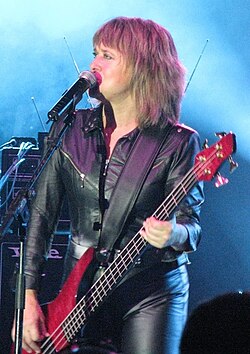
- Gender dynamics historically limited women to vocal roles, though pioneers like Suzi Quatro broke these barriers as instrumentalists and bandleaders.
- Variable lineups allow some artists to record as solo acts while touring with a full band.
Two-Member Bands: The Challenge of the Duo
Two-member bands are relatively rare because it is difficult for two people to provide all the essential elements of a rock sound: vocals, chordal accompaniment, bass lines, and percussion. To compensate, duos often omit the drummer, using guitars or keyboards to maintain the rhythmic pulse. Examples include The White Stripes, The Black Keys, and Twenty One Pilots.
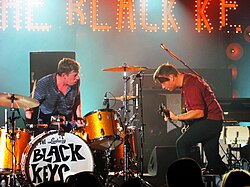
The 1980s saw a shift with the introduction of electronic sequencers—devices that program musical elements like synth bass and electronic drums. This allowed groups like Soft Cell and Yazoo to perform as duos. Other acts, such as Wham! and Tears for Fears, appeared as duos but utilized "behind the scenes" musicians to fill out their sound. Some modern innovators have created custom gear, such as Doug Blair of Signal2Noise, who invented a guitar with both regular and bass strings.
Three-Member Bands: The Power Trio
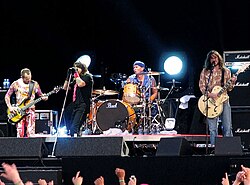
The trio is the smallest ensemble commonly used in rock. In hard rock and heavy metal, the power trio—consisting of electric guitar, electric bass, and drums—is a staple. Usually, one or more members handle lead vocals. Notable examples include the Jimi Hendrix Experience, Green Day, and Nirvana.


An alternative is the organ trio, featuring a guitarist, drummer, and keyboardist. In these groups, the keyboardist often uses a Hammond organ to perform bass lines, chords, and leads simultaneously. A variation of this is the synthesizer-led trio, such as Emerson, Lake & Palmer.
Four-Member Bands: The Standard Configuration
The four-piece is the most prevalent setup in the industry. Early configurations typically featured two guitarists (lead and rhythm), a bassist, and a drummer, as seen with The Beatles and Kiss. Another common variation features a dedicated vocalist who does not play an instrument, supported by a guitarist, bassist, and drummer, such as Led Zeppelin and U2.
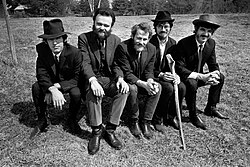
Flexibility is common in four-piece bands; some guitarists may double as keyboardists, or the bassist may take over lead vocals. In some cases, a keyboardist replaces the guitarist entirely, or the drummer is not an official member of the band, as was the case with the Four Seasons.
Five-Member Bands and Larger Ensembles
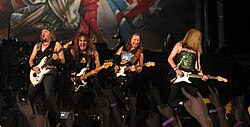
Five-piece bands often expand the standard four-piece by adding a second guitarist, a keyboardist, or a turntablist. For example, Aerosmith and AC/DC use a dual-guitar approach, while bands like Limp Bizkit include a turntablist. Some five-piece groups incorporate saxophones or a second drummer.
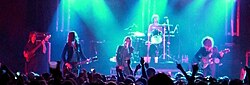
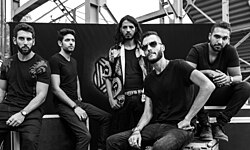
Larger ensembles often draw from the big-band jazz model, adding horn sections, multiple percussionists, or additional keyboardists. Slipknot is a notable example of a large ensemble, featuring nine members including custom percussionists and a sampler. Some experimental artists have pushed this further, with Glenn Branca conducting orchestras of up to 400 guitars.
The Role of Women in Rock Instrumentation
While women have always been prominent as singers, professional female instrumentalists were historically uncommon in rock and heavy metal. This was often due to homosocial solidarity—the tendency for bands to form within sex-segregated friendship networks—and a cultural perception of rock as a form of male rebellion.
In the 1960s, women were often viewed as passive consumers or singers dependent on male bandleaders. However, pioneers like Suzi Quatro, who emerged in 1973 as a singer, bassist, and bandleader, challenged these norms. By the 2010s, women have carved out a significant presence in heavy metal and other rock genres.
Summary of Band Configurations
| Configuration | Typical Instrumentation | Example Artists |
|---|---|---|
| Duo | Guitar/Vocals + Drums or Synth/Vocals + Sequencer | The Black Keys, Soft Cell |
| Power Trio | Electric Guitar, Electric Bass, Drums | Green Day, Nirvana |
| Four-Piece | Vocals, Guitar, Bass, Drums (or 2 Guitars) | The Beatles, U2 |
| Five-Piece | Vocals, 2 Guitars, Bass, Drums (or Keyboard/Turntablist) | AC/DC, Limp Bizkit |
| Large Ensemble | Multiple Guitars, Horns, Percussion, Samplers | Slipknot, Toto |
Frequently Asked Questions
What is a power trio?
A power trio is a rock ensemble consisting of an electric guitar player, an electric bass guitar player, and a drummer, where one or more members typically provide the vocals.
Why are two-member bands less common?
They are rarer because it is challenging to cover all necessary musical elements—vocals, chords, bass, and percussion—with only two people, often requiring the omission of a drummer or the use of electronic sequencers.
How did electronic sequencers change band structures?
Introduced widely in the 1980s, sequencers allowed duos to program electronic drum parts and synth bass lines, making it possible to achieve a full sound without additional live musicians.
Who was Suzi Quatro and why is she significant?
Suzi Quatro was a singer, bassist, and bandleader who emerged in 1973. She is significant for being one of the first prominent women to break the male-dominated barrier of being a rock instrumentalist and bandleader.
Can a band have different lineups for recording and touring?
Yes. Some artists record as a solo act or a small group in the studio but hire supplementary musicians for live performances to recreate the full sound on stage.