Robert Chambers: The Polymath Publisher and Evolutionary Thinker
Robert Chambers (1802–1871) was a formidable figure in 19th-century intellectual life. A Scottish publisher, geologist, author, and editor, Chambers bridged the gap between commercial publishing and speculative science. Alongside his brother William, he helped shape the educational and political landscape of mid-Victorian Britain, leaving behind a legacy that spanned from local Scottish antiquities to international debates on the origin of species.
Key Facts
- Born: 10 July 1802 in Peebles, Scotland.
- Died: 17 March 1871 in St Andrews, Scotland.
- Major Achievement: Co-founded W. & R. Chambers Publishers.
- Controversial Work: Authored the anonymous bestseller Vestiges of the Natural History of Creation (1844).
- Scientific Interests: Geology, phrenology, and evolutionary theory.
- Notable Publications: Traditions of Edinburgh and The Book of Days.
Early Life and the Path to Publishing
Born in Peebles to James Chambers, a cotton manufacturer, and Jean Gibson, Robert was the second of six children. His early years were marked by the volatility of the Industrial Revolution; the introduction of the power loom crippled his father's business, and subsequent financial losses led to the family's bankruptcy. In 1813, the family relocated to Edinburgh, where Robert attended the High School.
At age sixteen, Robert entered the world of commerce as a bookstall-keeper on Leith Walk. Starting with a modest stock of his father's old books, he gradually grew his business through diligence and a passion for literature. This entrepreneurial spirit soon merged with that of his brother, William, who had acquired a home-made printing press.
The Rise of W. & R. Chambers
The partnership between Robert and William was a synergistic blend of content and production: Robert wrote, and William printed. Their early collaborations included The Kaleidoscope, or Edinburgh Literary Amusement (1821) and Illustrations of the Author of Waverley (1822). Robert's deep fascination with local history led to the publication of Traditions of Edinburgh (1824), a work that earned him the friendship of the legendary Sir Walter Scott.
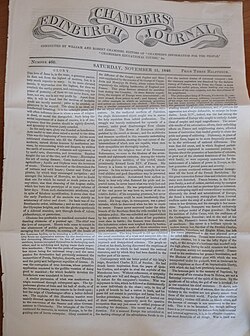
The brothers' influence expanded significantly with the launch of Chambers's Edinburgh Journal in 1832. Robert eventually became joint editor, and the publication became a cornerstone of mid-19th-century journalism. Together, they established W. & R. Chambers Publishers, producing a vast array of educational and reference works, including the Biographical Dictionary of Eminent Scotsmen and the comprehensive Chambers's Encyclopaedia.
Scientific Pursuits and the Mystery of 'Vestiges'
Beyond publishing, Chambers was an avid student of geology and a member of the Royal Society of Edinburgh and the Geological Society of London. He explored the natural world through travels in Canada and Scandinavia, publishing his findings in works such as Ancient Sea Margins (1848).
However, his most enduring—and controversial—contribution was Vestiges of the Natural History of Creation (1844). Written while recuperating from depression in St Andrews and dictated to his wife, Anne Kirkwood, the book was published anonymously. It proposed a theory of evolution that predated and anticipated Charles Darwin's Origin of Species (1859). Because of the era's scientific and religious sensitivities, Chambers kept his authorship a secret for decades.
The Cost of Anonymity
The secrecy surrounding Vestiges had real-world consequences. In 1848, when Robert ran for Lord Provost of Edinburgh, political opponents used rumors of his authorship of the "reviled" book to attack his character, leading him to withdraw his candidacy in disgust.
Personal Life and Later Years
Robert married Anne Kirkwood in 1829, and the couple had 14 children. Outside of his professional and scientific endeavors, Chambers was a passionate golfer and an honorary member of the Musselburgh Golf Club. His son, Robert Chambers Jr., would later become a renowned player and Champion Golfer in 1858.
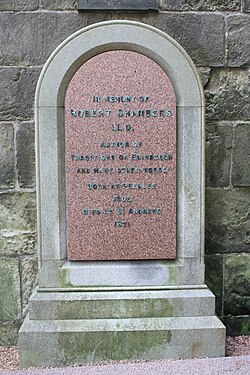
Robert Chambers passed away on 17 March 1871. He was buried in the St Regulus Chapel burial ground in St Andrews, as per his wishes.
Summary of Major Contributions
| Category | Notable Work/Role | Significance |
|---|---|---|
| Publishing | W. & R. Chambers Publishers | Major 19th-century educational publishing house. |
| Science | Vestiges of the Natural History of Creation | Early evolutionary theory; international bestseller. |
| History | Traditions of Edinburgh | Pioneering work on Edinburgh's antiquities. |
| Journalism | Chambers's Edinburgh Journal | Highly influential weekly publication. |
| Reference | The Book of Days | Comprehensive chronological reference work. |
Frequently Asked Questions
Did Robert Chambers influence Charles Darwin?
While there is no direct evidence of a collaborative relationship, Vestiges of the Natural History of Creation (1844) anticipated many of the evolutionary concepts later detailed in Darwin's Origin of Species (1859) and helped prepare the public for evolutionary thought.
Why was Vestiges of the Natural History of Creation published anonymously?
Anonymity was common in journalism at the time, but in science, it was rare. Chambers likely chose anonymity to protect his professional reputation and avoid the intense religious and scientific backlash associated with evolutionary theories in the 1840s.
What was the relationship between Robert and William Chambers?
They were brothers and lifelong business partners. Robert focused primarily on writing and intellectual research, while William handled the printing and business operations of their publishing firm.
Where is Robert Chambers buried?
He is buried in the Cathedral burial ground at the old Church of St. Regulus in St Andrews, Scotland.
What other interests did Robert Chambers have outside of writing?
Chambers was an enthusiastic golfer and a student of phrenology (the study of the shape of the skull as an indicator of mental faculties), as well as an explorer of geology in Northern Europe and Canada.