Rio+20: The United Nations Conference on Sustainable Development
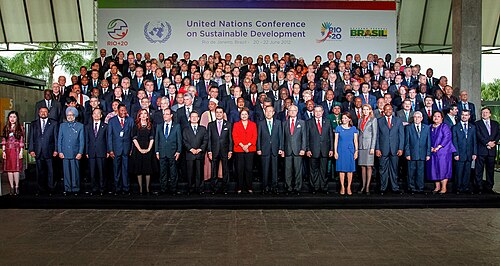
The United Nations Conference on Sustainable Development (UNCSD), widely known as Rio+20 or the Earth Summit 2012, was a landmark international gathering aimed at reconciling the global community's economic and environmental goals. Held in Rio de Janeiro, Brazil, from June 13 to 22, 2012, the event served as a critical 20-year follow-up to the 1992 Earth Summit and a 10-year anniversary marker for the 2002 World Summit on Sustainable Development.
Organized by the United Nations Department of Economic and Social Affairs, this "mega-summit" brought together 192 UN member states. The event was designed to renew political commitment to three core dimensions of sustainable development: economic growth, social improvement, and environmental protection, with a specific focus on poverty reduction, job creation, and the sustainable use of resources.
Key Facts
- Dates: June 13–22, 2012.
- Location: Rio de Janeiro, Brazil.
- Participation: 45,400 accredited participants, including 88 heads of state or government.
- Outcome Document: A non-binding 49-page document titled "The Future We Want."
- Core Focus: Integrating economic growth, social equity, and environmental protection.
- Foundation: Based on the principles of Agenda 21 from the 1992 Earth Summit.
The Path to Rio+20: Historical Context
Rio+20 did not happen in isolation; it was the third in a series of major international efforts to define the global green agenda. In 1992, the first United Nations Conference on Environment and Development (UNCED), or the Rio Conference, raised global awareness about the need to integrate environment and development. This summit produced Agenda 21, a revolutionary document that popularized the term "sustainable development."
Ten years later, the 2002 World Summit on Sustainable Development (WSSD), often called Rio+10, took place in Johannesburg, South Africa. This meeting emphasized the need for UN agencies and international financial institutions to better integrate sustainable development into their core activities.
The Preparatory Process
According to historian Felix Dodds, the formal preparation for Rio+20 occurred in three distinct phases:
- Phase One (May 2010 – January 2012): This period involved preliminary intergovernmental negotiations and the publication of the first draft of "The Future We Want" in January 2012.
- Phase Two (March 2012 – April 2012): This phase focused on informal negotiations, resulting in a streamlined version of the outcome text.
- Phase Three (April 2012 – June 2012): The final round of negotiations concluded in Rio de Janeiro just before the high-level meetings began.
The Summit and "The Future We Want"
The ten-day event culminated in a three-day high-level conference from June 20 to 22, 2012. During these intense sessions, world leaders finalized "The Future We Want," a non-binding document in which they renewed their commitment to ensuring an economically, socially, and environmentally sustainable future for present and future generations.

Civil Society and Activism
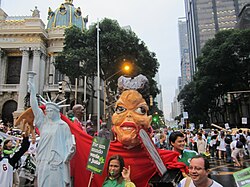
While world leaders met in closed sessions, Rio+20 attracted massive public attention and significant protest. An estimated 50,000 protesters took to the streets of downtown Rio de Janeiro. Thousands of non-governmental organizations (NGOs), including Greenpeace and the World Wide Fund for Nature, gathered at Flamengo Park.
Activists and indigenous groups criticized the draft text for omitting mentions of planetary boundaries (the environmental limits within which humanity can safely operate) and nuclear energy, particularly following the Fukushima disaster in Japan. Artistic contributions, such as Jens Galschiøt's "Freedom to Pollute" sculptures, were used to highlight the link between global warming and the refugee crisis.
Conference Summary
| Category | Details |
|---|---|
| Official Name | United Nations Conference on Sustainable Development |
| Host City/Country | Rio de Janeiro, Brazil |
| Member States | 192 UN Member States |
| Total Participants | Approximately 45,400 accredited individuals |
| Key Outcome | "The Future We Want" (Non-binding document) |
| Security Presence | 15,000 soldiers and police |
Frequently Asked Questions
What was the primary goal of Rio+20?
The primary goal was to reconcile the economic and environmental goals of the global community by renewing political commitment to sustainable development, specifically focusing on economic growth, social improvement, and environmental protection.
What is "The Future We Want"?
It is the 49-page non-binding outcome document finalized by world leaders at the end of the conference, declaring their commitment to a sustainable future for current and future generations.
How did Rio+20 differ from the 1992 Earth Summit?
While the 1992 summit focused on raising awareness and creating the global green agenda (via Agenda 21), Rio+20 was a 20-year follow-up intended to redirect and renew those commitments in a modern global context.
Who participated in the conference besides government leaders?
The event included private sector companies, NGOs, indigenous groups, environmental activists, and artists, with over 500 parallel events and exhibitions taking place alongside the official UN meetings.
Why did some activists protest the conference?
Many protesters and NGOs criticized the outcome text for being too weak, specifically noting the lack of mention regarding planetary boundaries and the risks of nuclear energy.