The Life and Legacy of Abdullah Kamil: From Political Activist to Distinguished Diplomat
Abdullah Kamil was a man of diverse talents and unwavering conviction. Throughout his life, he transitioned from a passionate journalist and socialist activist to one of Indonesia's most respected career diplomats. Serving as an ambassador to three different major entities, Kamil played a pivotal role in shaping Indonesia's international relations during the mid-to-late 20th century.
Early Life and Political Awakening
Born on December 27, 1919, in Binjai, Dutch East Indies, Abdullah Kamil was the third child of Muhammad Nur Ismail, a qadhi (a religious official) in the Sultanate of Langkat. His early education was a blend of religious instruction from his father and scholars like Syeikh Abdullah Afifuddin and Zainal Ariffin Abbas, alongside formal schooling at the Khalsa English School and Taman Dewasa, a branch of the Taman Siswa education movement in Medan.
Kamil's early professional life was rooted in communication and politics. He worked as a teacher of English and a correspondent for the Pewarta Deli daily and the Antara news agency. His commitment to socialist ideals led him to chair the Gerindo movement in Binjai. This activism did not go unnoticed by the colonial government; he was imprisoned for three months by Dutch East Indies authorities for organizing an unauthorized meeting.
Exile and Activism in Malaya
To escape colonial pressure, Kamil migrated to Kuala Lumpur, then the capital of British Malaya. After passing his Senior Cambridge examination in 1936 and studying at the Victoria Institution, he resumed his journalistic career as a representative for the Warta Malaya newspaper under the pen name Arif Budiman.
In 1938, Kamil co-founded the Kesatuan Melayu Muda (KMM), the first leftist and national political organization in Malaya, serving as its assistant secretary general. His political activities eventually led to his arrest by British authorities in 1941, resulting in imprisonment at Changi Prison. He was released on February 16, 1942, following the fall of Singapore to Japanese forces.
The Japanese Occupation and Tokyo Years
During the Japanese occupation, the authorities sought to prevent the revival of the KMM by providing its leaders with employment. Kamil served as an editor for the Semangat Asia periodical and Berita Malai in Singapore. In October 1943, he was sent to Tokyo for a linguistic exchange, where he became a member of the Board of Indonesian Association and a consultant for the International Institute for Cultural Relations. He also served as the editor-in-chief of Indonesia magazine.
A Distinguished Diplomatic Career
Abdullah Kamil officially entered the Indonesian diplomatic service in 1948 as an information officer in Bangkok. As the Indonesian National Revolution concluded, the office became a full embassy, and Kamil was appointed as second secretary. Over the next two decades, he held various strategic roles, including head of the information section at the foreign ministry and first secretary at the Indonesian high commissariat in the Hague.
In 1956, he served as a consul in Kuala Lumpur, receiving his exequatur (the official recognition of a consul by the receiving state). By 1957, he was promoted to counsellor and moved to New York to manage press and public relations for the permanent mission to the United Nations (UN).
Kamil's rise continued through the 1960s. After undergoing military education at the Indonesian Army Command and General Staff College in 1961, he served in Tunisia from 1965 to 1966. He later returned to the UN mission as the chargé d'affaires ad interim (a diplomat who temporarily heads a mission in the absence of an ambassador) before being promoted to minister counsellor.
Ambassadorial Appointments
President Suharto appointed Abdullah Kamil to three prestigious ambassadorial roles, cementing his status as a top-tier diplomat.
Ambassador to Yugoslavia (1968–1971)
Appointed on February 8, 1968, Kamil presented his credentials to President Josip Broz Tito on May 18. Following this term, he returned to Jakarta to serve as the director of international organizations, where he led delegations to the 1972 Seabed conference and a 1973 conference of Muslim countries' foreign ministers in Benghazi.
Ambassador to Austria (1975–1979)
Kamil began his second ambassadorship on January 18, 1975. In addition to his duties in Austria, he was accredited to the International Atomic Energy Agency and the United Nations Industrial Development Organization (UNIDO). In 1976, he served as a special envoy to the fifth summit of the Non-Aligned Movement in Colombo.
Permanent Representative to the United Nations (1979–1982)
Kamil reached a career pinnacle when he was accredited as Indonesia's representative to the UN on April 10, 1979. During his tenure, he was known for his insistence on hiring experienced diplomats over fresh graduates for the permanent mission, believing that seasoned knowledge was essential for the role.
Final Years and Public Service
After his UN tenure, Kamil served as a special advisor to the foreign minister. From March 23, 1983, to January 28, 1984, he held the position of acting Director General of Political Affairs. During this time, he accompanied Foreign Minister Mochtar Kusumaatmadja to key ASEAN-EEC dialogues and foreign ministers' meetings in Bangkok.
In his personal life, Kamil was married to Acharavarn, a Thai national he met during his first assignment in Bangkok. They had four children; their daughter, Halimah Agustina, married Bambang Trihatmodjo, the son of President Suharto.
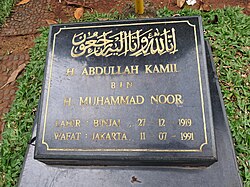
Abdullah Kamil passed away from cardiac arrest on July 11, 1991, at the Gatot Soebroto Army Hospital in Jakarta. He was interred at the Tanah Kusir cemetery.
Cultural Contributions and Legacy
Beyond diplomacy, Kamil was deeply committed to philanthropy and culture. He established the Genta Budaya foundation to promote Minangkabau culture, investing 750 million rupiah in a dedicated building for the foundation. Although he died before its completion, the building was inaugurated by President Suharto in 1992 and later renamed in Kamil's honor.
He also chaired the Tunas Harapan foundation, which provided support for children born with disabilities, working in close coordination with the Harapan Kita hospital.
Career Summary of Abdullah Kamil
| Period | Role/Position | Location/Organization |
|---|---|---|
| 1938–1941 | Assistant Secretary General | Kesatuan Melayu Muda (KMM) |
| 1943–1945 | Editor-in-Chief / Consultant | Tokyo, Japan |
| 1948–1952 | Information Officer / Second Secretary | Embassy in Bangkok |
| 1957–1960 | Counsellor (Press & PR) | Permanent Mission to the UN |
| 1968–1971 | Ambassador | Yugoslavia |
| 1975–1979 | Ambassador | Austria |
| 1979–1982 | Permanent Representative | United Nations |
| 1983–1984 | Acting Director General of Political Affairs | Ministry of Foreign Affairs |