Righteous Armies: Korea's Legacy of Civilian Resistance
Throughout its history, Korea has faced numerous foreign incursions that threatened its sovereignty and cultural identity. In response, a unique phenomenon emerged: the Righteous Armies (Korean: 의병, uibyeong). These were spontaneously formed civilian armed organizations—essentially irregular militias—composed of ordinary people who took up arms to defend their land when formal government defenses failed.
From the scholars of the Joseon dynasty to the peasants of the early 20th century, the Righteous Armies represented a grassroots manifestation of national sentiment and a refusal to submit to foreign aggression.
Key Facts
- Composition: Included Confucian scholars (seonbi), peasants, former government officials, and Buddhist warrior monks.
- Primary Motivation: Defense of local communities, protection of family, and adherence to Confucian ethics.
- Strategic Impact: Frequently disrupted enemy supply lines, particularly during the Imjin War.
- Evolution: Transitioned from local defense units to the core of the organized Korean Independence Army in Manchuria.
- Major Conflicts: Active during the Japanese invasions (1592–1598), Manchu invasions, and the Japanese annexation (1905–1910).
The Japanese Invasions of Korea (1592–1598)
During the Imjin War, the Righteous Armies played a critical role in slowing the Japanese advance. At the start of the conflict, much of the government's organized resistance in Gyeongsang and Chungcheong Provinces had been destroyed. Furthermore, many district officers were incompetent or cowardly, leaving a vacuum of leadership.
The Japanese military, accustomed to civilians submitting once their leaders fell, was shocked by the emergence of organized civilian resistance. These irregular forces, most active in the southwestern Jeolla Province, focused on interrupting Japanese supply lines, which fundamentally undermined the success of the invasion.
Leadership and Social Dynamics
The movement was largely led by seonbi—Confucian philosophers who were often trained archers. These leaders were typically small to medium-sized landowners with strong organic ties to the local peasantry. Their motivation was twofold: a desire to practice Confucian Taoism through action (Geunwang) and a visceral reaction to the barbarity of the invaders.
For the common people, joining a Righteous Army was often more appealing than joining the government army. It allowed them to protect their families and homes locally under the command of a trusted community leader rather than an incompetent government general.
The Manchu Invasions
During the Jeongmyo-Horan and Byeongja-Horan (Manchu invasions), Righteous Armies again rose to fill the gaps left by the defeated government forces. These groups were primarily Geunwangbyeong (Royal Provincial Armies), aimed at supporting the monarchy.
However, the resistance during this period was significantly weaker than during the Imjin War. Political turmoil and economic collapse had eroded the unity between the people and the dynasty. Many activities in the rear areas were largely symbolic or focused on supply mobilization rather than direct combat, and the movements disbanded once King Injo conceded to the Qing dynasty.
Resistance Against Japanese Annexation (1905–1910)
The early 20th century saw a resurgence of the Righteous Armies as Japan moved to annex Korea. Following the Japan-Korea Protectorate Treaty of 1905, the Eulsa Righteous Army emerged, led initially by Confucian scholars like Choe Ik-hyeon. However, because feudal ethics forbade drawing a sword against the king (who had signed the treaty), many scholars eventually surrendered, leaving the struggle to the gentry and peasants.
A turning point occurred in 1907 when the Korean Empire's army was disbanded. Professional soldiers joined the civilian militias, forming the Jeongmi Righteous Army. This infusion of military expertise transformed the resistance into a more lethal force.
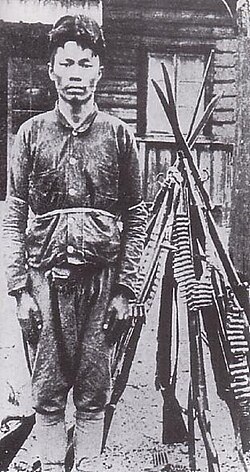
Between 1907 and 1910, the struggle intensified. Japanese statistics record approximately 150,000 uprisings and 2,851 clashes, resulting in over 53,000 Righteous Army casualties. The most intense fighting occurred in South Jeolla Province. By 1909, the Japanese launched the "Great Suppression of the Southern Insurgents Operation," a decisive campaign that forced the remaining resistance fighters to relocate to Manchuria and Siberia, where they became the foundation of the Korean Independence Army.
Summary of Major Righteous Army Eras
| Period | Primary Enemy | Key Participants | Outcome/Impact |
|---|---|---|---|
| 1592–1598 | Japan (Toyotomi Hideyoshi) | Seonbi, Peasants, Monks | Disrupted supply lines; hindered invasion success. |
| Manchu Invasions | Manchu (Qing Dynasty) | Royal Provincial Army | Limited impact due to social unrest and political collapse. |
| 1905–1910 | Imperial Japan | Scholars, Peasants, Disbanded Soldiers | Intense guerrilla warfare; evolved into Independence Army. |
Frequently Asked Questions
Who were the Righteous Armies?
The Righteous Armies (uibyeong) were spontaneous, civilian-led irregular military organizations in Korea that formed to fight foreign invasions when the official government military was unable or unwilling to do so.
What role did Confucian scholars play in these movements?
Confucian scholars, known as seonbi, often served as the spiritual and organizational leaders. They provided the moral justification for the resistance based on Confucian ethics and utilized their social standing to mobilize local peasants.
Why was the 1907 resistance more intense than the 1905 resistance?
The 1907 resistance (Jeongmi Righteous Army) benefited from the disbandment of the official Korean Empire army. This allowed trained professional soldiers to join the civilian militias, significantly increasing their combat effectiveness.
Where did the Righteous Armies go after the Japanese annexation in 1910?
After being pushed out of the Korean peninsula by Japanese suppression operations, many survivors fled to Manchuria, Siberia, and the Primorsky Krai region to continue their fight for liberation.
How did the Japanese view the Righteous Armies during the Imjin War?
The Japanese were shocked by the resistance, as their military strategy assumed that civilians would simply submit once their leaders were defeated. The Righteous Armies' ability to organize and attack supply lines was entirely unexpected.