Battle of Haengju: The Defiant Defense of Haengjusanseong
The Battle of Haengju, fought on March 14, 1593, stands as one of the most remarkable military achievements in Korean history. Occurring during the broader Japanese invasions of Korea (1592–1598), this clash pitted a small, determined Joseon force against a massive invading army. The result was a stunning victory for the Joseon defenders, who managed to hold their ground against overwhelming odds.
Key Facts
- Date: March 14, 1593
- Location: Haengjusanseong fortress, west of Hanseong (modern-day Seoul)
- Outcome: Decisive Joseon victory
- Force Ratio: Approximately 2,300 Joseon defenders against 30,000 Japanese attackers
- Key Commander: General Gwon Yul (Joseon)
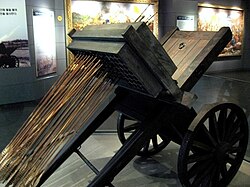
- Defining Weaponry: Use of the hwacha (a multiple-rocket launcher) alongside cannons and arrows
The Strategic Setting
The conflict centered on Haengjusanseong, a fortress consisting of a wooden stockade perched on a cliff overlooking the Han River. Because of its proximity to Hanseong—the capital of the Joseon dynasty and modern-day Seoul—the fortress represented a significant strategic threat to the Japanese occupation forces. To secure their hold on the region, the Japanese military launched a massive assault to neutralize the position.
General Gwon Yul commanded the Joseon defense, utilizing the natural geography of the cliffside to offset the massive numerical disadvantage of his troops.
The Course of the Battle
On March 14, 1593, a Japanese force of 30,000 men, led by Konishi Yukinaga, initiated the attack. Due to the limited space around the fortress, the Japanese were unable to deploy their full strength at once and were forced to attack in successive waves.
The Joseon defenders retaliated with a devastating combination of cannons, arrows, and the hwacha, a specialized weapon capable of firing multiple arrows simultaneously to create concentrated fire.
Waves of Assault
The Japanese launched several desperate attempts to breach the walls:
- Initial Attacks: The first three assaults failed, including one attempt utilizing a siege tower. During these clashes, the Japanese commander Ishida Mitsunari was wounded.
- The Breach: Ukita Hideie eventually managed to break through the outer defenses and reach the inner wall, but he too was wounded and forced to retreat.
- The Final Push: In a final effort, Kobayakawa Takakage succeeded in burning a hole through the fort's log pilings. However, the Korean defenders held the line long enough to repair the damage.
The Critical Resupply
As the battle raged toward its conclusion, the Joseon forces nearly exhausted their supply of arrows. In a pivotal moment, I Bun arrived via supply ships, delivering 10,000 additional arrows. This replenishment allowed the defenders to maintain their fire until dusk, at which point the Japanese forces finally retreated.
Aftermath and Strategic Impact
The defeat at Haengju severely weakened the Japanese position. Simultaneously, a group of raiders led by Zha Dashou struck Hanseong, burning over 6,500 tons of grain. This left the Japanese army with less than a month of food supplies.
Following negotiations led by Shen Weijing, the Japanese forces abandoned Hanseong on May 17, 1593. The conditions of the retreating army were dire; Ming Chinese generals Li Rusong and Song Yingchang noted that the soldiers looked "like ghosts" upon their departure.
Battle Summary
| Feature | Joseon (Korea) | Toyotomi Japan |
|---|---|---|
| Commanders | Gwon Yul | Ukita Hideie, Konishi Yukinaga, et al. |
| Troop Strength | 2,300 | 30,000 |
| Key Tactics | Fortified stockade, concentrated rocket fire | Wave attacks, siege towers, arson |
| Casualties | Unknown | 110 to 10,000 (estimated) |
| Result | Victory | Defeat |
Legacy
The Battle of Haengju is remembered as one of the three most decisive Korean victories of the era, alongside the Battle of Hansan Island and the siege of Jinju. Today, a memorial dedicated to General Gwon Yul stands at the site of Haengjusanseong to honor the bravery and strategic brilliance of the defenders.
Frequently Asked Questions
What was the hwacha and why was it important?
The hwacha was a multiple-rocket launcher used by the Joseon army. It allowed the defenders to launch a concentrated barrage of arrows and rockets, which was essential in repelling the numerically superior Japanese forces.
How did the Joseon army win despite being outnumbered?
The victory was achieved through a combination of strong defensive positioning at Haengjusanseong, the use of superior firepower (cannons and hwacha), and a timely resupply of 10,000 arrows delivered by I Bun.
Who were the primary commanders in the battle?
The Joseon forces were led by General Gwon Yul. The Japanese forces included several prominent leaders, such as Konishi Yukinaga, Ukita Hideie, Ishida Mitsunari, and Kobayakawa Takakage.
What happened to the Japanese forces after the battle?
The defeat, combined with the burning of 6,500 tons of grain by Zha Dashou's raiders, left the Japanese with critical food shortages, eventually forcing them to abandon Hanseong in May 1593.
Where is the battle site located today?
The battle took place at Haengjusanseong, located on the Han River west of modern-day Seoul, South Korea.