Right of Asylum: Historical Evolution and Modern Legal Frameworks
The right of asylum—derived from the Ancient Greek word ásulon, meaning sanctuary—is a juridical concept that allows individuals persecuted by their own rulers to seek protection from another sovereign authority. Whether provided by a foreign country or a protected entity, this right ensures that those fleeing oppression can find safety under a different jurisdiction.
This tradition is not a modern invention; it was recognized by the Ancient Egyptians, Greeks, and Hebrews before being integrated into Western tradition. Throughout history, prominent intellectuals have utilized this protection: René Descartes sought refuge in the Netherlands, Voltaire fled to England, and Thomas Hobbes found safety in France.
Key Facts
- Foundational Document: Modern asylum is based on Article 14 of the 1948 Universal Declaration of Human Rights.
- Refugee Definition: A refugee is someone unable or unwilling to return home due to a well-founded fear of persecution based on race, religion, nationality, social group, or political opinion.
- Global Standards: The 1951 Convention Relating to the Status of Refugees and its 1967 Protocol provide the primary international legal framework.
- US Statistics: Since the 1980 Refugee Act, the United States has admitted over 3.1 million refugees.
- EU Trends: The European Union received over 1.1 million asylum applications in 2023, with a 43% grant rate for refugee or subsidiary protection status.
The Legal Framework of Contemporary Asylum
Today, the right of asylum is enshrined in international law via the United Nations. While the Universal Declaration of Human Rights provides the moral and conceptual foundation, the 1951 Convention Relating to the Status of Refugees establishes the legal criteria for who qualifies as a refugee.
Asylum in the European Union
EU member states have developed common policies over the last several decades to manage asylum seekers, particularly following the Schengen Agreement, which removed internal borders. The Dublin Convention (1990) and the subsequent Dublin Regulation (2003) were designed to prevent "asylum shopping," where seekers apply in multiple member states.
While the EU provides overarching directives—such as the Temporary Protection Directive for war refugees—individual member states remain primarily responsible for granting and organizing asylum.
The French Model
France has a long history of constitutional asylum. Although the Constitution of 1793 was never enacted, it was the first to establish a right for foreigners banished for the "cause of liberty." This principle was carried into the 1946 and 1958 Constitutions.
To manage the volume of requests, France utilizes the OFPRA (French Office for the Protection of Refugees and Stateless Persons). In 2003, France introduced a "safe countries" list; applicants from these nations face expedited 15-day processing and receive no social assistance. This measure significantly reduced application numbers from listed countries, such as Benin, India, and Ukraine, in the mid-2000s.
National Perspectives on Asylum
United States
In the U.S., asylum is available to those who meet the refugee definition and are either already inside the country or seeking admission at a port of entry. Since the September 11 attacks, the process has been managed by the USCIS (U.S. Citizenship and Immigration Services), alongside ICE and CBP.
Despite admitting millions of refugees since 1980, the U.S. system faces criticism. Some scholars describe the process as "refugee roulette," suggesting outcomes depend more on the assigned adjudicator than the merits of the case. In 2023, the Department of Justice reported 478,885 applications, with a grant rate of 14.40%.
China and Poland
China's approach to political asylum is highly restrictive; the last foreigner granted asylum was Hoàng Văn Hoan in 1979, and recipients have historically been pro-communist leaders. In Europe, Poland has recently challenged EU mandates, with Prime Minister Donald Tusk stating in February 2025 that Poland would refuse the EU Asylum and Migration Pact's mandatory relocation of 30,000 seekers, citing the high number of Ukrainians already hosted.
Historical Roots: Medieval Sanctuary
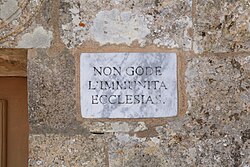
Before modern nation-states, asylum often took the form of sanctuary—protection granted within the confines of a church or religious site.
In medieval England, sanctuary laws date back to King Æthelberht of Kent (c. 600 AD). By the Norman era, two levels of sanctuary existed: general church sanctuary and broader zones granted by royal charter to specific sites like Westminster Abbey and York Minster.

The 14th-century Articuli Cleri (1315) provided basic humanitarian protections, ensuring fugitives could leave the church for basic needs and would not starve. However, these rights were occasionally ignored or forcibly breached. High-profile figures, including Queen Elizabeth (wife of Henry VI), used the sanctuary of Westminster to escape political rivals in the 15th century.

The system was gradually dismantled. The Sanctuaries Act 1540 under Henry VIII limited the crimes eligible for asylum, and the practice was entirely abolished by James VI and I in 1623.

Summary of Asylum Frameworks
| Entity/Era | Primary Mechanism | Key Characteristic |
|---|---|---|
| Medieval England | Ecclesiastical Sanctuary | Protection within church boundaries; abolished 1623. |
| European Union | Dublin Regulation / Geneva Convention | Coordinated policies to prevent multiple applications. |
| France | Constitutional Right / OFPRA | Use of "safe countries" lists to expedite processing. |
| United States | USCIS / Refugee Act of 1980 | High total volume of refugees; strict adjudication process. |
| China | State Discretion | Limited almost exclusively to pro-communist leaders. |
Frequently Asked Questions
What is the difference between a refugee and an asylum seeker?
An asylum seeker is someone who has applied for protection but whose claim has not yet been finally decided. A refugee is someone who has been legally recognized as meeting the criteria of the 1951 Convention, meaning they have a well-founded fear of persecution.
How does the EU's Dublin Regulation work?
The Dublin Regulation aims to ensure that an asylum application is processed in only one EU member state, typically the first country the seeker entered, to prevent multiple applications across the union.
What were the "safe countries" in the French system?
These are countries identified by OFPRA as respecting political rights and liberty. Applicants from these nations (such as Ghana, India, or Georgia in earlier lists) face faster processing and are not eligible for social assistance during the process.
Why was medieval sanctuary abolished?
The system was gradually restricted by monarchs like Henry VIII to prevent criminals from escaping justice, eventually leading to its total abolition in 1623 under James VI and I.
What is the current status of asylum in the United States?
Asylum is handled by the USCIS. While the U.S. has historically admitted more refugees than any other nation, recent years have seen a decrease in annual admissions due to security concerns, and 2023 data shows a grant rate of approximately 14.40%.