Richard Nixon: The Presidency, Global Diplomacy, and the Watergate Legacy
Richard Nixon served as the 37th President of the United States from January 20, 1969, to August 9, 1974. His tenure was marked by a complex blend of historic diplomatic breakthroughs, significant domestic shifts, and a political downfall that remains one of the most studied events in American history.
The Path to the White House
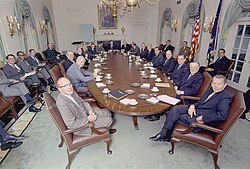
Nixon first secured the presidency in the 1968 election, defeating Democrat Hubert Humphrey. The race was tight, with Nixon winning 43.4% of the vote to Humphrey's 42.7%, while George Wallace captured 13.5%. Nixon's victory was bolstered by support from white ethnic and Southern white voters, though he saw a decline in support among African American voters.
In the Electoral College, Nixon won 301 votes compared to Humphrey's 191 and Wallace's 46. Despite this victory, Republicans did not gain control of the House or the Senate during the concurrent congressional elections.
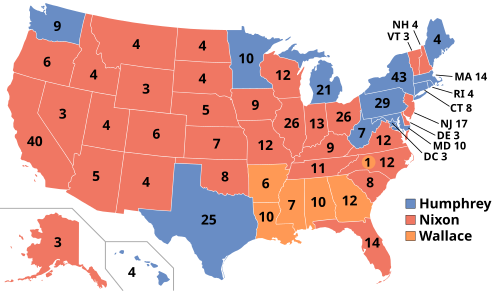
Key Facts
- Term of Office: January 20, 1969 – August 9, 1974.
- Historic Visit: First U.S. president to visit mainland China in February 1972.
- Landslide Victory: Won the 1972 election with 61% of the popular vote.
- Resignation: Only U.S. president to resign from office, departing on August 9, 1974.
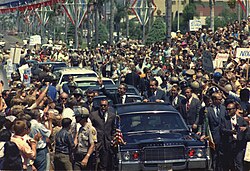
- Diplomatic Reach: Conducted 15 international trips to 30 different countries.
Administration and Governance
Nixon's administration featured a rotating cabinet of key figures, including Secretary of State William P. Rogers and later Henry Kissinger. His vice presidency also saw a historic transition; Spiro Agnew resigned in October 1973 after pleading no contest to tax evasion. Using the 25th Amendment—the constitutional provision allowing for the filling of vice presidential vacancies—Nixon nominated Gerald Ford, who took office on December 6, 1973.
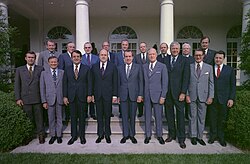
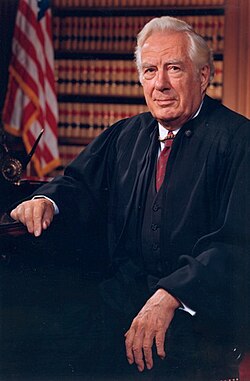
In the judicial sphere, Nixon nominated Warren E. Burger as the 15th Chief Justice of the United States in May 1969, who was confirmed by the Senate with a 74–3 vote.
Domestic Policy and Economy
Nixon's domestic agenda was a mixture of social initiatives and economic management. He endorsed the Equal Rights Amendment (ERA), which passed Congress in 1972 but ultimately failed to be ratified by the required 38 states. He also appointed more women to administration positions than his predecessor, Lyndon B. Johnson.
Economically, the era saw fluctuating GDP and debt levels. While the GDP grew from $980.3 billion in 1969 to $1,482.9 billion by 1974, the federal budget moved from a surplus of $3.2 billion in 1969 to significant deficits in the following years.
| Fiscal Year | Receipts (Billions) | Outlays (Billions) | Surplus/Deficit (Billions) | GDP (Billions) | Debt as % of GDP |
|---|---|---|---|---|---|
| 1969 | 186.9 | 183.6 | 3.2 | 980.3 | 28.4 |
| 1970 | 192.8 | 195.6 | -2.8 | 1,046.7 | 27.1 |
| 1971 | 187.1 | 210.2 | -23.0 | 1,116.6 | 27.1 |
| 1972 | 207.3 | 230.7 | -23.4 | 1,216.3 | 26.5 |
| 1973 | 230.8 | 245.7 | -14.9 | 1,352.7 | 25.2 |
| 1974 | 263.2 | 269.4 | -6.1 | 1,482.9 | 23.2 |
| 1975 | 279.1 | 332.3 | -53.2 | 1,606.9 | 24.6 |
Foreign Affairs and the Cold War
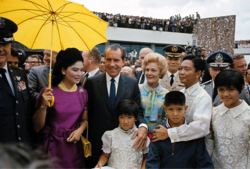
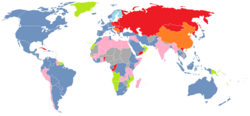
Nixon's foreign policy was defined by the Nixon Doctrine and a strategy of détente (the easing of strained relations). He sought to manage the Cold War divide through strategic diplomacy with both the Soviet Union and China.
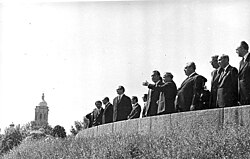
In February 1972, Nixon made a historic visit to mainland China, meeting with Premier Zhou Enlai and Chairman Mao Zedong. This move fundamentally shifted the geopolitical landscape of the Cold War.
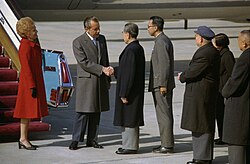
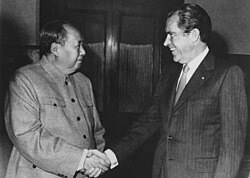
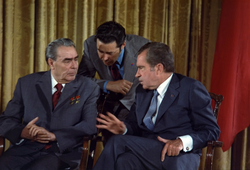
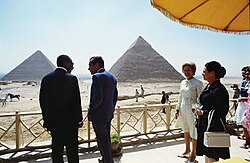
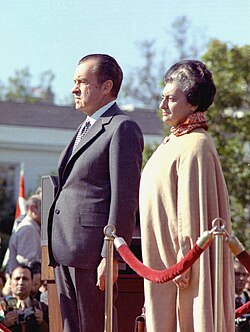
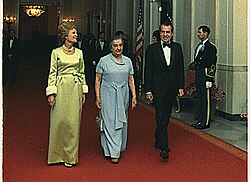
Simultaneously, Nixon engaged with the Soviet Union, meeting with Leonid Brezhnev to pursue stability. His international reach extended to India, Latin America, and the Middle East, where he met with leaders such as Anwar Sadat of Egypt and Golda Meir of Israel.
The Vietnam War
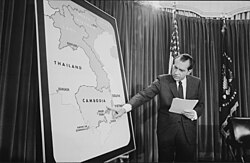
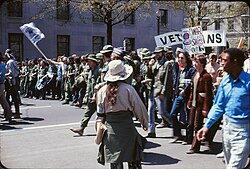
The Vietnam War remained a central and contentious issue. Nixon's administration oversaw the bombing of Cambodia, known as Operation Freedom Deal, which he announced to the nation on April 30, 1970. These actions fueled widespread anti-war protests across the United States.
The 1972 Election and Watergate
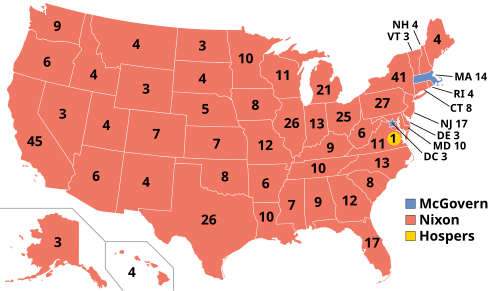
Nixon was re-elected in 1972 in one of the largest landslide victories in U.S. history. He defeated Democrat George McGovern, winning 61% of the popular vote (47,168,710 votes to McGovern's 29,173,222). In the Electoral College, the victory was even more pronounced, with Nixon receiving 520 votes to McGovern's 17.
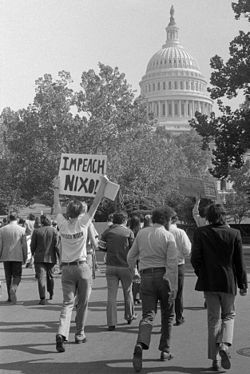
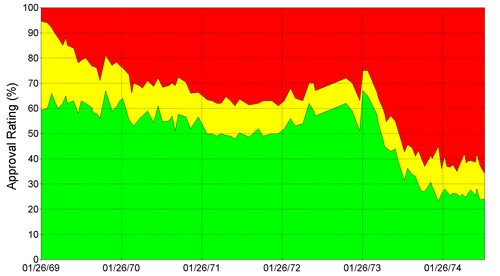
However, this triumph was overshadowed by the Watergate scandal. The controversy began with a burglary at the Democratic National Committee headquarters and escalated into a crisis of presidential authority and legality. As the scandal grew, public approval plummeted and calls for impeachment intensified.
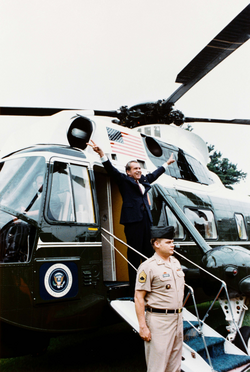
Facing inevitable impeachment, Richard Nixon resigned the presidency on August 9, 1974. He left the White House displaying the V-for-victory sign, ending a presidency defined by both global achievement and domestic turmoil.
Frequently Asked Questions
![Nixon made fifteen international trips to thirty different countries during his presidency.[204]](/images/0a/b2/0ab2109594e6caa9158302ce9d4a414a7b4dfc0c912e2a4328b5a97ef2f4f8ec.png)

![Map of the cumulative support for Richard Nixon over his three presidential campaigns.[a] Nixon consistently gained support with white southerners and ethnic northerners, reshaping the Republican Party's electoral coalition. Voted for Nixon three times Voted for Nixon twice Voted for Nixon once Never voted for Nixon](/images/a4/a9/a4a933a1857dd4a74ed05555e63053e4e959c8b3f7d973759da16bd97faf4d55.webp)
Why did Richard Nixon resign from the presidency?
Nixon resigned due to the Watergate scandal, which involved a break-in at the Democratic National Committee headquarters and subsequent attempts by the administration to cover up the events. Facing imminent impeachment, he chose to resign on August 9, 1974.
What was the significance of Nixon's visit to China?
His February 1972 visit to mainland China was historic as it was the first time a U.S. president had visited the country, helping to normalize relations and shift the balance of power during the Cold War.
How was the vacancy in the vice presidency filled in 1973?
After Spiro Agnew resigned due to tax evasion charges, Nixon used the 25th Amendment to nominate Gerald Ford. Ford was confirmed by Congress and took office on December 6, 1973, marking the first time an intra-term vacancy in the vice presidency was filled.
How did Nixon perform in the 1972 election?
Nixon won a massive landslide victory against George McGovern, securing 61% of the popular vote and 520 electoral votes to McGovern's 17.
What was the Nixon Doctrine?
The Nixon Doctrine was a foreign policy strategy that aimed to maintain stability during the Cold War by encouraging allies to take more responsibility for their own defense, while the U.S. provided economic and military assistance.