Richard Long: Redefining Sculpture Through Nature and Movement
Since the mid-1960s, Richard Long has challenged the traditional boundaries of art by transforming the act of walking into a creative medium. By traversing diverse landscapes—from the vast Sahara Desert and the rugged terrains of Iceland and Australia to the familiar surroundings of his home in Bristol, United Kingdom—Long has shifted the focus of sculpture from static objects to the dynamic process of interaction with the earth.
His revolutionary approach suggests that art is not limited to traditional materials like bronze or marble. Instead, Long utilizes alternative materials such as rock, earth, and flint, proposing that the actual process of creating the work—the journey itself—can be the art piece.
Key Facts
- Core Mediums: Land-based natural sculpture, photography, text, and maps.
- Philosophy: A balance between natural patterns and human formalism (abstract lines and circles).
- Key Locations: Works installed globally, including the UK, USA, Netherlands, and Australia.
- Major Influence: Expanded the definition of sculpture to include the process of creation and non-traditional materials.
The Art of the Walk
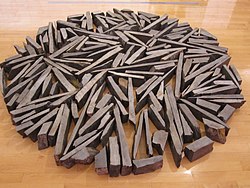
Long's work is often a direct response to the environments he explores. In some instances, he deliberately alters the landscape, as seen in A Line Made by Walking (1967). In other cases, he constructs sculptures from found materials within the landscape, which are then documented through photography. Some of his pieces are more minimalist, consisting of maps or photographs of unaltered landscapes paired with text detailing the specific time and location of his journey.
The Geometry of Nature
A recurring theme in Long's work is the relationship between humanity and the natural world. He describes his work as a meeting point where human characteristics—represented by abstract ideas of lines and circles—intersect with the natural forces of the world.
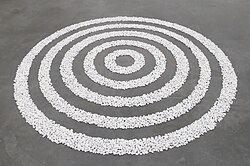
This philosophy is epitomized in the Delabole Slate Circle, a central piece at the Bristol City Museum and Art Gallery. Measuring nearly 2 metres in diameter, the work is composed of 168 pieces of slate from the Delabole quarry in Cornwall. While the piece can be configured in different ways, Long mandates two strict rules: the stones must form a circle, and every piece must touch to ensure the structure is locked and stable.
Notable Installations and Commissions
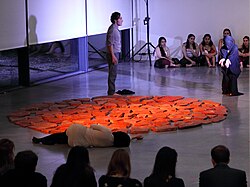
Long's portfolio spans intimate site-specific works to massive permanent installations. At Houghton Hall in Norfolk, he created a circle of Cornish slate at the end of a mown grass path. Similarly, at the New Art Centre in Salisbury, his Tame Buzzard Line (2001) uses flint stones to mimic the flight path of a buzzard between an ash and an oak tree.
His permanent installations demonstrate his ability to scale his vision for urban and institutional spaces:
- Riverlines (2006): Located at the Hearst Tower in New York, this wall work measured approximately 35 x 50 feet (11 x 15 metres), marking his largest wall work at the time.
- Planet Circle (1991): Installed at the Museum de Pont in Tilburg, Netherlands.
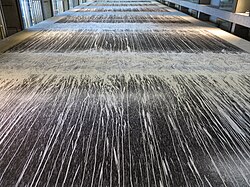
- White Water Falls (2012): Located at the Garvan Institute in Sydney, Australia.
Exhibitions and Legacy
The significance of Long's contribution to contemporary art has been recognized through major retrospectives. In 2009, Tate Britain hosted "Heaven and Earth," a comprehensive look at his career. Later, in 2015, the Arnolfini in Bristol presented Richard Long: Time and Space, celebrating the artist's work in his hometown.
| Work Title | Location | Material/Medium | Year |
|---|---|---|---|
| A Line Made by Walking | Various/Landscape | Environmental alteration | 1967 |
| Delabole Slate Circle | Bristol City Museum and Art Gallery | Cornish Slate | Acquired 1997 |
| Tame Buzzard Line | New Art Centre, Salisbury | Flint stones | 2001 |
| Riverlines | Hearst Tower, New York | Wall installation | 2006 |
| White Water Falls | Garvan Institute, Sydney | Permanent installation | 2012 |
Frequently Asked Questions
What materials does Richard Long use in his sculptures?
Long uses alternative, natural materials such as rock, earth, slate, and flint, moving away from traditional sculptural materials.
How does Richard Long define the "art" in his walking pieces?
For Long, the art is not just the final result, but the actual process of creating the work, including the act of walking through the landscape.
What are the rules for assembling the Delabole Slate Circle?
The pieces must be arranged to form a circle, and all stones must touch one another to ensure the structure is stable and locked together.
What is the primary theme of Richard Long's work?
His work explores the balance between the patterns of nature and human formalism, specifically the intersection of natural forces with abstract human ideas like lines and circles.
Where can some of Richard Long's permanent installations be found?
His permanent works are located in various global sites, including the Hearst Tower in New York, the Museum de Pont in the Netherlands, and the Garvan Institute in Sydney.