Olafur Eliasson: Transforming Perception Through Light, Water, and Nature
Olafur Eliasson is a contemporary artist whose work bridges the gap between nature, science, and human perception. By utilizing elemental materials—such as light, water, and air temperature—Eliasson creates immersive environments that challenge how viewers perceive their surroundings. His projects often function as social experiments, inviting the audience to become active participants in the artwork rather than passive observers.
Key Facts
- The Weather Project (2003) remains his most famous work, attracting two million visitors to London's Tate Modern.
- Environmental Focus: Projects like Ice Watch use actual Greenlandic ice to raise awareness about climate change.
- Architectural Impact: He designed the distinctive glass facade of the Harpa concert hall in Reykjavík.
- Sensory Exploration: His work often manipulates atmospheric density (the thickness or opacity of air) to alter spatial orientation.
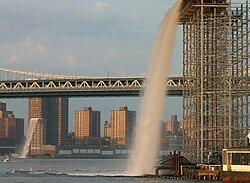
- Public Scale: The New York City Waterfalls was one of the most expensive public art projects in NYC history at $15.5 million.
Mastering the Elements: Light and Atmosphere
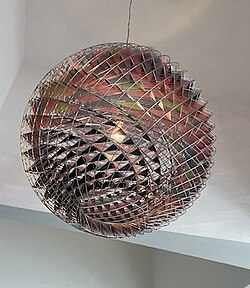
Eliasson frequently experiments with how light affects the human brain and spatial awareness. In Room For One Colour (1998), he used low-pressure sodium lamps to bathe a corridor in monochromatic yellow light, stripping away other colors and altering the viewer's perception. He pushed this further with 360 degrees Room For All Colours (2002), a circular sculpture that subsumes the participant in intense light, causing a loss of perspective.
His exploration of visibility is most evident in Din blinde passager (Your blind passenger, 2010). This 90-meter tunnel fills the space with dense fog, reducing visibility to just 1.5 meters. This forces visitors to rely on senses other than sight to navigate, creating a profound feeling of isolation and internal awareness.
The Weather Project and Large-Scale Illusions
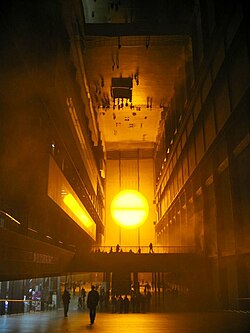
One of the most iconic moments in 21st-century art was The Weather Project (2003) at the Tate Modern's Turbine Hall. The installation used a large semicircle and a mirrored ceiling to create the illusion of a full, glowing sun inside a cloud-filled room. The mirror allowed visitors to see themselves from above, leading many to lie on the floor and interact with their own reflections, effectively socializing a massive, industrial space.
Interacting with the Natural World
Eliasson often brings the outdoors inside or alters natural landscapes to provoke thought. In Riverbed (2014–2015), he transformed a gallery at the Louisiana Museum of Modern Art into a physical landscape using natural rocks, dirt, and water. This immersive experience questioned the boundary between the real and the artificial.
His work also extends to the city's arteries. In the Green river series, Eliasson used uranin—a non-toxic powder used for leak detection—to dye rivers in cities like Stockholm, Tokyo, and Los Angeles a fluorescent green. These unannounced interventions turned urban waterways into striking visual statements.
Climate Activism through Ice Watch
To make the abstract concept of global warming tangible, Eliasson created the Ice Watch series (2014–2018). He transported massive ice blocks from the Nuup Kangerlua fjord in Greenland to public squares in Copenhagen, Paris, and London. By allowing people to touch and watch the ice melt in real-time, he created a direct bodily reaction to the climate crisis.
Architectural and Public Landmarks
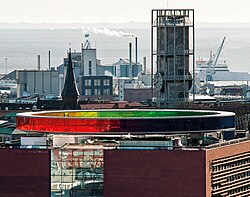
Beyond gallery walls, Eliasson's vision shapes urban architecture. He collaborated with Henning Larsen Architects to design the facade of Harpa in Reykjavík, using twelve-sided steel and glass modules that reflect the changing Icelandic light. Similarly, Your rainbow panorama (2011) is a 150-meter circular glass corridor atop the ARoS Art Museum in Denmark, offering a 360-degree view of the city through every color of the spectrum.
The Parliament of Reality
At Bard College in New York, Eliasson created The Parliament of Reality (2009). Inspired by the Althingi (the ancient Icelandic parliament), this permanent installation features a 100-foot-diameter island with a compass-like floor and river-washed boulders. It serves as a forum for students to gather, discuss, and negotiate, emphasizing the role of dialogue in education.
Summary of Major Works
| Project Name | Year | Key Medium/Feature | Location/Context |
|---|---|---|---|
| The Weather Project | 2003 | Mirrors, spotlights, mist | Tate Modern, London |
| Your rainbow panorama | 2011 | Colored glass corridor | ARoS Museum, Denmark |
| Ice Watch | 2014–2018 | Greenlandic glacial ice | Copenhagen, Paris, London |
| The New York City Waterfalls | 2008 | Man-made waterfalls | New York Harbor |
| Harpa Facade | 2011 | Steel and glass modules | Reykjavík, Iceland |
Frequently Asked Questions
What is the purpose of the Ice Watch installation?
Ice Watch aims to raise awareness about climate change by bringing melting glacial ice from Greenland into urban centers, allowing people to experience the physical reality of melting ice firsthand.
How did The Weather Project create the illusion of a sun?
The installation used a large semicircle of lights and a mirrored ceiling. The reflection of the semicircle in the mirror created the appearance of a full circle, while the mirrors also reflected the visitors below.
What is the significance of the Parliament of Reality?
Based on the Althingi, one of the world's earliest democratic forums, this work is designed as a space for students and the public to gather for discussion and negotiation, highlighting these as core elements of education.
What is uranin, and how was it used in Green river?
Uranin is a non-toxic, fluorescent powder used to trace leaks in plumbing. Eliasson used it to dye entire rivers a bright green to draw attention to the natural environment within urban settings.
What is the concept behind Your blind passenger?
This installation uses dense fog to limit visibility to 1.5 meters, forcing visitors to abandon their reliance on sight and use other senses to orient themselves within a 90-meter tunnel.