Revocation: Legal Definitions and Applications Across Law and Government
In its simplest form, revocation is the act of recalling, annulling, or cancelling a previously existing deed, grant, or privilege. Whether it occurs in a commercial contract, a government mandate, or religious law, revocation effectively makes a prior action void. While a permanent cancellation is a full revocation, a temporary version of this action is known as a suspension.
Key Facts
- Definition: The act of recalling or annulling a grant, privilege, or deed.
- Contract Law: Buyers can revoke acceptance of nonconforming goods if the value is substantially impaired.
- Offer Termination: An offeror can generally revoke an offer before it is accepted.
- Government Use: Revocation is used as a punishment or to prevent the abuse of privileges (e.g., driver's licenses).
- Legal Rights: Power of attorney grants can be revoked by the principal at any time.
Revocation in Contract Law
In the realm of contracts, revocation serves as a critical remedy for buyers who receive nonconforming goods—items that do not meet the specifications agreed upon in the contract. When this happens, a buyer has three primary choices: accept the goods despite the flaw, reject them entirely, or revoke their acceptance.
Revocation of Acceptance under the UCC
Under Article 2 of the Uniform Commercial Code (UCC), a buyer may revoke their acceptance if they can prove two things: the goods failed to conform to the contract, and this failure substantially impaired the value of the goods. This determination is treated as a question of fact.
The ability to revoke depends on the buyer's knowledge at the time of acceptance:
- Known Nonconformity: If the buyer knew about the defect, they can only revoke if they accepted the goods believing the seller would cure (fix) the issue, and the seller failed to do so.
- Unknown Nonconformity: If the buyer was unaware of the defect, they must prove they were reasonably induced by the difficulty of discovering the flaw or by assurances provided by the seller.
For a revocation to be valid, it must occur within a reasonable time after discovery, before any substantial change to the goods (unless caused by the defect itself), and only after the buyer notifies the seller. Once revoked, the buyer can cancel the contract and demand a refund, though some courts allow sellers to deduct a fee for the time the buyer possessed the goods.
Termination of Offers
Revocation also applies to the initial proposal or offer. An offeror may revoke an offer at any time before the communication of acceptance is complete. This revocation must be communicated to the offeree, though the offeror does not necessarily have to be the one to deliver the message. If an offer was made to the general public (as seen in Carlill v Carbolic Smoke Ball Co), the revocation must be delivered in a similar public form. However, an offer cannot be revoked if it is protected by an option.
In the case of unilateral contracts, the contract may be revoked at any time unless a separate ancillary contract exists to guarantee the main contract will not be withdrawn.
Government Administration and Public Law
Governmental bodies use revocation primarily as a punitive measure or a safeguard against the abuse of privileges. These actions can be handled through administrative channels or criminal courts.
Licenses and Legal Rights
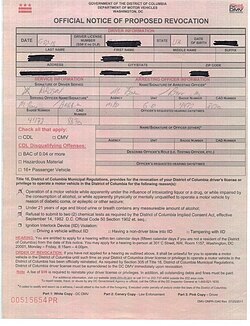
A common example is the revocation of a driver's license following repeated or egregious traffic violations. Depending on the jurisdiction, this may be decided by a criminal court or an administrative traffic court.
Institutional and Professional Revocations
Revocation is also used within restricted government environments to limit rights that are normally granted to citizens:
- Military Service: The revocation of privileges such as liberty passes.
- Correctional Facilities: The revocation of prison inmate privileges, such as visitation rights.
- Criminal Justice: The revocation of probation occurs when a subject violates probation terms and is subsequently incarcerated.
Additionally, revocation can apply to rank or office (demotion/removal) or the grant of representation. For instance, a person who has signed a power of attorney can revoke it, thereby stripping the grantee of the right to make decisions on the principal's behalf.
Revocation in Canon Law
In canon law (the internal legal system of the Catholic Church), grants, laws, contracts, sentences, jurisdiction, and appointments may be revoked by the grantor, their successor, or a superior. While revocation without just cause is considered illicit, it is often still legally valid. Laws and customs are typically revoked when changes in circumstances render them no longer just or reasonable. Furthermore, concordats (agreements between the Holy See and a state) are revocable if they cause serious injury to the Church.
Summary of Revocation Types
| Domain | What is Revoked | Primary Condition/Reason |
|---|---|---|
| Contract Law | Acceptance of Goods | Substantial impairment of value |
| Contract Law | Offer/Proposal | Before acceptance is complete |
| Administration | Driver's License | Egregious or repeated violations |
| Criminal Law | Probation | Violation of probation terms |
| Civil Law | Power of Attorney | Decision by the principal (grantor) |
| Canon Law | Laws or Concordats | Change in circumstances or serious injury |
Frequently Asked Questions
What is the difference between revocation and suspension?
Revocation is the permanent cancellation or annulment of a grant, privilege, or deed. Suspension is a temporary revocation of that same privilege.
Can a buyer always revoke their acceptance of a product?
No. Under the UCC, a buyer must show that the goods were nonconforming and that this nonconformity substantially impaired the value of the goods. There are also specific time limits and notification requirements.
When is an offer irrevocable?
An offer generally cannot be revoked once it has been accepted or if it has been encapsulated in an option contract.
How does revocation work with a power of attorney?
The principal (the person who granted the power) can revoke the grant of representation at any time, which immediately removes the grantee's legal right to make decisions on their behalf.
What happens during the revocation of probation?
When a person violates the specific terms of their probation, the court may revoke that probation, which typically results in the individual being incarcerated.