Synods in Christian Tradition: Governance, Doctrine, and Structure
In the context of Christian denominations, a synod is a formal council convened to resolve issues regarding doctrine, administration, or the application of church law. Derived from the Ancient Greek word synodos, meaning "assembly" or "meeting," the term is functionally similar to the Latin concilium (council). While historically these gatherings were exclusively for bishops, modern usage has expanded to describe the governing bodies of various churches or the churches themselves when governed by such a body.
Key Facts
- Etymology: From the Greek synodos, meaning a meeting or assembly.
- Primary Purpose: To decide on matters of faith, morality, church discipline, and administration.
- Diversity of Form: Ranges from permanent advisory bodies (Catholicism) to representative assemblies of clergy and laity (Anglicanism).
- Regional Variations: Known as a sobor in Slavic-speaking Eastern Orthodox traditions.
- Authority: Varies by denomination, from binding legislative power to purely advisory roles.
Eastern Orthodox and Oriental Orthodox Traditions
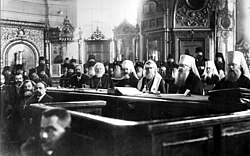
In Eastern and Oriental Orthodox churches, synods of bishops serve as the primary mechanism for electing new bishops and establishing ecclesiastical laws that apply across different dioceses. A distinct feature of these traditions, particularly among Slavic-speaking churches (such as the Russian, Ukrainian, Bulgarian, Serbian, and Macedonian) and the Romanian Orthodox Church, is the sobor.
A sobor is a formal assembly that includes not only bishops but also clerical and lay delegates. This inclusive structure is designed to discern the consensus of the wider church on matters of faith, rite, and cultural life. However, the bishops function as an "upper house," meaning the laity cannot overrule their final decisions.
Historically, the first East Slavic church sobor was recorded in Kiev in 1051. Other significant milestones include the Stoglavy Sobor (Sobor of a Hundred Chapters) in 1551 and the All-Russian Sobor of 1917, which restored the Moscow Patriarchate.
The Roman Catholic Perspective
In Roman Catholic tradition, the terms "synod" and "council" are theoretically synonymous, but in modern practice, they refer to different types of gatherings.
The Synod of Bishops
Established in 1965, the Synod of Bishops is a permanent advisory body to the pope. It consists of bishops and religious superiors who vote on proposals (propositiones). While the Synod expresses a collective will, it does not issue decrees independently; its findings typically form the basis for "post-synodal apostolic exhortations" issued by the pope, who holds the ultimate authority to summon, dissolve, and ratify the assembly's decisions.
Councils and Canon Law
Under Catholic canon law, a council is typically an irregular meeting with binding legislative force. These are categorized as follows:
- Ecumenical Council: The highest legislative authority of the universal Church, consisting of the entire episcopate in communion with the pope.
- Plenary Council: A meeting of the entire episcopate of a single nation.
- Provincial Council: A meeting of bishops within a specific ecclesiastical province.
Diocesan Synods and Episcopal Conferences
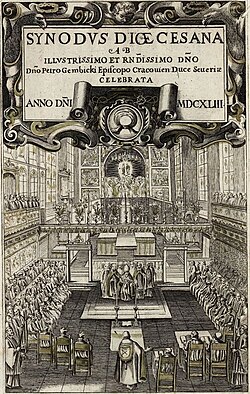
A diocesan synod is an irregular meeting of clergy and laity summoned by a diocesan bishop to deliberate on legislative matters, though the bishop remains the sole legislative authority. Additionally, national episcopal conferences act as permanent bodies for bishops within a nation. Unlike councils, these conferences generally only issue supplementary legislation when specifically authorized by the Holy See.
Synodal Structures in Other Denominations
Anglican Communion
Anglican synods are elected bodies comprising clergy and laity. They operate through a geographical hierarchy, with the General Synod at the apex. Within these synods, members are often organized into "houses" (bishops, clergy, and laity) to facilitate governance.
Lutheran and Presbyterian Traditions
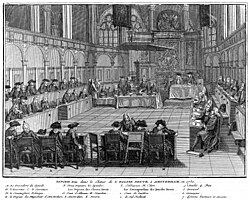
In North American Lutheranism, a synod may refer to a local administrative region (similar to a diocese) or, in the case of the Lutheran Church–Missouri Synod, the entire church body. In Presbyterian governance, the synod acts as an intermediate administrative level between the local presbytery and the national general assembly.
Reformed and Congolese Traditions
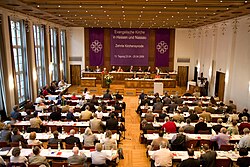
In Swiss and southern German Reformed churches, the synod corresponds to a general assembly. In the Democratic Republic of the Congo, the Church of Christ in Congo (CCC) uses a national synod as a general assembly for 62 different Protestant denominations, supported by provincial synods.
Summary of Synodal Types
| Tradition | Primary Term | Composition | Primary Function |
|---|---|---|---|
| Eastern Orthodox | Sobor / Synod | Bishops, Clergy, Laity | Election of bishops, canonical laws |
| Roman Catholic | Synod of Bishops | Bishops, Religious Superiors | Advisory to the Pope |
| Roman Catholic | Ecumenical Council | Universal Episcopate | Universal Church legislation |
| Anglican | General Synod | Elected Clergy and Laity | Hierarchical governance |
| Presbyterian | Synod | Representative delegates | Intermediate administration |
Frequently Asked Questions
What is the difference between a synod and a council in the Catholic Church?
While historically similar, a council in modern Catholic canon law typically refers to an irregular meeting with binding legislative power (such as an ecumenical council), whereas a synod is often a representative or advisory meeting, such as the Synod of Bishops.
What is a sobor?
A sobor is a formal church assembly used in Slavic-speaking Eastern Orthodox churches. It is distinguished from Western synods by the inclusion of lay and clerical delegates alongside the bishops.
Do laypeople have power in a synod?
This depends on the denomination. In Anglican and some Reformed traditions, laity are elected members with significant roles. In the Eastern Orthodox sobor, laity provide consensus, but bishops hold the final decision-making power. In Catholic diocesan synods, laity act in an advisory capacity.
What is an ecumenical council?
An ecumenical council is a global meeting of the entire episcopate (bishops) intended to represent the universal church. In the Catholic tradition, these are the highest legislative authority when acting with the pope.
How does a Presbyterian synod differ from a Lutheran one?
In Presbyterianism, a synod is a middle tier of administration between a local presbytery and a national assembly. In some Lutheran traditions, a synod may simply be a local administrative region or the name of the entire denomination.