Reserved Wild Animals of Thailand
In Thailand, the highest level of legal protection for fauna is granted to Reserved wild animals. This designation ensures that the most threatened species receive stringent safeguards to prevent extinction and promote conservation within the kingdom's borders.
The current legal framework is governed by The Wild Animal Conservation and Protection Act B.E. 2562 (2019), which updated and replaced the original legislation from 1992. Under this law, it is strictly prohibited to hunt, breed, possess, or trade any species listed as reserved. There are only two primary exceptions: scientific research conducted with explicit permission from the Permanent Secretary of National Park, Wildlife and Plant Conservation, or breeding and possession by authorized public zoos.
Key Facts
- Highest Protection: Reserved status is the most stringent protection class in Thailand's wildlife framework.
- Legal Basis: Governed by the Wild Animal Conservation and Protection Act B.E. 2562 (2019).
- Species Count: There are currently 21 designated reserved species.
- Strict Prohibitions: Hunting, trading, and private possession are illegal.
- Extinction Status: Schomburgk's deer is extinct, while Javan and Sumatran rhinoceroses are locally extinct in Thailand.
The List of Reserved Species
The list of reserved animals has evolved over decades, reflecting changing ecological needs and the discovery of new threats. The current list includes a diverse array of mammals, birds, reptiles, and fish.
Among the mammals, the list includes rare ungulates like the Chinese goral and the mainland serow. The Chinese goral (Naemorhedus griseus) is a goat-like antelope adapted to rugged terrain.
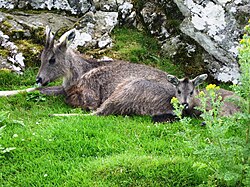
Other notable mammals include the Malayan tapir, the marbled cat, and several whale species, such as the Blue whale and Omura's whale. The avian representatives include the rare White-eyed river martin and the Helmeted hornbill, the latter of which was added to the list in 2024.
Summary of Reserved Wild Animals
| Common Name | Scientific Name | Group | Year Added |
|---|---|---|---|
| Javan rhinoceros | Rhinoceros sondaicus | Mammal | 1960 |
| Sumatran rhinoceros | Dicerorhinus sumatrensis | Mammal | 1960 |
| Kouprey | Bos sauveli | Mammal | 1960 |
| Wild Asian water buffalo | Bubalus bubalis (B. arnee) | Mammal | 1960 |
| Mainland serow | Capricornis sumatraensis | Mammal | 1960 |
| Chinese goral | Naemorhedus griseus | Mammal | 1960 |
| Schomburgk's deer | Cervus schomburgki | Mammal | 1960 |
| Eld's deer | Cervus eldii | Mammal | 1960 |
| Fea's muntjac | Muntiacus feae | Mammal | 1992 |
| Dugong | Dugong dugon | Mammal | 1992 |
| Malayan tapir | Tapirus indicus | Mammal | 1992 |
| Marbled cat | Pardofelis marmorata | Mammal | 1992 |
| White-eyed river martin | Pseudochelidon sirintarae | Bird | 1992 |
| Gurney's pitta | Pitta gurneyi | Bird | 1992 |
| Sarus crane | Grus antigone | Bird | 1992 |
| Leatherback turtle | Dermochelys coriacea | Reptile | 2019 |
| Whale shark | Rhincodon typus | Fish | 2019 |
| Bryde's whale | Balaenoptera edeni | Mammal | 2019 |
| Omura's whale | Balaenoptera omurai | Mammal | 2019 |
| Helmeted hornbill | Rhinoplax vigil | Bird | 2024 |
| Blue whale | Balaenoptera musculus | Mammal | 2024 |
Changes in Species Status
The list of reserved animals is not static. For example, the Indian hog deer (Axis porcinus) was originally added in 1960 but was subsequently removed from the list in 1992. Conversely, new species are added as threats emerge. The Irrawaddy dolphin (Orcaella brevirostris) is slated for addition to the reserved list following a survey of Songkhla Lake that found only 14 individuals.
Tragically, some species have already been lost. The Schomburgk's deer is now extinct, and both the Javan and Sumatran rhinoceroses are considered locally extinct within Thailand.
Frequently Asked Questions
What is the legal penalty for harming a reserved wild animal?
Under the Wild Animal Conservation and Protection Act B.E. 2562 (2019), hunting, breeding, possessing, or trading reserved species is strictly prohibited, except for authorized scientific research or public zoo management.
Which reserved species are no longer found in Thailand?
The Schomburgk's deer is extinct, and the Javan rhinoceros and Sumatran rhinoceros are locally extinct in Thailand.
Why is the Irrawaddy dolphin being added to the reserved list?
The Irrawaddy dolphin is being added due to critical population declines, with a recent survey in Songkhla Lake identifying only 14 individuals.
Who can legally possess a reserved wild animal?
Only authorized public zoos are permitted to breed and possess reserved wild animals, or researchers who have obtained permission from the Permanent Secretary of National Park, Wildlife and Plant Conservation.
When was the current wildlife protection law enacted?
The current framework is defined by the Wild Animal Conservation and Protection Act B.E. 2562, which was enacted in 2019 to replace the 1992 law.