Reichstag: The Architectural and Political Heart of Berlin
Standing prominently on the Platz der Republik in Berlin, the Reichstag is more than just a government building; it is a living chronicle of Germany's turbulent and triumphant history. Today, it serves as the seat of the Bundestag (the German federal parliament) and hosts the Federal Convention, the body responsible for electing the president of Germany.
From its origins as a symbol of imperial strength to its role as a witness to the rise and fall of the Third Reich, the building has undergone multiple transformations. Its current form, characterized by a striking glass dome, symbolizes the transparency and openness of modern German democracy.
Key Facts
- Location: Platz der Republik 1, 11011 Berlin, Germany.
- Architects: Originally designed by Paul Wallot (1884); redesigned by Norman Foster (1992–1999).
- Height: 47 meters (154 ft).
- Floor Area: 61,166 square meters.
- Key Feature: A walk-in glass dome providing a 360° view of Berlin.
- Famous Inscription: "Dem deutschen Volke" (To the German people).
Imperial Origins and the Weimar Republic
Construction of the Reichstag began on June 9, 1884, based on the Neo-Renaissance and Neo-Baroque plans of architect Paul Wallot. Wallot drew inspiration from Philadelphia's Memorial Hall, incorporating crowns and eagles to symbolize imperial power. The building's four corner towers were designed to represent the four German kingdoms at the time of unification: Prussia, Bavaria, Saxony, and Württemberg.
Completed in 1894, the building initially faced criticism for its eclectic mix of architectural styles, though its steel and glass cupola was praised as an engineering marvel. In 1916, the inscription "Dem deutschen Volke" was added to the frieze above the entrance, a move that faced opposition from Kaiser Wilhelm II due to its democratic connotations.
Following the abdication of the Kaiser in 1918, the building became the seat of the parliament for the Weimar Republic. This era was marked by political volatility, including the "Reichstag Bloodbath" of January 13, 1920, the deadliest demonstration in German history, where 42 protesters died.
The Nazi Era and World War II
The trajectory of the building changed drastically on February 27, 1933, when a severe arson attack gutted much of the interior. While Marinus van der Lubbe was identified as the culprit, Adolf Hitler used the event as a pretext to suspend civil liberties via the Reichstag Fire Decree, effectively entrenching the Nazi regime.
For the next 12 years, the building was largely unused for legislative purposes, as the parliament moved to the Kroll Opera House. The Reichstag was eventually converted into a fortress with bricked-up windows, and later served as a hospital and a radio tube manufacturing facility for AEG.
During the Battle of Berlin in 1945, the building became a primary target for the Red Army. Its capture was of immense symbolic importance to the Soviet Union, and the walls were left covered in graffiti by victorious Soviet soldiers.
Cold War and the Path to Reunification
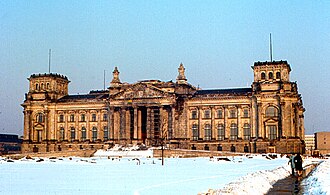
Located in West Berlin, the ruined building became a site of political assembly during the Cold War. In 1948, Mayor Ernst Reuter delivered a famous speech here during the Berlin Blockade. Between 1961 and 1971, the building was restored under Paul Baumgarten, though the original cupola was removed and the façade simplified.
Because of the 1971 Four Power Agreement, the Bundestag could not formally meet in West Berlin, leaving the building to be used for exhibitions and special events, including concerts by Tangerine Dream and Barclay James Harvest.
The official ceremony for German reunification took place at the Reichstag on October 3, 1990. Following a historic parliamentary debate in 1991, it was decided that the government and parliament would return to Berlin from Bonn.
Modern Reconstruction and the Glass Dome
From 1995 to 1999, architect Norman Foster led a fundamental redesign of the building. Before work began, the structure was famously wrapped in fabric by artists Christo and Jeanne-Claude. Foster's design focused on transparency, retaining historical scars—such as Soviet graffiti and bullet holes—while creating a modern interior.
The most iconic addition is the walk-in glass dome, proposed by Gottfried Böhm and executed by Foster. This dome allows visitors to look directly down into the plenary chamber, symbolizing the people's oversight of their representatives. To prevent glare and overheating, an electronic sun shield tracks the sun's movement to block direct light.
| Feature | Detail |
|---|---|
| Construction Period | 1884–1894 |
| Major Renovations | 1934–37, 1961–64, 1992–99 |
| Architects | Paul Wallot, Norman Foster |
| Current Tenant | Bundestag |
| Floor Count | 6 |
| Total Floor Area | 61,166 m² |
Frequently Asked Questions
What is the significance of the glass dome?
The glass dome symbolizes political transparency. It allows the public to physically stand above the members of parliament, representing the principle that the people are above the government.
Why was the Reichstag fire so important?
The 1933 fire was used by Adolf Hitler as a justification to suspend civil liberties and eliminate political opposition, specifically targeting Communists, which helped consolidate Nazi power.
Who is the current tenant of the building?
The building is the seat of the Bundestag, the lower house of the German parliament.
Can the public visit the Reichstag?
Yes, the Reichstag is one of Germany's most visited attractions. Visitors can access the glass dome and the roof terrace, though prior registration is required.
What does "Dem deutschen Volke" mean?
The phrase translates to "To the German people" and is inscribed on the frieze above the main entrance.