Redeemers: The Political Coalition that Ended Reconstruction
Following the American Civil War, the Southern United States entered a turbulent period known as the Reconstruction Era. During this time, a powerful political faction known as the Redeemers emerged. Comprising the Southern wing of the Democratic Party, the Redeemers were a coalition of white Southerners—often led by white yeomen—who sought to reclaim political control and establish a social order based on white supremacy.
The Redeemers' primary objective was "Redemption," a process intended to oust the Radical Republicans. This opposing coalition consisted of freedmen (formerly enslaved African Americans), "carpetbaggers" (Northerners who moved South), and "scalawags" (Southern whites who supported Reconstruction). By the 1870s, the Redeemers began to dominate Southern politics, a grip they maintained in many areas until 1910.
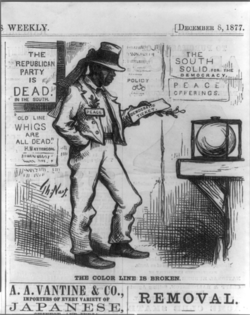
Key Facts
- Founded: 1865; dissolved around 1877.
- Ideology: Reactionism, conservatism, white supremacy, and anti-Reconstruction.
- Political Affiliation: Southern wing of the Democratic Party.
- Primary Goal: To remove Radical Republicans from power and enforce racial segregation.
- Tactics: Used both legislative changes and paramilitary violence to suppress the Republican vote.
- Outcome: Led to the creation of the "Solid South," a period of one-party Democratic dominance.
The Path to Redemption: Violence and Paramilitaries
The rise of the Redeemers was not merely a political shift but was fueled by systemic violence. In the 1870s, paramilitary organizations affiliated with the Democratic Party—such as the White League in Louisiana and the Red Shirts in Mississippi and North Carolina—worked openly to undermine Republican influence.
These groups used intimidation, threats, and murder to disrupt political gatherings and suppress the Black vote. A stark example occurred in 1868 in St. Landry Parish, Louisiana, during the Opelousas massacre, where white terrorists killed approximately 200 freedmen. Between April and October of that year, Louisiana saw 1,081 political murders, the majority of whom were freedmen.
Further violence erupted during the Colfax Massacre of 1873, where a white Democratic militia killed over 100 Republican Blacks during a confrontation over parish office control. Such tactics were common in every Southern election year from 1868 onward, often accompanied by widespread electoral fraud.
The Compromise of 1877 and the End of Reconstruction
By the presidential election of 1876, only three Southern states—Florida, Louisiana, and South Carolina—remained "unredeemed." The election between Rutherford B. Hayes and Samuel J. Tilden was heavily disputed and allegedly resolved by the Compromise of 1877 (also called the Corrupt Bargain).
Under this agreement, Hayes became president in exchange for several concessions to the South, most notably the removal of Federal troops from the remaining unredeemed states. Once these troops were withdrawn, the national enforcement of constitutional amendments passed after the Civil War ceased, effectively ending Reconstruction and returning the South to "home rule."
Systemic Disenfranchisement
Once the Redeemers secured control of state legislatures, they implemented legal mechanisms to strip African Americans and poor whites of their voting rights. Between 1890 and 1908, ten of the eleven former Confederate states passed new constitutions featuring:
- Poll taxes: Fees required to vote that disproportionately affected the poor.
- Literacy tests: Subjective exams used to disqualify Black voters.
- Residency requirements: Strict rules on how long a person must live in a district.
The impact was devastating. In Alabama, for example, the number of registered Black voters in 14 "Black Belt" counties plummeted from 79,311 in 1900 to just 1,081 by 1903. By 1941, estimates suggest that 600,000 whites and 500,000 Blacks had been disenfranchised in Alabama alone.
Legal Challenges and the Supreme Court
Educated African Americans, some secretly funded by Booker T. Washington, challenged these laws in court. However, the U.S. Supreme Court upheld the restrictive provisions in cases such as Williams v. Mississippi (1898) and Giles v. Harris (1903). It was not until the mid-20th century, with the Civil Rights Acts of 1957 and 1964 and the Voting Rights Act of 1965, that these barriers were finally dismantled.
Summary of the Redeemer Movement
| Category | Details |
|---|---|
| Prominent Members | Wade Hampton III, Benjamin Tillman, Alcibiades DeBlanc, Murphy J. Foster, Isham G. Harris, Lucius Q. C. Lamar |
| Paramilitary Allies | Ku Klux Klan, White League, Red Shirts, Knights of the White Camelia |
| Key Opponents | Radical Republicans, Freedmen, Carpetbaggers, Scalawags |
| Political Legacy | The "Solid South" (Democratic dominance until the mid-20th century) |
| Primary Methods | Voter intimidation, paramilitary violence, poll taxes, literacy tests |
Historiography: Changing Perspectives
The interpretation of the Redeemers has evolved significantly over time. In the early 20th century, the Dunning School portrayed Reconstruction as a failure caused by corruption and the "misgovernment" of freedmen. They argued the South needed to be redeemed from Northern extremists.
By the 1930s, revisionist historians like C. Vann Woodward argued that the conflict was primarily economic, with both Republicans and Redeemers serving as tools for railroad interests. In 1935, W. E. B. Du Bois published Black Reconstruction, a Marxist analysis that highlighted the achievements of the era—such as the establishment of universal public education—and the central role African Americans played in attempting to build a true democracy.
Frequently Asked Questions
Who were the Redeemers?
The Redeemers were a coalition of white Southern Democrats during the Reconstruction Era who sought to regain political power and enforce white supremacy after the American Civil War.
What was the "Redemption" process?
Redemption refers to the effort by white Democrats to oust the Radical Republican governments in the South through a combination of political maneuvering, legislative changes, and paramilitary violence.
How did the Compromise of 1877 affect the South?
The Compromise of 1877 resulted in the removal of Federal troops from the South, which ended Reconstruction and allowed the Redeemers to establish full political control over the region.
What methods did Redeemers use to stop Black people from voting?
They used paramilitary violence and intimidation, as well as legal barriers such as poll taxes, literacy tests, and strict residency requirements.
What was the "Solid South"?
The Solid South refers to the period following Reconstruction when the Democratic Party held nearly total political control over the Southern states, creating a one-party voting bloc that lasted for decades.