Ray Nagin: The Rise and Fall of New Orleans' 60th Mayor
Clarence Ray Nagin Jr. is a figure whose legacy is inextricably linked to one of the most tumultuous periods in American urban history. Serving as the 60th Mayor of New Orleans from 2002 to 2010, Nagin transitioned from a high-flying corporate executive to a political leader tasked with guiding a city through the catastrophic aftermath of Hurricane Katrina. His tenure was marked by early economic successes, a historic disaster, and an eventual descent into federal legal battles.
Early Life and Business Success
Born on June 11, 1956, in New Orleans, Louisiana, Ray Nagin built a formidable reputation in the private sector before entering politics. After earning a BS from Tuskegee University and an MBA from Tulane University, Nagin entered the corporate world. In 1985, he joined Cox New Orleans, the city's cable television franchise. At the time, the franchise was struggling with low profits and high customer dissatisfaction.
Nagin's leadership led to a rapid ascent within the company. He was promoted to general manager and eventually became the vice-president and general manager of Cox Louisiana, overseeing all properties in south Louisiana. By 1989, his professional success was evident, with an annual salary of $400,000.
The Path to City Hall
Nagin entered the political arena in 2002. In the first round of the mayoral election in February, he secured first place with 29% of the vote, competing against candidates such as Police Chief Richard Pennington, State Senator Paulette Irons, and City Councilman Troy Carter. In the runoff election on March 2, 2002, Nagin defeated Pennington with 59% of the vote to become the mayor.
First Term: Economic Growth and Early Warnings
The initial years of Nagin's administration were characterized by significant economic indicators. According to the 2004 Comprehensive Annual Financial Report certified by KPMG, the city gained 4,500 jobs, and approximately 38,000 residents rose out of poverty. During this time, New Orleans saw the fastest rate of per capita income growth in the nation.
Nagin also focused on modernization and infrastructure. He passed a $260 million bond issue in November 2004, and the city's digital presence improved dramatically, with the city website ranking 4th best in the nation and the city jumping to 38th on Intel's "Most Wired Cities" list.
Early signs of Nagin's approach to disaster management appeared during Hurricane Ivan in September 2004. He famously advised residents to keep "an axe in the attic," recalling the tragedies of Hurricane Betsy in 1965 when residents were trapped by rising waters. He issued a voluntary evacuation that saw roughly 600,000 people leave the metro area.
The Crisis of Hurricane Katrina
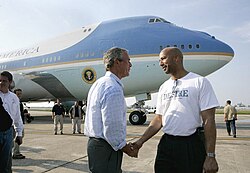
In August 2005, the city faced its greatest challenge: Hurricane Katrina. Initially, Nagin encouraged residents to prepare and promised that those who stayed would be taken care of. While he called for mandatory evacuations in surrounding parishes like Jefferson and St. Charles, he initially ignored recommendations to evacuate the entire city.
Following a late-night call from Max Mayfield, head of the National Hurricane Center, Nagin realized the severity of the threat. On August 28, 2005, he signed the first mandatory evacuation order in the city's nearly 300-year history. The Superdome was opened as a shelter of last resort, and by Sunday evening, 80% of the population had been evacuated or relocated.
Second Term and Rebuilding Struggles
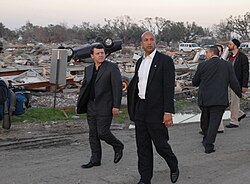
Nagin won re-election on May 20, 2006, defeating Mitch Landrieu with 52% of the vote. However, his second term was plagued by intense media criticism. His "100-day plan" for rebuilding was criticized for lacking detail and timeliness. While his spokesperson, Rob Couhig, argued the plan was a short-range initiative rather than a strict timeline, the recovery was further hampered by delays in federal recovery dollars and FEMA reimbursements.
Corruption Allegations and Legal Downfall
The latter part of Nagin's career was overshadowed by allegations of graft. In 2009, reports emerged regarding a 2004 trip to Hawaii partially funded by a city vendor's credit card. Further investigations revealed other trips paid for by NetMethods, a company owned by city vendor Mark St. Pierre.
A subsequent FOIA request led to a forensic investigation by SunBlock Systems, which recovered 5,400 deleted official emails. These emails became critical evidence in a federal trial. On January 18, 2013, Nagin was indicted on 21 corruption charges, including bribery, wire fraud, money laundering, and conspiracy. He became the first mayor in New Orleans' history to be criminally charged for corruption in office.
Conviction and Incarceration
On February 12, 2014, a jury convicted Nagin on 20 of the 21 counts. The evidence showed he had accepted over $500,000 in payouts from businessmen in exchange for city contracts worth millions. Judge Helen Ginger Berrigan sentenced him to ten years in prison and ordered over $585,000 in restitution and forfeiture.
After several failed appeals, Nagin served his sentence, eventually moving to house arrest and community confinement. His supervised probation officially concluded on March 16, 2024.
Key Facts
- Office: 60th Mayor of New Orleans (2002–2010).
- Education: BS from Tuskegee University; MBA from Tulane University.
- Business Background: Former Vice-President and General Manager of Cox Louisiana.
- Katrina Milestone: Issued the first mandatory evacuation order in New Orleans' history.
- Legal Outcome: Convicted on 20 federal corruption counts in 2014.
- Sentence: 10 years imprisonment, concluding all terms of release in March 2024.
| Term | Period | Key Focus/Events | Outcome |
|---|---|---|---|
| First Term | 2002–2006 | Economic growth, digital infrastructure, Hurricane Katrina | Re-elected in 2006 |
| Second Term | 2006–2010 | Post-Katrina rebuilding, FEMA coordination | Left office in 2010 |
Frequently Asked Questions
Why was Ray Nagin convicted of corruption?
Nagin was convicted of taking more than $500,000 in bribes from businessmen in exchange for awarding them millions of dollars in city contracts.
What was the "axe in the attic" comment?
During Hurricane Ivan in 2004, Nagin advised residents to keep an axe in their attics so they could break through the roof if they became trapped by rising floodwaters, a reference to the 1965 Hurricane Betsy.
How did the deleted emails affect his case?
After a FOIA request, forensic investigators recovered 5,400 deleted emails from Nagin's city account, which were used as evidence during his 2013 criminal trial.
When did Ray Nagin complete his legal sentence?
His supervised probation, the final phase of his 10-year sentence, concluded on March 16, 2024.
Who succeeded Ray Nagin as Mayor of New Orleans?
Ray Nagin was succeeded by Mitch Landrieu, who had previously run against him in the 2006 election.