Hurricane Katrina Diaspora and the Displacement of the Gulf Coast
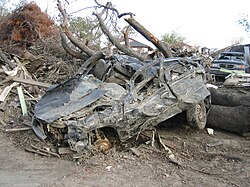
In 2005, the devastating impact of Hurricane Katrina forced approximately 1.5 million people from Louisiana, Mississippi, and Alabama to flee their homes. This mass exodus created what is now known as the Gulf Coast diaspora. Many of these individuals are classified as internally displaced persons (IDPs)—people forced to leave their homes to avoid the effects of armed conflict, similarity, or natural disasters, but who remain within their country's borders.
The scale of the crisis was immense. At the peak of the disaster, evacuee shelters housed 273,000 people, and FEMA (Federal Emergency Management Agency) trailers eventually provided housing for at least 114,000 households. For many, the displacement became permanent; roughly 40% of evacuees, primarily those from Louisiana, were unable to return home.
Key Facts
- Total Displaced: Approximately 1.5 million people across Alabama, Mississippi, and Louisiana.
- New Orleans Population Loss: The city dropped from 484,674 (2000) to an estimated 230,172 (2006).
- Relocation Patterns: 25% of evacuees moved within 10 miles of their county, while 10% relocated over 830 miles away.
- Housing Impact: 4,500 units of traditional public housing in New Orleans were demolished post-storm.
- Texas Refuge: Texas accepted an estimated 220,000 refugees from Louisiana.
Population Shifts and the New Orleans Crisis
The demographic shift in New Orleans was staggering. By July 2006, the city had lost over half of its population. While the population grew to an estimated 383,997 by 2020, it remained below pre-Katrina levels. This recovery was not uniform; while some neighborhoods grew, others remained at less than half of their original population thirteen years later.
The Privatization of Public Housing
The disaster accelerated a push toward privatization. The New Orleans city council unanimously voted to demolish 4,500 units of traditional public housing, replacing them with "mixed-income" projects and vouchers. Although described as "deconcentration," this move displaced many low-income residents, leaving 16,000 families on the subsidized housing waitlist as of 2015.
The Diaspora Destinations
Data from the U.S. Postal Service and FEMA registrations indicate that while many stayed local, nearly 15% of New Orleans evacuees moved to distant cities on the East, Midwest, and West Coasts. The primary hubs for the displaced were Baton Rouge, Atlanta, Dallas, Houston, and suburban New Orleans.
The Texas Response
Texas played a critical role in the emergency response, taking in roughly 220,000 people. The Reliant Astrodome in Houston initially accepted 25,000 evacuees from the Louisiana Superdome. As shelters reached capacity, Governor Rick Perry activated emergency plans to open spaces in San Antonio and the Dallas-Fort Worth Metroplex.
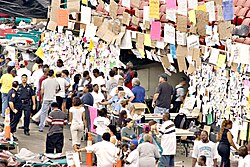
The influx was so rapid that by September 6, Texas declared a state of emergency. To manage the volume, 20,000 evacuees were diverted to Oklahoma and 30,000 to Arkansas. Texas communities provided essential support, including expedited school enrollment, food stamp access, and health services for those treating HIV and tuberculosis.
Human Rights and Social Equity
The aftermath of Katrina sparked international scrutiny regarding human rights. A 2006 UN Human Rights Committee report urged the U.S. to ensure that poor and Black Americans were prioritized in reconstruction plans for housing, healthcare, and education.
Further investigations by the Institute for Southern Studies and the UN Special Rapporteur Doudou Diène highlighted failures to adhere to internationally recognized human rights principles. Reports also documented the mistreatment of prison populations during the flooding.
Housing and Economic Recovery
Housing remains one of the most contentious legacies of the storm. Rents in New Orleans spiked by an average of 40% following the disaster. While FEMA ended its temporary housing program in 2009, it allowed some residents still living in government trailers to purchase them for as little as $1.
| Metric | Pre-Katrina / Initial | Post-Katrina / Recovery |
|---|---|---|
| New Orleans Population | 484,674 (2000) | 383,997 (2020) |
| Public Housing Units | Traditional Units | 4,500 units demolished |
| Texas Evacuees | 0 | ~220,000 |
| Average Rent Change | Baseline | 40% Increase |
Frequently Asked Questions
What is the Gulf Coast diaspora?
The Gulf Coast diaspora refers to the collective group of people from the southern United States, particularly New Orleans, who were forced to leave their homes due to Hurricane Katrina in 2005 and were unable to return.
How many people were displaced by Hurricane Katrina?
Approximately 1.5 million people from Louisiana, Mississippi, and Alabama were forced to leave their homes.
Why were so many people unable to return to New Orleans?
Factors included the destruction of homes, a 40% spike in rental costs, and the demolition of 4,500 units of traditional public housing in favor of mixed-income developments.
What role did Texas play in the evacuation?
Texas took in an estimated 220,000 refugees, utilizing the Astrodome and other shelters in Houston, Dallas, and San Antonio, and providing essential social and health services.
What were the human rights concerns following the storm?
The UN and other organizations raised concerns regarding racial discrimination in reconstruction plans and the mistreatment of prisoners during the flooding.