Railway Forces and Superelevation Dynamics
When a train navigates a curve, it is subject to a complex interplay of physical forces. To ensure stability, passenger comfort, and the longevity of the infrastructure, engineers employ superelevation—the practice of banking the track by raising the outer rail higher than the inner rail. This design allows the vehicle to counteract the forces generated by circular motion.
At the core of this movement is centripetal acceleration, the acceleration directed toward the center of the circular path. For a vehicle traveling at speed v along a curve with radius R, the magnitude of this acceleration is defined as v²/R. This acceleration is produced by the horizontal forces applied by the rails to the wheels, totaling Mv²/R, where M represents the mass of the vehicle.
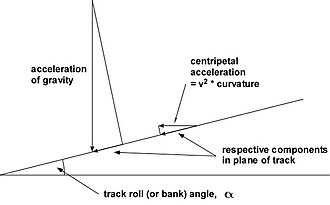
The Mechanics of Banked Tracks
The net horizontal force acting on a vehicle is divided into two components: one that is normal (perpendicular) to the track and one that lies within the plane of the track. The normal component acts alongside the gravitational force; while it may slightly increase the vertical load on the vehicle's suspension, it does not cause lateral deflection or the lateral acceleration felt by passengers.
By banking the track at a specific angle (α), engineers use a component of gravity to offset the centripetal acceleration. When the components of gravitational and centripetal acceleration in the plane of the track are perfectly equal, the vehicle is in a state of balance. This equilibrium is expressed by the equation:
v²/R cos α = g sin α
Balancing Speed
The balancing speed (Vbal) is the specific velocity at which a vehicle can traverse a curve of a given radius and bank angle without experiencing lateral force. It is calculated as:
Vbal = √(Rg tan α)
Cant Deficiency and Real-World Application
In practice, passenger trains often travel faster than the balancing speed. This discrepancy leads to cant deficiency (CD), which is the amount of additional superelevation that would be required to make the actual travel speed the new balancing speed.
To calculate cant deficiency, engineers consider the rail gauge (GE), the actual superelevation (SE), and the actual speed (Vact). The formula is as follows:
CD = [GE / √(1 + (R²g² / Vact⁴))] - SE
Freight vs. Passenger Considerations
While passenger trains prioritize speed and comfort, freight traffic requires a different approach. Because freight cars often carry maximum allowed axle loads, superelevations are typically set so the balancing speed closely matches the actual speed of the freight traffic. This prevents heavy wheel loads from crushing the head of either rail.
Key Facts
- Centripetal Acceleration: Directed toward the center of the curve, calculated as v²/R.
- Superelevation: The banking of tracks to use gravity to counteract lateral forces.
- Balancing Speed: The speed at which the gravitational component perfectly offsets the centripetal component.
- Cant Deficiency: The difference between the actual superelevation and the amount needed for the current travel speed.
- Freight Optimization: Freight tracks are balanced to actual running speeds to prevent rail head deformation.
| Parameter | Value |
|---|---|
| Curve Radius (R) | 1,746.40 m |
| Rail Gauge (GE) | 1,511.3 mm |
| Actual Superelevation (SE) | 152.4 mm |
| Calculated Balancing Speed (Vbal) | 149.99 km/h (93.20 mph) |
| Actual Speed (Vact) | 201.17 km/h (125 mph) |
| Resulting Cant Deficiency (CD) | 118.7 mm (4.67 in) |
Frequently Asked Questions
What is the purpose of superelevation in railway tracks?
Superelevation banks the track to allow a component of the vehicle's weight (gravity) to counteract the centripetal force generated during circular motion, improving stability and reducing wear.
What happens when a train exceeds the balancing speed?
When a train travels faster than the balancing speed, it experiences cant deficiency. This means there is a net lateral force pushing the vehicle toward the outside of the curve.
Why is balancing speed critical for freight trains?
Freight trains have very high axle loads. If the balancing speed is not closely matched to their actual speed, the excessive weight can crush the rail head on either the inner or outer rail.
Does the normal component of force affect passenger comfort?
No. The component normal to the track increases the vertical load on the suspension but does not create the lateral acceleration that passengers perceive as being pushed to the side.
How is the rail gauge factored into cant deficiency?
The rail gauge (GE), measured from the low rail gauge side corner to the high rail field side corner, serves as the baseline width used to determine how much the track must be tilted to achieve a specific balance.