Rachel Lambert Mellon: The Visionary Gardener and Art Patron
Rachel Lambert Mellon, affectionately known as "Bunny," was a towering figure in American horticulture, art collecting, and philanthropy. Though she avoided the public spotlight for much of her life, her influence is permanently etched into the landscape of the United States, most notably through her redesign of the White House Rose Garden. A woman of immense wealth and refined taste, Mellon blended a deep passion for botanical history with a commitment to the arts, leaving behind a legacy of understated elegance.
Key Facts
- Primary Achievement: Redesigned the White House Rose Garden for President John F. Kennedy.
- Botanical Legacy: Created the French-inspired gardens at Oak Spring Farms and amassed a world-class collection of rare horticultural books.
- Art Patronage: Collected significant works by Mark Rothko and co-founded the Yale Center for British Art.
- Family Ties: Granddaughter of Jordan Lambert, the inventor of Listerine.
- Longevity: Lived to the age of 103, passing away in 2014.
Early Life and Family Heritage
Born Rachel Lowe Lambert in New York City, she was the eldest child of Gerard Barnes Lambert, president of the Gillette Safety Razor Company and co-founder of Warner–Lambert. Her family's scientific and entrepreneurial roots ran deep; her paternal grandfather, Jordan Lambert, was the chemist who invented Listerine. Mellon was educated at Miss Fine's School in New Jersey and the Foxcroft School in Virginia.
Mellon's personal life was marked by two marriages. Her first, to Stacy Barcroft Lloyd Jr. in 1932, ended in divorce in 1948. She subsequently married Paul Mellon, a renowned philanthropist and horse breeder. Together, the couple became prolific collectors of 18th- and 19th-century European paintings, donating over a thousand works to the National Gallery of Art.
A Master of Horticulture
Despite having no formal training, Rachel Mellon became one of the most respected authorities on American horticulture. Her passion began at her family's Princeton estate, "Albemarle," where she observed the work of the Olmsted Brothers. She was heavily influenced by the classical French styles of André Le Nôtre and Jean-Baptiste de La Quintinie.
Mellon's most public triumph came in 1961 when President John F. Kennedy commissioned her to redesign the White House Rose Garden. She focused on creating open spaces for public ceremonies and introduced American plant species, including Magnolia soulangeana. Her work continued into the East Garden, a project she resumed under the request of Lady Bird Johnson following Kennedy's assassination.
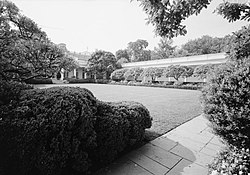
Beyond the White House, Mellon's botanical expertise extended to the John F. Kennedy Presidential Library, the headquarters of the American Horticultural Society at River Farm, and the 4,000-acre Oak Spring Farms in Virginia. Internationally, she contributed to the restoration of the potager du Roi in Versailles and designed landscapes for Hubert de Givenchy.
Art Collections and Philanthropy
Mellon was a sophisticated collector of modern art, specifically the works of Mark Rothko. She purchased thirteen of his pieces, including the massive No. 20 (Yellow Expanse). Her eye for quality and discretion defined her approach to collecting; she famously remarked in 1969 that "nothing should be noticed," a philosophy that applied to both her gardens and her private life.
Following her death, the scale of her collection became public. A 2014 Sotheby's auction of her jewelry, furniture, and art totaled $158.7 million, while three major paintings—including two Rothkos—were sold privately for a reported $250 million. The proceeds benefited the Gerard B. Lambert Foundation, established in honor of her father.
| Category | Key Contributions / Details |
|---|---|
| Landscaping | White House Rose Garden, Oak Spring Farms, Versailles potager du Roi |
| Art | Major Mark Rothko collector; National Gallery of Art donor |
| Institutions | Yale Center for British Art (Co-founder) |
| Honors | Veitch Memorial Medal, Henry Shaw Award, Officier de l'Ordre des Arts et des Lettres |
Later Years and Political Involvement
Mellon's later years were marked by personal resilience. After the death of Paul Mellon in 1999 and a tragic accident that left her daughter, Eliza, paralyzed in 2000, she remained active in her community and her interests. A lifelong Democrat, she became a significant financier for presidential candidate John Edwards, contributing millions of dollars to his 2008 campaign.
This generosity later became a source of controversy. It was revealed that some of her funds, intended for campaign expenses, were used to support Edwards' extramarital affair. While Mellon expressed regret over this specific use of her money, she maintained her belief in Edwards' potential as a leader.
Final Years and Passing
In her final decade, Mellon battled cancer and macular degeneration, which eventually forced her to stop gardening in 2011. However, she maintained her health through swimming and Pilates. Rachel Lambert Mellon died of natural causes on March 17, 2014, at her home in Upperville, Virginia, at the age of 103.
Frequently Asked Questions
What was Rachel Mellon's most famous landscaping project?
Her most famous project was the redesign of the White House Rose Garden in 1961, where she introduced American plant species and created more open space for official ceremonies.
How did she contribute to the arts?
Mellon was a major collector of Mark Rothko's work and, along with her husband Paul, donated over a thousand European paintings to the National Gallery of Art and established the Yale Center for British Art.
What was the significance of Oak Spring Farms?
Oak Spring Farms was her 4,000-acre Virginia estate, featuring French-inspired gardens and serving as the site of her extensive horticultural research and private residence.
What was her connection to the Kennedy family?
She was a close friend and advisor to Jacqueline Kennedy, assisting her with the White House restoration and designing landscapes for the Kennedy home in Martha's Vineyard and the JFK Presidential Library.
What happened to her art collection after her death?
Much of her collection was sold via Sotheby's and private sales, raising hundreds of millions of dollars for the Gerard B. Lambert Foundation.