First Lady of the United States: Evolution of an Iconic Role
The position of the First Lady is one of the most visible yet unique roles in American society. While not an elected or appointed office within the United States Government, the First Lady serves as a prominent figure in the nation's political and social life. From the early days of the republic to the modern era, the role has evolved from that of a traditional White House hostess to a platform for global advocacy and political influence.
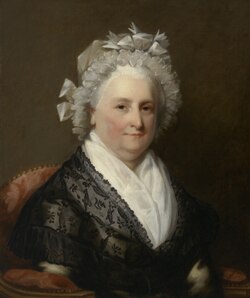
Since January 20, 2025, the office has been held by Melania Trump, wife of President Donald Trump. Often referred to by the abbreviation FLOTUS, the First Lady continues a legacy that began with the nation's first presidential spouse, Martha Washington.
Key Facts
- Inaugural Holder: Martha Washington (April 30, 1789).
- Official Status: Neither elected nor appointed; carries ceremonial duties rather than governmental power.
- Primary Residence: The White House.
- Modern Scope: Includes political campaigning, White House management, and championship of social causes.
- Terminology: The term "FLOTUS" first appeared in The Washington Post in 1983.
Origins of the Title
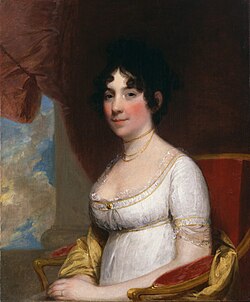
The term "First Lady" was not used officially at the start of the presidency. Popular belief suggests that Dolley Madison was the first to be called "First Lady" during a funeral eulogy in 1849, though no written record of this exists. The title gradually permeated Washington, D.C. social circles before appearing in print.
The first person to be called "First Lady" while actively holding the office was Harriet Lane (niece of James Buchanan) in an 1860 article by Leslie's Illustrated Newspaper. By 1863, William Howard Russell used the phrase in his diary regarding Mary Todd Lincoln. The title achieved nationwide recognition in 1877 through journalist Mary C. Ames, who described Lucy Webb Hayes as "the First Lady of the Land." The term was further popularized by a 1911 comedic play and became widely accepted by the 1930s.
The Evolving Role and Influence
Because the role is not codified, each First Lady has shaped the position to fit her own strengths and the needs of the era. Historically, the First Lady is the primary hostess of the White House, organizing official ceremonies and state functions.
Historical Themes of the First Ladyship
Scholar Lisa Burns identifies four distinct eras of the role:
- Public Woman (1900–1929): Transitioning into a more visible public figure.
- Political Celebrity (1932–1961): Using fame to influence public perception.
- Political Activist (1964–1977): Direct engagement in social and political causes.
- Political Interloper (1980–2001): A more integrated role in political strategy and policy.
Dolley Madison set the early standard by assisting orphans and women and saving national treasures during the War of 1812. This model persisted until Eleanor Roosevelt in the 1930s, who broke tradition by voicing personal political opinions, writing a newspaper column, and hosting a radio show.
Modern Transitions and Political Ambition
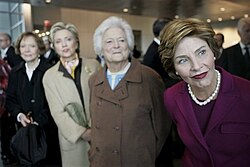
In the late 20th century, the role shifted further. Hillary Clinton became the first First Lady to seek political office when she ran for the U.S. Senate. During her campaign, her daughter Chelsea assumed many of the First Lady's duties. Clinton later served as a Senator from New York and as Secretary of State.
Causes and Initiatives
First Ladies often champion specific social issues, using their platform to bring national attention to critical causes. These initiatives range from environmental protection to public health.
| First Lady | Key Cause / Initiative |
|---|---|
| Eleanor Roosevelt | Civil rights, women's rights, and humanitarian efforts |
| Jacqueline Kennedy | White House restoration and the Arts |
| Lady Bird Johnson | Environmental protection and Beautification |
| Nancy Reagan | Drug awareness ("Just Say No") |
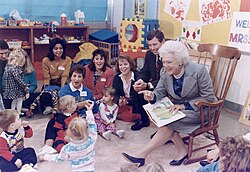
| Barbara Bush / Laura Bush | Childhood literacy |
| Michelle Obama | Childhood obesity ("Let's Move!") and girls' education |
| Melania Trump | Cyberbullying, foster care reform, and "Be Best" |
| Jill Biden | Military families ("Joining Forces") |
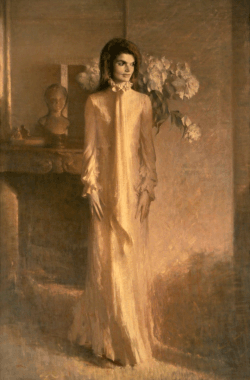
Jacqueline Kennedy is particularly remembered for her dedication to the arts and her extensive effort to redecorate and restore the White House to its historical glory.
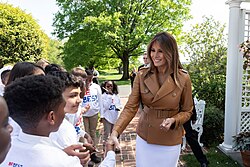
Melania Trump's "Be Best" initiative focused on cyberbullying awareness, foster care reforms, and raising awareness regarding deepfakes and non-consensual intimate imagery.
The First Ladies Collection
The history of these women is preserved at the Smithsonian Institution. Established in 1912, the First Ladies Collection was one of the first Smithsonian exhibitions to prominently feature women. While it began with a focus on fashion, it has expanded to explore the contributions of First Ladies to American society.
The current exhibition, which opened in November 2011, features over 160 objects—including 26 dresses—ranging from the era of Martha Washington to Melania Trump, alongside personal possessions and White House china.
Non-Spouses and Future Titles
The role has occasionally been filled by non-spouses, such as Harriet Lane. Additionally, the emergence of female elected officials has led to new terminology. In 2021, Doug Emhoff became the first male spouse of a nationally elected officeholder as the Second Gentleman of the United States. This precedent suggests that any future male spouse of a president would likely be titled the First Gentleman.
Frequently Asked Questions
Is the First Lady an official government employee?
No. The role of the First Lady is neither elected nor appointed and is not a formal position within the United States Government. It is primarily a ceremonial role.
Who was the first person to be called "First Lady" while in office?
Harriet Lane, the niece of President James Buchanan, was the first to have the title applied to her in print while she was serving as the White House hostess in 1860.
What does the abbreviation FLOTUS stand for?
FLOTUS is an abbreviation for "First Lady of the United States." It was first used in 1983 by Donnie Radcliffe in The Washington Post.
Can a man hold the title of First Lady?
While the traditional title is "First Lady," the precedent set by Doug Emhoff as "Second Gentleman" indicates that a male spouse of a president would likely be referred to as the "First Gentleman."
Where can the public see artifacts from past First Ladies?
The Smithsonian Institution's National Museum of American History houses the First Ladies Collection, which features dresses, personal items, and White House china.