R. Dale Reed: The Pioneer of NASA Lifting Body Aircraft
The evolution of modern aerospace design owes a significant debt to R. Dale Reed, an aerospace engineer whose vision challenged the fundamental assumption that aircraft require wings to fly. Throughout his tenure at NASA's Dryden Flight Research Center, Reed pioneered the development of lifting bodies—aircraft that generate lift from the shape of their fuselage rather than from traditional wings—and advanced the field of remotely piloted research aircraft.
Key Facts
- Primary Contribution: Pioneered lifting body and remotely piloted research aircraft for NASA.
- Notable Project: Led the development of the M2-F1, the first lifting body at the Flight Research Center.
- Career Scope: Managed 19 projects and designed 12 aircraft.
- Education: Degree in mechanical engineering from the University of Idaho.
- NASA Tenure: Joined in 1953; retired in 1985, later returning as a contract engineer.
Early Life and Education
Born on February 20, 1930, Robert Dale Reed's fascination with aviation began at the age of 12. While attending high school in Hailey, Idaho, he received foundational aeronautics instruction from his physics and chemistry teacher, Mr. Kinney. By age 16, Reed began practical flight training in an Aeronca Defender L-3 under the guidance of local pilot Bob Silveria.
Reed pursued higher education at the University of Idaho in Moscow. Although the institution did not offer a specific degree in aeronautical engineering, he earned a degree in mechanical engineering while supplementing his studies with every available aeronautics course.
Professional Career at NASA
The Formative Years (1950s)
Reed joined NASA's Dryden Flight Research Center in 1953. His early work focused on the critical measurement of aerodynamic loads—the forces exerted by air on a moving object. Using gauges, accelerometers, and gyros, he analyzed the control surfaces of several high-profile aircraft, including the Bell X-5. His research contributions extended to other experimental vehicles such as the X-1E, F-100A, D-558-11, and the X-15.
The Birth of Wingless Flight (1960s)
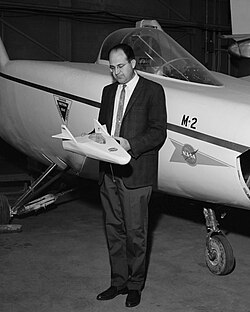
In 1962, Reed began exploring wingless flight concepts, initiating collaborations with engineers at NASA's Ames and Langley research centers. Facing skepticism from the broader industry, Reed took a hands-on approach to prove his theories. He constructed a free-flight scale model featuring a half-cone configuration, which served as the technical foundation for the M2-F1.
To move the M2-F1 from a model to a full-scale piloted program, Reed partnered with research engineer Dick Eldredge. Together, they designed a piloted glider based on their successful balsa-wood models. After convincing NASA research pilot Milt Thompson to serve as the primary test pilot, the team secured authorization from Flight Research Center director Paul Bikle to build the full-scale prototype.
Later Contributions and Retirement
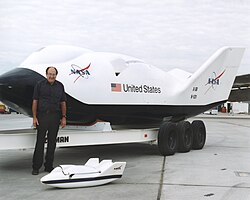
Reed officially retired from NASA in 1985, having earned four prestigious awards, including the Exceptional Service Medal and an Associate Fellow Award. However, his expertise remained in demand. He returned as a contract aerospace engineer to contribute to the X-33, X-36, and X-38 research vehicles. Notably, two of these projects utilized the lifting body configurations he had helped pioneer decades earlier.
Career Summary
| Category | Details |
|---|---|
| Total Projects Managed | 19 |
| Aircraft Designed | 12 |
| Key Aircraft/Vehicles | M2-F1, X-33, X-36, X-38, Bell X-5, X-15 |
| Specialization | Lifting bodies and remotely piloted aircraft |
| NASA Awards | 4 (including Exceptional Service Medal) |
Frequently Asked Questions
What is a lifting body aircraft?
A lifting body is a type of aircraft that generates lift from the shape of its main fuselage (the body) rather than relying on separate wings.
What was the significance of the M2-F1?
The M2-F1 was the first lifting body developed at the NASA Flight Research Center, proving that wingless flight was viable through the use of a half-cone configuration.
Which NASA research vehicles did Reed work on after retirement?
After retiring in 1985, Reed returned as a contract engineer to work on the X-33, X-36, and X-38 research vehicles.
Where did R. Dale Reed study engineering?
He studied mechanical engineering at the University of Idaho in Moscow, Idaho, where he took as many aeronautics courses as possible.
How many aircraft did R. Dale Reed design during his career?
Over the course of his career, R. Dale Reed designed a dozen aircraft and managed a total of 19 projects.