Purchasing Power Parity: Measuring Global Economic Value
When comparing the wealth of nations, looking at simple currency exchange rates often tells only half the story. A dollar in New York does not buy the same amount of goods as a dollar's equivalent in Mumbai or Hong Kong. To solve this discrepancy, economists use Purchasing Power Parity (PPP), a metric that measures the relative price of specific goods across different countries to determine the absolute purchasing power of their currencies.
At its core, PPP is the ratio of the price of a specific "market basket" of goods in one location divided by the price of that same basket in another. While market exchange rates fluctuate based on trade and speculation, PPP focuses on the actual cost of living and the real value of money in local markets.
Key Facts
- Core Principle: Based on the "law of one price," which suggests identical goods should cost the same globally if there are no trade barriers.
- GDP Impact: PPP can drastically change GDP figures; for example, India's GDP per capita is significantly higher on a PPP basis than on a nominal basis.
- The Basket Approach: To avoid errors from single-item price spikes, organizations like the OECD use baskets containing thousands of goods and services.
- International Dollar: The Geary–Khamis dollar (GK dollar) is a common adjustment used to create a hypothetical currency for global comparison.
The Mechanics of PPP
The Law of One Price
PPP is rooted in the law of one price. This theory posits that in an efficient market without transaction costs or tariffs, a product—such as a computer—should cost the same in New York as it does in Hong Kong. If a computer costs $500 in New York and 2,000 HK dollars in Hong Kong, the PPP exchange rate would be 4 HK dollars per 1 US dollar.
The Market Basket Method
In reality, frictions like transportation costs, tariffs, and poverty prevent a single good from being a perfect measure. To increase accuracy, economists use a basket of goods. By calculating the total cost of a diverse set of items (e.g., rice, steel, and electronics) in two different cities, they can derive a more stable inflation and exchange rate ratio.
The OECD employs a rigorous professional standard for this, using a final product list that covers approximately 3,000 consumer goods and services, 200 types of equipment, 30 government occupations, and 15 construction projects.
Comparing Global Economies
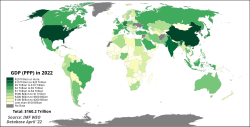
PPP is essential for comparing Gross Domestic Product (GDP), labor productivity, and individual consumption. The difference between nominal exchange rates and PPP can be stark. For instance, World Bank data from 2003 showed that one Geary–Khamis dollar was equivalent to about 1.8 Chinese yuan via PPP, a figure quite different from the nominal rate.
This discrepancy is evident in per capita GDP. In one historical comparison, India's nominal GDP per capita was approximately USD 1,965, but its PPP-adjusted figure rose to Int$7,197. Conversely, developed nations like Denmark may see their nominal GDP per capita (e.g., US$53,242) slightly decrease when adjusted to PPP (e.g., Int$46,602).
OECD Comparative Price Levels
The OECD tracks how many US dollars are required in various countries to purchase a basket of goods that costs $100 in the United States. This highlights the varying cost of living across member nations.
| Country | Price Level 2015 | Price Level 2024 |
|---|---|---|
| Australia | 123 | 96 |
| Switzerland | 162 | 127 |
| Japan | 96 | 69 |
| Turkey | 61 | 31 |
| United States | 100 | 100 |
Simplified PPP Indices
Because professional PPP calculations are complex, several "simplified" indices use a single product to illustrate the concept.
The Big Mac Index
Created by The Economist in 1986, this index uses a McDonald's Big Mac as the sole item in the basket. It helps identify if a currency is overvalued or undervalued. For example, if a Big Mac costs HK$20.00 in Hong Kong and US$5.58 in the US, the implied PPP is 3.58 HK$/US$. If the actual market rate is 7.83 HK$/US$, the Hong Kong dollar is considered undervalued.
The KFC and iPad Indices
The KFC Index was developed by Sagaci Research to measure PPP in African nations where McDonald's is less common, using a chicken bucket as the benchmark. Similarly, the iPad Index compares the price of the same hardware globally. Because iPads are largely identical in performance, price differences typically reflect taxes, transportation, and local market dynamics. In 2013, for example, an iPad cost roughly twice as much in Argentina as it did in the United States.
Challenges and Limitations
PPP is not without its flaws. Significant price differences in non-tradable goods—such as gasoline, which cost US$0.91 in Saudi Arabia versus US$6.27 in Norway in 2005—can skew results. Additionally, the quality of goods may vary between rich and poor nations, and trade barriers often prevent the "law of one price" from functioning perfectly.
Frequently Asked Questions
What is the difference between nominal GDP and PPP GDP?
Nominal GDP is calculated using current market exchange rates, while PPP GDP adjusts for the cost of living and inflation differences between countries, providing a more accurate reflection of real purchasing power.
Why is the Big Mac Index useful?
While not scientifically precise, the Big Mac Index provides an easy-to-understand way to visualize whether a currency is overvalued or undervalued relative to the US dollar.
Who is credited with developing the PPP concept?
While the idea dates back to the 16th-century School of Salamanca and was discussed by economists like Henry Thornton and Ludwig von Mises, Gustav Cassel is often credited with developing the modern PPP theory in the early 20th century.
What is a Geary–Khamis dollar?
Also known as the international dollar (Int$), it is a hypothetical currency unit used to compare the purchasing power of different nations on a standardized scale.
Why do some countries have a lower PPP price level than the US?
A lower price level (below 100 in OECD tables) indicates that the same basket of goods and services is cheaper in that country than it is in the United States.