Emerging Markets: Economic Definitions, Trends, and Global Impact
In the landscape of global finance, an emerging market (EM)—also known as an emerging economy or country—represents a society that possesses some characteristics of a developed market but does not yet fully meet its rigorous standards. These economies are often in a state of transition, moving toward greater economic freedom and integration with the global marketplace.
While the term is widely used, it exists on a spectrum. On one end are frontier markets, which describe developing countries with smaller, riskier, or more illiquid capital markets than those found in emerging economies. On the other end are emerged markets, countries that have graduated from emerging status but have not yet reached the full technological and economic development of the world's most advanced nations.
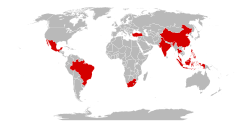
Key Facts
- Global Shift: The share of global PPP-adjusted GDP held by emerging markets rose from 27% in 1960 to approximately 53% by 2013.
- Dominant Players: As of 2025, China and India are considered the largest emerging markets.
- Investment Growth: Emerging market hedge fund capital hit a record $121 billion in the first quarter of 2011.
- Income Threshold: Intermediate income is often defined as PPP per capita income between 10% and 75% of the average EU per capita income.
Defining the Emerging Economy
The terminology used to describe these nations has evolved significantly. In the 1970s, the term "less developed countries" (LDCs) was common. However, this was replaced by "emerging market" to better reflect the potential for growth, though critics note that economic progress is not guaranteed and some countries can regress from developed to less developed status.
Diverse Perspectives on Development
Different institutions define emerging markets through various lenses:
- Sociopolitical Transition: Some define it as a society transitioning from a dictatorship to a free-market economy with an expanding middle class and improving standards of living.
- Informationalization: The Center for Knowledge Societies describes them as regions experiencing rapid informationalization despite limited industrialization.
- Financial Capitalism: Some scholars argue that "emerging finance capitalism" describes an era where the interests of financial capital shape government choices more than the needs of labor or the general public.
Major Emerging Economies and Classifications
The identification of emerging markets often varies by organization. The BRICS (Brazil, Russia, India, China, and South Africa) are among the most prominent. Other significant economies include Mexico, Indonesia, Turkey, Saudi Arabia, and Poland.
However, classifications are often debated. For instance, the IMF and World Bank no longer consider South Korea and Taiwan as emerging markets, though they frequently appear on other lists. If these are excluded, countries like Argentina and Thailand often move into the top ten.
Alternative Groupings
To provide more nuance, analysts have created specialized categories:
- EAGLEs: Introduced by BBVA Research, "Emerging and Growth-leading Economies" are those whose expected incremental GDP over ten years is larger than the average of the G7 (excluding the US).
- 3G (Global Growth Generators): A Citigroup classification for countries with the most promising growth prospects for 2010–2050, including Indonesia, Egypt, Iraq, and Mongolia.
- E20+1: A grouping of the top 20 emerging economies plus China, based on nominal GDP per capita, poverty levels, and share in global trade.
Investing in Emerging Markets
Investment in these regions is not a new phenomenon, dating back to the mid-1800s with the Foreign and Colonial Investment Trust (FCIT). Pioneers like John Maynard Keynes in the 1930s and John Templeton in the 1950s and '60s also focused heavily on these stocks.
Today, individual investors typically access these markets through:
- Global Funds: Diversified funds that include emerging market assets.
- ADRs (American Depositary Receipts): Stocks of foreign companies that trade on US exchanges.
- ETFs (Exchange Traded Funds): Baskets of stocks focused on a specific country (e.g., India) or region (e.g., Latin America).
Economic Projections and Data
The following table provides the projected GDP (PPP) for the largest emerging economies for 2026. Bolded entries indicate members of BRICS, BRICS Partners, or the New Development Bank.
| Rank | Country | Continent | GDP (PPP) Millions USD |
|---|---|---|---|
| 1 | China | Asia | 44,295,453 |
| 2 | India | Asia | 18,902,320 |
| 3 | Russia | Europe/Asia | 7,525,159 |
| 4 | Indonesia | Asia/Oceania | 5,449,145 |
| 5 | Brazil | South America | 5,229,586 |
| 6 | Turkey | Asia/Europe | 4,025,249 |
| 7 | Mexico | North America | 3,580,952 |
| 8 | South Korea | Asia | 3,542,014 |
| 9 | Saudi Arabia | Asia | 2,894,592 |
| 10 | Egypt | Africa/Asia | 2,566,688 |
Frequently Asked Questions
What is the difference between an emerging market and a frontier market?
Emerging markets have some characteristics of developed markets and are generally more stable. Frontier markets are developing countries with smaller, riskier, and less liquid capital markets.
What are the BRICS countries?
BRICS is an acronym for five major emerging economies: Brazil, Russia, India, China, and South Africa.
How can an individual investor buy stocks in an emerging market?
Investors can use American Depositary Receipts (ADRs) to buy foreign stocks on US exchanges, or invest in Exchange Traded Funds (ETFs) and global mutual funds.
What is an "emerged market"?
An emerged market is a country that has transitioned out of emerging status but has not yet reached the full economic and technological level of a fully developed country.
What is the EMBI Global index?
The Emerging Market Bond Index Global, created by J.P. Morgan, is a comprehensive index that tracks USD-denominated sovereign and quasi-sovereign bonds from emerging markets.