BRICS: The Evolution of a Global Economic and Political Powerhouse
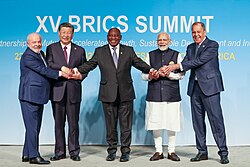
BRICS is an intergovernmental organization composed of several of the world's leading emerging economies. Originally formed to foster economic and political cooperation among a small group of influential nations, the bloc has evolved into a significant force in international politics, challenging traditional global power structures and promoting a more multipolar world order.
The organization is named after the initials of its five founding members: Brazil, Russia, India, China, and South Africa. Since its inception, BRICS has expanded its membership and developed its own financial architecture to reduce reliance on Western-led institutions.
Key Facts
- Founded: June 16, 2009, in Yekaterinburg, Russia.
- Current Members: Brazil, China, Egypt, Ethiopia, India, Indonesia, Iran, Russia, South Africa, and the United Arab Emirates.
- Current Chairman: Narendra Modi, Prime Minister of India.
- Primary Purpose: Economic and political cooperation among emerging powers.
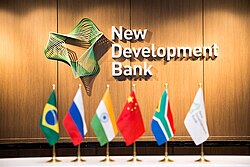
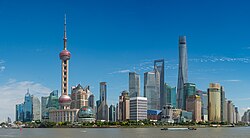
- Financial Pillar: The New Development Bank (NDB), headquartered in Shanghai.
The History and Expansion of BRICS
The bloc began as "BRIC" before South Africa joined in December 2010, adding the "S" to the acronym. The organization operates through a rotating presidency, with leaders meeting annually at summits to issue joint declarations and set strategic goals.
In recent years, the organization has undergone significant expansion to include more nations from the Global South. Notable additions occurred in January 2024 with the inclusion of Egypt, Ethiopia, and Iran, followed by Indonesia joining as a full member on January 6, 2025. While the bloc has grown rapidly, discussions regarding the 2026 presidency have indicated a more cautious approach toward further expansion.
Financial Architecture and Initiatives
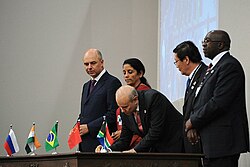
To support its members and provide alternatives to established global financial systems, BRICS has established several key mechanisms:
- New Development Bank (NDB): Established in 2014, the NDB provides loans for infrastructure and sustainable development projects.
- Contingent Reserve Arrangement (CRA): A framework designed to protect member states from global liquidity pressures and currency volatility.
- BRICS PAY: A distributed payment messaging mechanism intended to facilitate trade and reduce dependence on traditional systems like SWIFT.
![The New Development Bank, headquartered in Shanghai, China, is the premier institution of BRICS.[28]](/images/18/19/18198cf3987541eb5a2e8d4b56b98d426cbfaf78bb1f9c93cd0f59c88a2f3ab1.jpg)
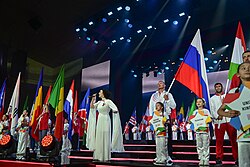
Beyond finance, the bloc engages in diverse fields including the BRICS Games, a multi-sport event, and the BRICS Universities League, a consortium of research institutions.
BRICS vs. G7: A Comparative Analysis
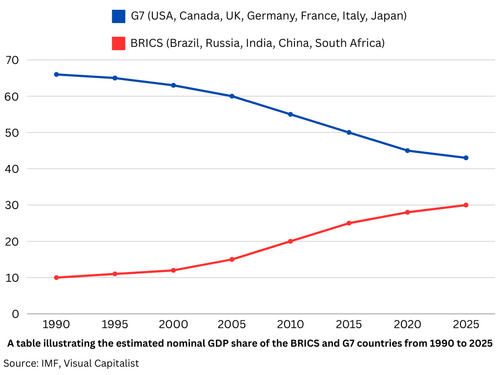
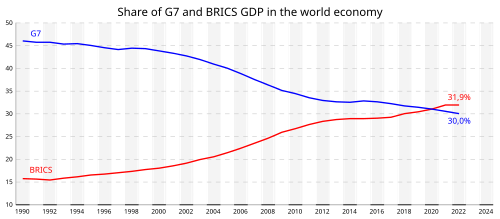
The growth of BRICS is often measured against the G7 (Group of Seven), the forum of the world's most advanced economies. While the G7 maintains a higher nominal GDP and Human Development Index (HDI), BRICS leads in terms of total land area, population, and GDP growth rates.
As of 2022, the G7 held a 43.7% share of nominal global GDP, while BRICS+ accounted for 28.7%.
| Parameter | BRICS | G7 |
|---|---|---|
| Number of Countries | 5 (Founding) | 7 |
| Total Area (km) | 39.7 million | 21.7 million |
| Population | 3.3 billion | 0.8 billion |
| GDP Growth Rate | 4% to 5% | 1.5% to 2% |
| Nominal GDP (USD) | 26.7 trillion | 45.3 trillion |
| GDP PPP (USD) | 51.6 trillion | 48 trillion |
| Military Expenditures (USD) | 0.48 trillion | 1.20 trillion |
Recent Diplomatic Milestones
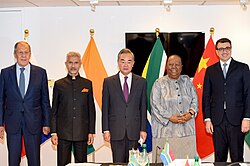
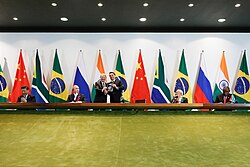
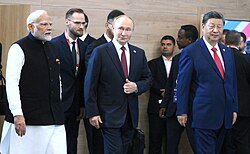
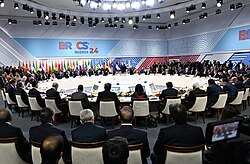
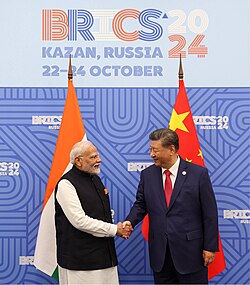
The 16th BRICS Summit, held in Kazan, Russia, in October 2024, served as a pivotal moment for the bloc, resulting in the Kazan Declaration. This summit highlighted the continued cooperation between major leaders, including Indian Prime Minister Narendra Modi, Russian President Vladimir Putin, and Chinese President Xi Jinping.
Looking forward, the 17th summit is scheduled for July 2025 in Rio de Janeiro, Brazil, followed by the 18th summit in India in September 2026.
Frequently Asked Questions
What does BRICS stand for?
BRICS is an acronym for the five original member states: Brazil, Russia, India, China, and South Africa.
What is the purpose of the New Development Bank?
The New Development Bank (NDB) is a multilateral development bank established to mobilize resources for infrastructure and sustainable development projects in BRICS and other emerging economies.
How does BRICS differ from the G7?
While the G7 consists of established advanced economies, BRICS focuses on emerging powers. BRICS has a significantly larger population and higher GDP growth rates, though the G7 currently maintains a higher total nominal GDP.
Which countries recently joined BRICS?
Egypt, Ethiopia, and Iran joined on January 1, 2024, and Indonesia became a full member on January 6, 2025.
Who is the current chairman of BRICS?
The current chairman is Narendra Modi, the Prime Minister of India.