GDP (PPP): Measuring Global Economic Power Through Purchasing Power Parity
When comparing the economic strength of different nations, a simple look at market exchange rates often fails to tell the whole story. To get a more accurate picture of a country's actual domestic market and the living standards of its people, economists use GDP (PPP)—Gross Domestic Product based on Purchasing Power Parity.
Unlike nominal GDP, which uses current market exchange rates, PPP adjusts for the relative cost of local goods and services. This allows for a "apples-to-apples" comparison by using the international dollar, a standardized unit that eliminates the distortions caused by inflation and currency fluctuations.
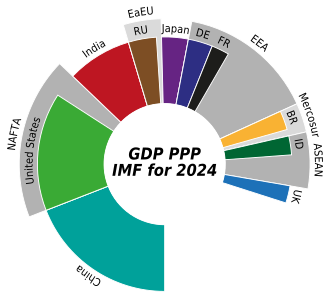
Key Facts
- PPP Adjustment: Accounts for local costs of living, making it more useful for assessing domestic markets than nominal GDP.
- International Dollar: The standardized unit used to compare economic output across different currencies.
- Broad Application: Used by the United Nations for the Human Development Index and to determine global poverty thresholds.
- Data Sources: Primary data is provided by the International Monetary Fund (IMF), the World Bank, and the CIA World Factbook.
- Scope: Includes 189 UN member states and various distinct economic entities like Hong Kong and Taiwan.
Nominal GDP vs. PPP: What is the Difference?
The primary difference between nominal GDP and GDP (PPP) lies in how they handle the cost of goods. Nominal GDP is calculated using international market exchange rates, which can be volatile and may not reflect the actual buying power within a country.
For example, consider the comparison between Germany and India. In nominal GDP rankings, Germany typically ranks higher. However, when adjusted for PPP, India's rank rises significantly while Germany's drops. This happens because the local cost of goods and services in India is lower; therefore, a single nominal dollar can purchase more in India than it can in Germany.
Limitations of PPP
While PPP is superior for measuring domestic consumption and poverty, it has limitations. It is less effective when measuring financial flows between countries (such as international trade or debt) and cannot account for differences in the quality of the same goods across different nations.
Global Economic Milestones
Tracking when countries hit specific GDP (PPP) thresholds provides insight into the shift of global economic power. The United States was the first to cross several major milestones, but in recent decades, China and India have seen rapid ascent.
| Threshold | United States | China | India | Japan |
|---|---|---|---|---|
| $1 Trillion | 1969 | 1991 | 1992 | 1980 |
| $2 Trillion | 1977 | 1995 | 2001 | 1988 |
| $3 Trillion | 1981 | 1999 | 2005 | 1996 |
| $5 Trillion | 1988 | 2004 | 2011 | 2015 |
| $10 Trillion | 2000 | 2009 | 2021 | N/A |
Data Sources and Methodology
Economic data is compiled from three primary institutional sources, each with slightly different scopes:
- International Monetary Fund (IMF): Covers 196 economies, including UN member states and areas like Aruba, Kosovo, and Puerto Rico.
- World Bank: Provides data for 180 UN member states and the Chinese Special Administrative Regions of Hong Kong and Macau.
- CIA World Factbook: Offers rebased data using International Comparison Program price surveys.
To ensure accuracy, these organizations use the International Comparison Program to estimate a representative "basket of goods," which includes both tradable and non-tradable items.
Frequently Asked Questions
Why is GDP (PPP) better for measuring poverty?
GDP (PPP) is more accurate for poverty measurement because it reflects the actual cost of living. Since basic necessities are cheaper in developing nations, PPP shows how much a person can actually afford to buy locally, rather than what their currency is worth on the global market.
What is an international dollar?
An international dollar is a hypothetical currency used by economists to create a common denominator for comparing GDP across countries with different price levels and currencies.
Does PPP include all types of goods?
Yes, surveys like the International Comparison Program include both tradable goods (like electronics) and non-tradable goods (like haircuts or local rent) to create a representative basket of all goods and services.
Which countries are currently the largest by GDP (PPP)?
Based on recent forecasts, China and the United States remain the dominant global economies, with India following closely as a major growth driver.
Can PPP be used to measure international trade?
No, PPP is limited when measuring financial flows between countries. For international trade, nominal GDP and market exchange rates are the appropriate metrics because goods are traded at market prices.