Province of Schleswig-Holstein
The Province of Schleswig-Holstein (German: Provinz Schleswig-Holstein) was a significant administrative territory of the Kingdom of Prussia from 1868 to 1918, and subsequently a province of the Free State of Prussia until 1946. Geographically, it spanned the region from the border of Denmark down to the lower course of the Elbe river and the state of Hamburg.
Its existence was marked by shifting borders, geopolitical conflicts between major European powers, and democratic plebiscites that ultimately redefined the national boundary between Germany and Denmark.
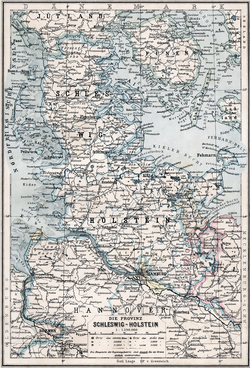
Key Facts
- Established: 1867 (annexed by decree); formally created as a province in 1868.
- Administrative Capitals: Kiel (1866–1879 and 1917–1946) and Schleswig (1879–1917).
- Territorial Changes: North Schleswig was ceded to Denmark in 1920 following public votes.
- Final Status: Disestablished in 1946 to become the modern German state of Schleswig-Holstein.
- Peak Population: Approximately 1,598,328 residents by 1939.
Founding and Early Prussian Rule
The province originated from the Duchies of Schleswig and Holstein. These territories were conquered from Denmark by the Kingdom of Prussia and the Austrian Empire during the Second War of Schleswig in 1864. Following the Austro-Prussian War of 1866, which resulted in an Austrian defeat, King Wilhelm I of Prussia annexed the territories by decree on January 12, 1867.
The formal province was established in 1868. Over the following decade, its borders expanded further when the Duchy of Lauenburg was incorporated into the province starting in 1876.
The 1920 Plebiscites and Border Shifts
Following the defeat of Imperial Germany in World War I, the Allied powers sought to determine the border between Germany and Denmark through democratic means. This led to two plebiscites (direct votes by the electorate) in northern and central Schleswig in February and March 1920.
- Northern Schleswig: 75% of voters chose reunification with Denmark, while 25% preferred to remain with Germany.
- Central Schleswig: 80% voted to stay with Germany, and 20% voted for Denmark.
- Southern Schleswig: No vote was held in the southern third of the region, as it was assumed the population would overwhelmingly choose Germany.
As a result, on June 15, 1920, northern Schleswig was officially reunited with Denmark. The remaining territory continued as a province of the Free State of Prussia.
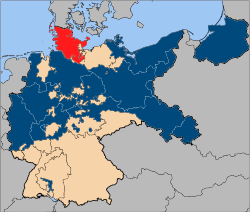
The Greater Hamburg Act and World War II
In 1937, the Greater Hamburg Act significantly reorganized the region's administrative boundaries. The Hanseatic City of Lübeck and the Oldenburgian exclave Region of Lübeck were integrated into the Province of Schleswig-Holstein. Conversely, several municipalities adjacent to Hamburg, including Altona and Wandsbek, were incorporated into the city of Hamburg. In exchange, Hamburg ceded the exclaves of Großhansdorf and Geesthacht to the province.
Following the end of World War II, the region fell under the British occupation zone. Some territorial adjustments occurred east of Ratzeburg, where municipalities were exchanged with Mecklenburg in the Soviet occupation zone under the Barber Lyashchenko Agreement.
Transition to a Modern State
The British-occupied territory was formally reorganized into the new German state of Schleswig-Holstein on August 23, 1946. This new state eventually joined the Federal Republic of Germany on May 23, 1949, marking the end of the Prussian provincial era.
Province Summary
| Metric/Event | 1914 Data | 1939 Data |
|---|---|---|
| Total Area | 19,004 km² | 15,682 km² |
| Total Population | 1,504,339 | 1,598,328 |
| Political Status | Kingdom of Prussia | Free State of Prussia |
| Primary Capital | Schleswig | Kiel |
Frequently Asked Questions
How was the Province of Schleswig-Holstein created?
It was created after Prussia and Austria conquered the Duchies of Schleswig and Holstein from Denmark in 1864. Following the Austro-Prussian War of 1866, King Wilhelm I annexed the territories by decree in 1867, and the province was formally established in 1868.
What happened to North Schleswig in 1920?
Following two plebiscites organized by the Allied powers, 75% of the population in northern Schleswig voted to reunite with Denmark. This transition became official on June 15, 1920.
What was the purpose of the Greater Hamburg Act of 1937?
The act reorganized boundaries between the province and the city of Hamburg. It incorporated Lübeck into the province and transferred municipalities like Altona and Wandsbek to Hamburg, while Hamburg ceded Geesthacht and Großhansdorf to the province.
Which cities served as the capital of the province?
The province had two capitals at different times: Kiel served as the capital from 1866 to 1879 and again from 1917 to 1946, while Schleswig served as the capital between 1879 and 1917.
When did the province cease to exist?
The province was disestablished in 1946. The British-occupied section became the modern German state of Schleswig-Holstein on August 23, 1946.