Province of Hanover
The Province of Hanover (German: Provinz Hannover) was a significant administrative territory within the Kingdom of Prussia and later the Free State of Prussia. Existing from 1866 to 1946, it served as a critical geopolitical entity in Northern Germany, bridging the gap between the former independent Kingdom of Hanover and the modern state of Lower Saxony.
Key Facts
- Existence: 1866 to 1946.
- Capital: Hanover.
- Area (1939): 38,705 km².
- Population (1939): 3,537,390.
- Preceded by: Kingdom of Hanover.
- Succeeded by: State of Hanover, later merged into Lower Saxony.
Historical Origins and Annexation
The province was born out of conflict during the Austro-Prussian War. While the Kingdom of Hanover initially attempted to remain neutral, it eventually voted on June 14, 1866, to mobilize confederation troops against Prussia. Prussia viewed this action as a declaration of war, leading to the swift dissolution and annexation of the Kingdom of Hanover.
Following the annexation, Otto von Bismarck utilized the private wealth of the dethroned House of Hanover to fund his ongoing political and military efforts against Ludwig II of Bavaria.
Administrative Evolution
Initially, the province was divided into six regions known as Landdrosteien (High-Bailiwicks). On April 1, 1885, these were reorganized into the Prussian standard Regierungsbezirke (governorates), which served as the primary regional administrative districts.
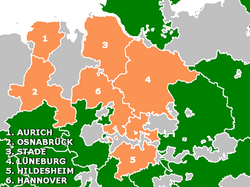
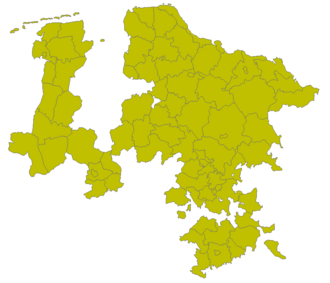
These governorates were further subdivided into Stadtkreise (urban counties) and Landkreise (rural counties), replacing the older Amt structure. This system allowed for more granular governance across the diverse landscapes of Northern Germany.
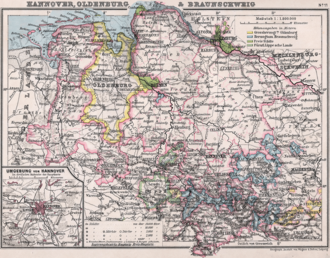
The Six Regierungsbezirke
The administrative landscape was split into the following districts:
- Aurich: Including urban centers like Emden and Wilhelmshaven.
- Hanover: The central hub, including the city of Hanover and surrounding rural counties.
- Hildesheim: Covering areas such as Göttingen and Goslar.
- Lüneburg: Including Celle and the Harburg region.
- Osnabrück: Centered around the city of Osnabrück and the Grafschaft Bentheim.
- Stade: Including Cuxhaven and Wesermünde.
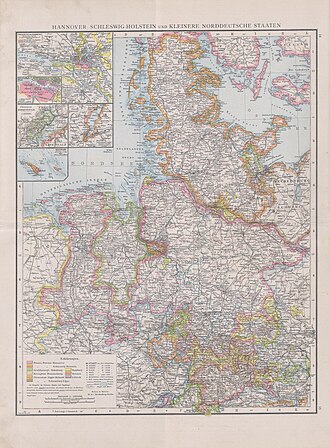
Provincial Governance
The province was led by an Oberpräsident (Upper President), who was appointed by the central Prussian government. While the Oberpräsident handled state-level directives, the Landesdirektor (provincial director) was elected by the Provinziallandtag (provincial parliament) to manage the provincial executive.
| Attribute | Detail |
|---|---|
| Total Area | 38,705 km² |
| Total Population | 3,537,390 |
| Administrative Center | Hanover |
| Primary Subdivisions | 6 Regierungsbezirke |
The End of the Province
The Province of Hanover ceased to exist in 1946. In August of that year, the British military administration recreated the State of Hanover. However, this was a short-lived arrangement; three months later, it was merged with the states of Oldenburg, Brunswick, and Schaumburg-Lippe to form the new Bundesland (federal state) of Lower Saxony, with Hanover remaining as the capital.
Frequently Asked Questions
Why was the Kingdom of Hanover annexed by Prussia?
Prussia annexed the Kingdom of Hanover after the latter voted to mobilize confederation troops against Prussia during the Austro-Prussian War in June 1866.
What were Regierungsbezirke?
Regierungsbezirke were regional administrative districts (governorates) introduced in 1885 to standardize the administration of the province, replacing the earlier Landdrosteien.
Who was the Oberpräsident?
The Oberpräsident was the head of the province, appointed directly by the central Prussian government to oversee provincial affairs.
What happened to the province after World War II?
In 1946, the British military administration briefly recreated the State of Hanover before merging it with Oldenburg, Brunswick, and Schaumburg-Lippe to create the modern state of Lower Saxony.
Which cities were designated as Stadtkreise?
Major urban centers such as Hanover, Emden, Osnabrück, Hildesheim, and Lüneburg were designated as Stadtkreise (urban counties) within their respective districts.