Protists: The Diverse Eukaryotic Foundation of Life
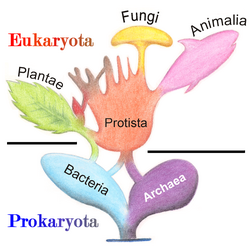
Protists represent one of the most diverse and complex groups of organisms on Earth. As eukaryotes—organisms with complex cells containing a nucleus and membrane-bound organelles—they encompass a vast array of life forms that do not fit into the kingdoms of animals, plants, or fungi. From microscopic single-celled hunters to giant multicellular algae, protists occupy nearly every moist habitat on the planet, serving as the evolutionary bridge from which all other complex life emerged.
Historically, the term "protist" was used as a convenient category for any eukaryote that wasn't a plant, animal, or fungus. However, modern science reveals that protists are not a single evolutionary lineage but a collection of several distinct supergroups, making them a paraphyletic group (a group that does not include all the descendants of a common ancestor).
Key Facts
- Domain: Eukaryota.
- Temporal Range: From the Paleoproterozoic era to the present.
- Diversity: Includes a massive range of forms, from unicellular organisms to complex multicellular algae.
- Ecological Roles: Act as primary producers, consumers, decomposers, and parasites.
- Evolutionary Significance: The ancestors of all land plants, animals, and fungi.
Classification and Evolutionary History
The classification of protists has evolved significantly since the 19th century. In 1866, Ernst Haeckel proposed the third kingdom, Protista, to accommodate organisms that didn't fit the binary of plants and animals.
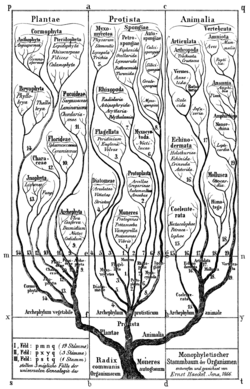
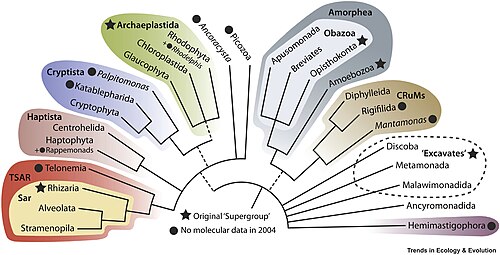
Today, phylogenomic analysis—the study of evolutionary relationships using entire genomes—has replaced simple morphological classification. Modern eukaryotes are divided into several major subdivisions, including:
- Amorphea: Including Amoebozoa and Obazoa (the group containing animals and fungi).
- Diaphoretickes: A massive group including Archaeplastida (ancestors of land plants), SAR (Stramenopiles, Alveolata, and Rhizaria), and others like Haptista and Telonemia.
- Discoba: Including Metamonada and Malawimonadida.
While many species have been catalogued, genetic diversity suggests that the actual number of protist species far exceeds those currently known to science.
![Difference between catalogued species (A) and genetic diversity (B) of eukaryotes. In the legend, "Archaeplastida" and "Opisthokonta" exclude Streptophyta, Animalia and Fungi.[97]](/images/e5/63/e563246f80ec8a7ab61017dfa458e285b06262b6546c840d006938b149989beb.png)
The Fossil Record
Protists appeared early in Earth's history, with stem-group eukaryotes appearing in the Paleoproterozoic. Vase-shaped microfossils from approximately 742 million years ago resemble modern testate amoebae, while Proterocladus and Bangiomorpha stand as some of the oldest known fossils of green and red algae, respectively.
Biology and Survival Strategies
Nutrition and Feeding
Protists employ a wide variety of nutritional strategies to survive in different environments:
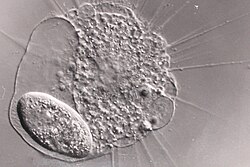
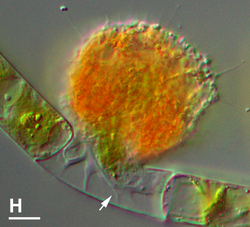
- Phagotrophy: The process of engulfing solid food particles. For example, the heliozoan Actinophrys sol uses this method to consume Paramecium ciliates.
- Osmotrophy: The absorption of dissolved organic compounds from the surrounding medium.
- Mixotrophy: A flexible strategy where an organism can switch between photosynthesis (autotrophy) and eating other organisms (heterotrophy).
Cellular Homeostasis and Organelles
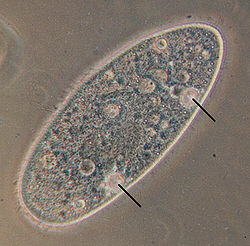
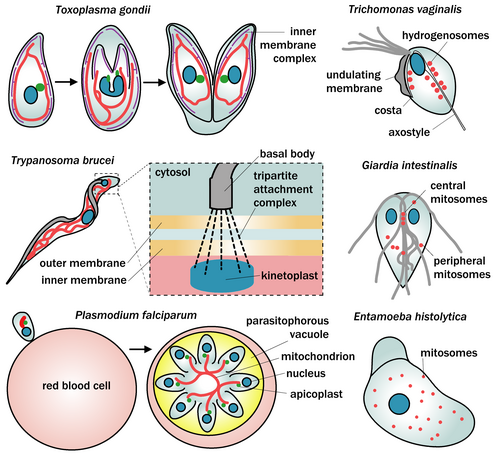
To maintain a stable internal environment, many protists use contractile vacuoles to pump out excess water, preventing the cell from bursting. Additionally, the diversity of mitochondria—the cell's powerhouses—varies wildly across different protist lineages, reflecting their diverse metabolic needs.
Sensory Perception and Symbiosis
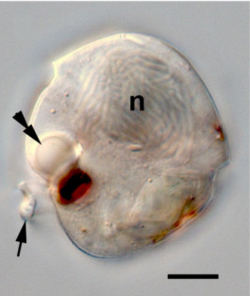
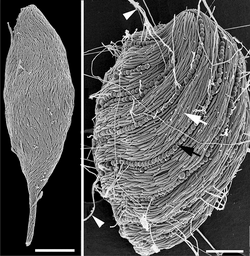
Some protists possess highly specialized structures for sensing their environment, such as the ocelloid found in certain dinoflagellates, which functions similarly to a complex eye. Many also form symbiotic relationships; some host epibiotic bacteria on their surfaces, while others live inside larger hosts.
Life Cycles and Reproduction
Protists exhibit a complex array of reproductive strategies. Asexual reproduction is common, allowing for rapid population growth. However, sexual reproduction is critical for genetic diversity.
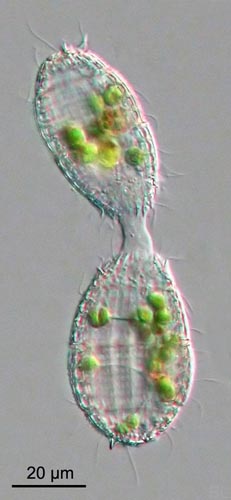
In some ciliates, a process called conjugation occurs, where two individuals join via a cytoplasmic bridge to exchange haploid nuclei. The overall life cycle can vary between haploid-dominant, diploid-dominant, or a full haplo-diploid cycle.
![Consensus life cycle of free-living protists, showing the ploidy (n) at each stage.[e] Purple arrows represent a full haplo-diploid cycle, while the green and blue arrows represent the variations present in the haploid (meiosis immediately after syngamy) and the diploid (syngamy immediately after meiosis) cycles, respectively. Vegetative reproduction is shown in pink.](/images/3f/a8/3fa8b663ddc867aac9275c2de1fb4386b0449d97f53dab5acd83943ea6f079a0.webp)
Ecological Impact
Protists are fundamental to the Earth's biogeochemical cycles. They operate in various ecological roles:
- Primary Producers: Algae provide a significant portion of the world's oxygen and form the base of aquatic food webs.
- Consumers: Predatory protists control bacterial and nematode populations in soil and water.
- Decomposers: They help break down organic matter, recycling nutrients back into the ecosystem.
- Parasites: Some protists are pathogens, causing diseases in plants, animals, and humans.
![Diagram of the soil food web, taking into account the diverse roles of protists as not just bacterivores, but also mycophages and omnivores.[127] Arrows show the flow of nutrients.](/images/2a/49/2a49e839514f8611f1228528434e1430c134cba317df096c8dbbfbaf1eeac295.webp)
| Feature | Description | Examples/Details |
|---|---|---|
| Cell Type | Eukaryotic | Nucleus and membrane-bound organelles |
| Nutrition | Diverse | Phagotrophy, Osmotrophy, Mixotrophy |
| Reproduction | Mixed | Asexual fission, Sexual conjugation |
| Habitat | Ubiquitous | Freshwater, Marine, Soil, Extreme environments |
| Major Groups | Supergroups | SAR, Amorphea, Archaeplastida, Discoba |
Frequently Asked Questions
Are protists the same as bacteria?
No. Bacteria are prokaryotes, meaning they lack a nucleus and membrane-bound organelles. Protists are eukaryotes, possessing a complex cell structure similar to that of plants and animals.
Why are protists no longer considered a single kingdom?
Modern genetic sequencing has shown that protists are paraphyletic. This means they do not share a single exclusive common ancestor that isn't also an ancestor to plants, animals, or fungi. They are a collection of diverse lineages rather than one unified group.
What is mixotrophy?
Mixotrophy is a nutritional strategy where an organism can produce its own energy through photosynthesis (like a plant) but can also ingest food particles (like an animal) when light is unavailable or nutrients are scarce.
How do protists contribute to the environment?
Protists are essential for oxygen production (via algae), nutrient cycling in soil and water, and regulating the populations of other microorganisms through predation.
Can protists be harmful?
Yes, some protists are parasites and pathogens that can cause significant diseases in humans, animals, and plants.