Proclamation of the German Empire: The Birth of a Nation at Versailles
On January 18, 1871, a pivotal moment in European history unfolded within the opulent walls of the Palace of Versailles. The Proclamation of the German Empire, known in German as the Deutsche Reichsgründung, marked the formal unification of various German states into a single, powerful empire. This event was not merely a political formality but the culmination of years of strategic diplomacy and military conflict.
The unification was catalyzed by the joint victory of the German states during the Franco-Prussian War. Following the November Treaties of 1870, the southern states—including Bavaria, Württemberg, Baden, and Hesse-Darmstadt—joined the Prussian-led North German Confederation. By January 1, 1871, a new constitution came into force, officially extending the federal lands into the newly created German Empire.
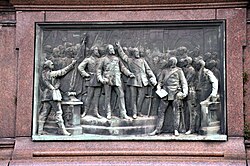
Key Facts
- Date: January 18, 1871.
- Location: Hall of Mirrors, Palace of Versailles, France.
- Key Figures: King Wilhelm I of Prussia and Minister-President Otto von Bismarck.
- Preceding Conflict: The Franco-Prussian War (1870–1871).
- Political Shift: Transition from the North German Confederation to the German Empire.
The Road to Unification
The "German Question" and the Exclusion of Austria
The path to a united Germany was complicated by the "German question": whether a unified state should include or exclude Austria. Otto von Bismarck, the Prussian minister president, argued that unification was only possible without Austria. He believed the Habsburg monarchy was too deeply tied to Slavic states in the Balkan peninsula to fit into a German-centric empire.
This tension led to the Austro-Prussian War of 1866. Following the Prussian victory at the Battle of Königgrätz and the subsequent Prague Treaty, the German Confederation (founded in 1815) was dissolved. In August 1866, Bismarck formed the North German Confederation as a military alliance, which evolved into a formal state with its own constitution a year later.
The Ems Dispatch and the Outbreak of War
Diplomatic tensions peaked in 1868 following the dethroning of Spanish Queen Isabella II. When Prince Leopold of Hohenzollern-Sigmaringen was proposed as a candidate for the Spanish throne, France viewed it as a threat. Despite the withdrawal of the candidacy, Emperor Napoleon III of France demanded a permanent renunciation of the Spanish throne by the Hohenzollern line.
The resulting diplomatic friction, famously encapsulated in the Ems Dispatch, led the French National Assembly to grant war funds. On July 19, 1870, the French Empire declared war on the Kingdom of Prussia. This declaration prompted the southern German states to honor their defensive alliances and side with Prussia.
The Ceremony at Versailles
Symbolism of the Venue
The choice of the Hall of Mirrors at the Palace of Versailles was deeply symbolic. The ceiling of the hall celebrated the conquests of Louis XIV, the "Sun King," over various German states. By proclaiming the empire here, while Paris was still under siege by coalition troops, the German leadership asserted a definitive victory over France.
The date, January 18, was also chosen to commemorate the 1701 coronation of Frederick I, which had established the Kingdom of Prussia.
The Proclamation Event
The ceremony began with German troops parading around the palace. Inside the Hall of Mirrors, delegations from field regiments displayed their battle-torn banners. Rather than a traditional throne, a field altar was used for a worship service, during which the participants sang Nun danket alle Gott (Now thank we all our God).
Otto von Bismarck read the proclamation from an elevated podium. The event reached its climax when Frederick I, Grand Duke of Baden, shouted, "His Majesty, Kaiser Wilhelm," a phrase repeated three times by the attendants. Notably, the term "Kaiser Wilhelm" was used instead of the formal constitutional title "German Emperor," as Wilhelm I was hesitant to accept the latter.
Historical Perspectives and Eyewitness Accounts
Contemporary accounts reveal a tension between modesty and grandeur. While some later historical narratives romanticized the event as a mythical union of all German tribes, eyewitnesses like soldier-historian Albert von Pfister noted the specific religious focus of the ceremony.
Interestingly, Bismarck and Wilhelm I had differing views on the event's tone. Wilhelm I viewed himself as a master of war triumphing alongside his faithful soldiers, treating the other German princes as equals. Bismarck, conversely, was critical of the Emperor's behavior, preferring a mood of religious retreat over a public display of victory.
| Category | Details |
|---|---|
| Official Date | January 18, 1871 |
| Primary Architect | Otto von Bismarck |
| First Emperor | Wilhelm I |
| Key Treaty | November Treaties of 1870 |
| Venue | Hall of Mirrors, Versailles |
Frequently Asked Questions
Why was the German Empire proclaimed in France?
The proclamation took place at the Palace of Versailles because it served as the headquarters for the German armies during the siege of Paris. Choosing the Hall of Mirrors was a symbolic act of victory over the French Empire.
What was the role of Otto von Bismarck in the unification?
Bismarck was the primary strategic driver. He orchestrated the exclusion of Austria from German affairs, formed the North German Confederation, and navigated the diplomatic crises that led to the Franco-Prussian War, which ultimately unified the northern and southern German states.
Why did Wilhelm I avoid the title "German Emperor"?
Wilhelm I was reluctant to accept the precise constitutional title of "German Emperor," preferring the more general term "Kaiser Wilhelm" during the ceremony.
Which states joined the empire in 1871?
The Prussian-dominated North German Confederation was joined by the southern states of Baden, Hesse-Darmstadt (territories south of the Main line), Württemberg, and Bavaria.
What was the significance of the Ems Dispatch?
The Ems Dispatch was a diplomatic communication that escalated tensions between Prussia and France regarding the Spanish throne, eventually provoking France to declare war on Prussia in July 1870.