Privatdozent: The Academic Title and Role in European Universities
In the complex landscape of European academia, particularly within German-speaking countries, the title of Privatdozent (for men) or Privatdozentin (for women) represents a significant milestone in a scholar's career. Abbreviated as PD, P.D., or Priv.-Doz., this title signifies that an individual has reached a level of academic maturity that grants them the formal right to teach and examine students at the highest university level.
At its core, the title is based on two legal and academic concepts: facultas docendi (the ability to teach) and venia legendi (the permission to lecture). To earn this distinction, a candidate must demonstrate excellence in research, teaching, and further education, meeting rigorous criteria set by their respective university.
Key Facts
- Definition: An academic title denoting the permission to teach and examine independently without holding a full professorial chair.
- Primary Requirement: Usually requires the completion of a habilitation (a higher doctoral degree).
- Employment Status: The title itself does not guarantee a salary or a tenured position.
- International Equivalents: Comparable in achievement to an Associate Professor (USA), Senior Lecturer (UK), or HDR holder (France).
- Maintenance: In Germany, the title may be revoked if the holder fails to lecture for more than two consecutive semesters.
Conferment and Academic Roles
A university faculty confers the title upon an academic who has typically completed a habilitation. It is important to distinguish between the title and an appointment. While a Privatdozent has the legal right to teach and examine, the title does not inherently come with a salaried position.
The professional reality for those holding the title varies significantly. Some are appointed as Senior Researchers or Dozents—either as tenured employees or on a fee-for-service basis. Others rely entirely on externally funded research projects to support themselves. In some cases, title holders are not employed by the university at all, yet they may still be required by local regulations to teach to maintain their status.
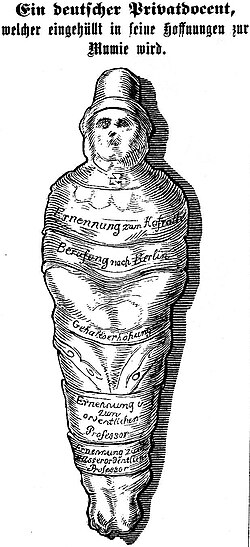
The financial precariousness of this role has been noted in academic discourse; for instance, in 2012, more than 5,000 honorarium Privatdozenten were working at German universities without a salary.
Historical Evolution
The origins of the Privatdozent date back to before 1800 in German-speaking regions. Historically, the term referred to a lecturer who was not paid a university salary but instead received fees directly from the students they taught.
In Prussia, the system began around 1810 and became firmly established by 1860. For several decades, from 1900 until 1968, the path to a full professorship almost exclusively required the holder to first be a Privatdozent, as the habilitation was the standard prerequisite for appointment.
Modern Shifts in Academia
Since the late 1960s, the necessity of a post-doctoral degree like the habilitation for professorships has been questioned. A major shift occurred in 2002 with the introduction of junior professorships. This new pathway allows academics to move toward a full professorship without completing a habilitation, meaning the habilitation is no longer the sole "gold standard" for appointments. Consequently, there has been a decline in the conferment of the Privatdozent title in certain academic disciplines.
Comparative Academic Standing
While the Privatdozent title indicates a high level of achievement, it differs from North American roles in terms of stability and authority. The following table provides a comparison of the title across different regions.
| Region/System | Comparable Role | Key Difference |
|---|---|---|
| Germany/Austria | Privatdozent (PD) | Not always linked to tenure or salary. |
| United States | Associate Professor | Usually a tenured position with PI status. |
| United Kingdom | Senior Lecturer | Typically a salaried employment contract. |
| France | Maître de conférences (HDR) | Based on the Habilitation à diriger des recherches. |
Frequently Asked Questions
What is the difference between a Privatdozent and a Professor?
A Privatdozent has the permission to teach and examine independently (venia legendi) but does not hold a full professorial chair or a guaranteed salaried appointment. A Professor typically holds a specific chair and a permanent employment contract.
Is a habilitation always required to become a Privatdozent?
Generally, yes. The title is usually conferred upon those who have completed a habilitation, which is a higher doctoral degree demonstrating the ability to conduct independent research and teach.
Can a Privatdozent lose their title?
Yes. In Germany, the title can be revoked if the holder does not lecture for more than two consecutive semesters. Additionally, the title ceases to be held if the person is appointed to a full professorship.
Do all Privatdozenten receive a salary from the university?
No. Many Privatdozenten are not salaried employees of the university. They may be supported by external grants, work as fee-based lecturers, or hold separate positions as Senior Researchers.
How has the role changed since 2002?
The introduction of junior professorships in 2002 created a route to full professorship that bypasses the habilitation process, leading to a decline in the use of the Privatdozent title in some fields.