Principality of Lippe: History, Governance, and Legacy
The Principality of Lippe was a sovereign state in Germany, ruled by the House of Lippe from its elevation to a principality in 1789 until the end of the monarchy in 1918. Situated between the Weser river and the southeastern reaches of the Teutoburg Forest, this region evolved from a medieval county into a constitutional monarchy, playing a distinct role within the complex tapestry of the German Empire.
The state's identity was shaped by its religious transitions—converting to Lutheranism in 1538 and later to Calvinism in 1604—and its gradual political modernization. While it remained largely agrarian and economically modest, its legal and administrative structures provided a stable foundation for its citizens until its eventual merger into the modern state of North Rhine-Westphalia in 1947.
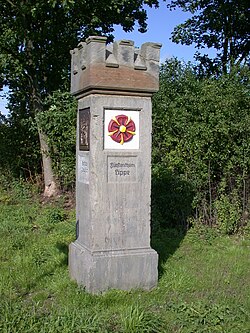
Key Facts
- Capital: Detmold
- Duration: 1789–1918 (as a Principality)
- Area: 1,215 km² (as of 1910)
- Population: Over 150,000 (as of 1910)
- Language: West Low German
- Final Ruler: Prince Leopold IV
The Evolution of Lippe: From County to Principality
The Early County (1123–1789)
The foundations of the state date back to 1123, when Bernhard I received a territorial grant from Lothair III, assuming the title of Edler Herr zu Lippe (Noble Lord at Lippe). The dynasty expanded significantly under Bernard II, who acquired lands following the collapse of the Duchy of Saxony in 1180. By 1528, Simon V became the first ruler to use the title of Count (Graf).
The county experienced several partitions, most notably in 1613 when it was split between the sons of Simon VI into the lines of Lippe-Detmold, Lippe-Brake, and Lippe-Alverdissen. Over time, these branches merged or evolved; the Lippe-Brake line reunited with Detmold in 1709, while the Lippe-Biesterfeld and Lippe-Weissenfeld lines existed as paragiums (non-sovereign estates of cadet branches) before eventually moving their primary residences outside the county.
The Princely Era (1789–1918)
In 1789, Leopold I was elevated to the status of Prince (Fürst), marking the official start of the Principality. Throughout the 19th century, Lippe navigated the shifting political tides of Europe, joining Napoleon's Confederation of the Rhine in 1807, the German Confederation in 1815, the North German Confederation in 1866, and finally becoming a federated state of the German Empire in 1871.
A significant period of instability occurred between 1895 and 1905 following the death of the childless Prince Woldemar. A succession dispute erupted between the House of Schaumburg-Lippe and the House of Lippe-Biesterfeld. Despite the support of Emperor Wilhelm II for the Schaumburg-Lippe claim, the Reichsgericht (Imperial Court) in Leipzig ruled in favor of the Lippe-Biesterfeld line. This conflict gained public attention when the regent, Ernest of Lippe-Biesterfeld, complained openly about the Emperor's lack of respect toward him.
Governance and Legal Structure
Lippe transitioned into a constitutional monarchy through a series of legal reforms. After a failed attempt in 1819, the first basic law was passed in 1836, establishing a Landtag (parliament) that granted the landed nobility moderate legislative power. The government was led by a cabinet headed by the State Minister, with the Regierungsollegium (governing college) serving as the top administrative authority.
In 1876, the state introduced a three-class franchise, which replaced the estates-based system but remained undemocratic. On the imperial stage, Lippe held a single representative in the Bundesrat (Federal Council), though it possessed little influence compared to the dominant Kingdom of Prussia.
Judicial Administration
The legal system of Lippe was often linked to neighboring regions. For much of the 19th century, it fell under the jurisdiction of courts in Wolfenbüttel and later Celle. By 1879, a treaty solidified its relationship with the Oberlandsgericht (supreme regional court) at Celle. Locally, the Detmold court district managed several district courts, including those in Lemgo, Salzuflen, and Blomberg.
Economy and Industry
Lippe was primarily an agrarian state, often regarded as one of the economically weakest members of the German Empire. Agriculture varied by geography: the loess floodplains of the Werre and Bega supported intensive farming, while the sandy soils of the Senne region were reserved for animal husbandry and the breeding of Senner horses.
Industrialization was slow, partly due to the conservative nature of the landed nobility and the monarchy's preference for direct income from their own estates, salt mines, and health baths. However, several key industries did emerge:
- Textiles: Flax farming and linen production were prominent.
- Specialized Manufacturing: Hoffmann's Stärkefabriken (starch factories) was a major industrial concern.
- Mining: Sepiolite extraction in Lemgo and salt evaporation in Salzuflen.
- Consumer Goods: A significant cigar industry and various breweries.
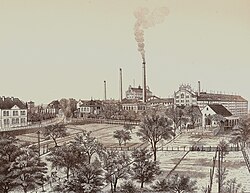
The arrival of the Lippe railway in 1880 and the Lippische branch line in 1895 provided critical connections to the Hamm–Minden railway, facilitating better trade and transport.
Military History
Lippe's military capacity was limited. While it formed a battalion in 1807 for the Confederation of the Rhine, it entered a military convention with Prussia in 1867. This effectively integrated Lippe's forces into the Prussian Army, specifically the 55th Infantry Regiment. By 1867, the distinct white-blue-red uniforms were replaced by Prussian uniforms, distinguished only by a yellow-red-yellow cockade.
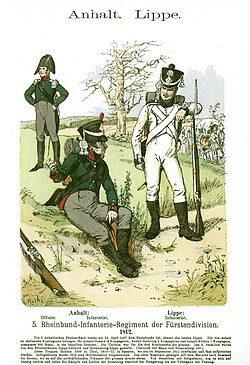
The state's military modesty became a point of local folklore, exemplified by the song "Lippe-Detmold, eine wunderschöne Stadt," which humorously suggests the army was so small that the death of a single soldier forced a general to abandon a campaign.
Summary of the Principality of Lippe
| Category | Details |
|---|---|
| Ruling House | House of Lippe |
| Political Status | Constitutional Monarchy (by 1918) |
| Economic Base | Agrarian, Salt, Timber, and Textiles |
| Key Cities | Detmold, Lemgo, Salzuflen, Lage |
| Successor State | Free State of Lippe (1918), then North Rhine-Westphalia (1947) |
Frequently Asked Questions
How did the Principality of Lippe end?
The principality ended on November 12, 1918, when Prince Leopold IV abdicated during the German Revolution. It subsequently became the Free State of Lippe before merging into North Rhine-Westphalia in 1947.
What was the cause of the succession dispute in the late 19th century?
The dispute arose after Prince Woldemar died childless in 1895. His brother Alexander was mentally ill and unable to rule, leading to a conflict between the House of Schaumburg-Lippe and the House of Lippe-Biesterfeld over who should hold the regency and the right to succeed.
What were the primary economic drivers of the region?
Lippe was overwhelmingly agrarian, focusing on intensive farming in floodplains and horse breeding in the Senne region. Industrial activity included salt production in Salzuflen, sepiolite in Lemgo, and the Hoffmann starch factories.
What was the role of the Bundesrat in Lippe's governance?
As a state of the German Empire, Lippe had one representative in the Bundesrat. However, because Prussia held 17 of the 58 seats, Lippe's influence in the federal council was practically irrelevant.
Which religious changes occurred in Lippe?
Lippe underwent two major religious shifts during the Reformation era: it first converted to Lutheranism in 1538 and later transitioned to Calvinism in 1604.