President of the Republic of Colombia
The President of the Republic of Colombia serves as the head of state, head of government, and commander-in-chief of the Military Forces of Colombia. As the leader of the executive branch, the president is the supreme administrative authority and a symbol of national unity, tasked with safeguarding the rights and liberties of all Colombian citizens.
The office was established on December 17, 1819, during the formation of Gran Colombia by the Congress of Angostura. Since then, the presidency has evolved from the foundational leadership of General Simón Bolívar into a central pillar of Colombian political life, seeing significant expansions of power in the early 20th century and again during the administration of Álvaro Uribe.
Key Facts
- Current President: Abelardo de la Espriella (assumed office August 7, 2026).
- Term Length: Four years, strictly non-renewable.
- Eligibility: Must be a natural-born citizen and at least 30 years old.
- Official Residence: Casa de Nariño in Bogotá, D.C.
- First Holder: Simón Bolívar (1819).
- Monthly Salary: 32,624,000 Colombian pesos (approximately US$ 6,847).
Executive Powers and Responsibilities
Commander-in-Chief
Under Article 189 of the Constitution, the president is the Supreme Commander of the Armed Forces. While the power to formally declare war is vested in Congress, the president holds ultimate responsibility for the direction and disposition of the public force.
Administrative Authority
The president leads the national government, which consists of the president, the vice president, the Council of Ministers, and the Directors of Administrative Departments. The executive branch is responsible for coordinating all administrative activities that serve the general interests of the community.
Foreign Affairs
The president possesses broad authority over foreign policy, including the exclusive power to recognize foreign governments and receive ambassadors. The president appoints Colombian ambassadors and negotiates international agreements which, upon advice from the minister of foreign affairs, carry the force of national law.
Judicial Oversight
The president is subject to the jurisdiction of the Supreme Court of Justice. In the event of a political trial, the Supreme Court acts as the primary body for judging the president or other senior officials for punishable acts.
Selection and Election Process
Eligibility and Nomination
To be eligible for the presidency, a candidate must be a natural-born Colombian citizen and at least 30 years of age. Most candidates are lawyers by profession. The process typically begins with party primaries to select a nominee, who then chooses a running mate for the vice presidency.
Election and Term Limits
The president and vice president are elected via universal suffrage for a four-year term. The rules regarding reelection have shifted over time: from 1910 to 2005, a single term was the limit; a 2005 law briefly allowed a second term; however, a 2015 constitutional amendment reverted the office to a strict one-term limit. No person who has served as president can be elected to a second term, even non-consecutively.
Inauguration
Inaugurations take place every four years on August 7, coinciding with the anniversary of the Battle of Boyacá. A central symbol of the office is the presidential sash, which features the colors of the national flag and the coat of arms in the center.
Incumbency and Presidential Logistics
Official Residences
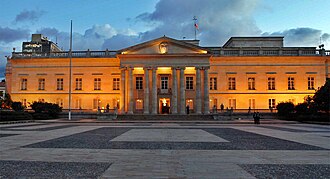
The primary residence and seat of power is the Casa de Nariño in Bogotá. This site evolved from the birth home of Antonio Nariño into the current palace. Additionally, the president utilizes the House of Illustrious Guests in Cartagena for international visitors and the Hato Grande country estate in Sopó for rest.
Transportation and Security
For official travel, the president uses a Boeing 737 Business Jet (registration FAC 0001) and VIP-configured helicopters, including a Bell 412 and a UH-60 Black Hawk.

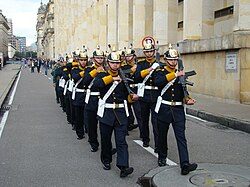
Security is provided by the Presidential Guard, a specialized battalion of the National Army established in 1927. This unit is responsible for the safety of the president, their family, and the Casa de Nariño.
Summary of the Colombian Presidency
| Feature | Details |
|---|---|
| Constitutional Basis | Constitution of Colombia (1991) |
| Term Length | 4 Years (Non-renewable) |
| Election Method | Popular Vote / Universal Suffrage |
| Primary Residence | Casa de Nariño, Bogotá |
| Key Roles | Head of State, Head of Government, Commander-in-Chief |
| Official Aircraft | Boeing 737 Business Jet (FAC 0001) |
Frequently Asked Questions
Can a Colombian president be re-elected?
No. Following a constitutional amendment in 2015, the president is barred from running for reelection, including non-consecutive terms.
Who is the current president of Colombia?
As of August 7, 2026, the current president is Abelardo de la Espriella.
What are the requirements to become president?
A candidate must be a natural-born citizen of Colombia and be at least 30 years of age.
What is the role of the Presidential Guard?
The Presidential Guard is a specialized National Army battalion responsible for the security of the president, the president's family, and the official residence at Casa de Nariño.
How is the president held accountable legally?
The Supreme Court of Justice is the body responsible for judging the president in the event of a political trial or for punishable acts.