Juan Manuel Santos: The Nobel Peace Prize-Winning President of Colombia
Juan Manuel Santos Calderón is a distinguished Colombian politician and diplomat who served as the 33rd President of Colombia from 2010 to 2018. His tenure is most notably defined by his resolute efforts to end one of the longest-running civil conflicts in the Western Hemisphere, an achievement that earned him the 2016 Nobel Peace Prize as the sole recipient.
Born on August 10, 1951, in Bogotá, Santos possesses a deep academic background with degrees from the University of Kansas (BA), the London School of Economics (MSc), and Harvard University (MPA). His early life included a period of military service in the Colombian Navy from 1967 to 1971, where he graduated from the Admiral Padilla Naval Cadet School.
Key Facts
- Presidency: Served as President of Colombia from August 7, 2010, to August 7, 2018.
- Nobel Peace Prize: Awarded the prize in 2016 for ending the 50-year civil war with the FARC.
- Ministerial Roles: Held portfolios for Foreign Trade, Finance and Public Credit, and National Defence.
- Military Background: Served as a naval cadet in the Colombian Navy (1967–1971).
- International Leadership: Served as President pro tempore of the Pacific Alliance.
Early Political Career and Ministerial Appointments
Santos began his ascent in Colombian governance through a series of high-level ministerial appointments under different administrations. In 1991, President César Gaviria appointed him as Colombia's first Minister of Foreign Trade, a role he held until 1994. During this period, he also served as the Presidential Designate of Colombia from 1993 to 1994 and presided over the VIII United Nations Conference on Trade and Development in 1992.
His expertise in economic management led President Andrés Pastrana Arango to appoint him as the 64th Minister of Finance and Public Credit, where he served from 2000 to 2002.
Minister of National Defence
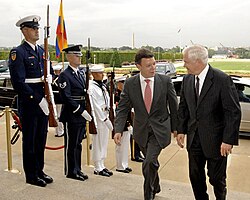
From July 18, 2006, to May 18, 2009, Santos served as the Minister of National Defence under President Álvaro Uribe. His resignation in May 2009 became a pivotal moment in Colombian politics; while he initially expressed support for Uribe's potential third term, the Constitutional Court's ruling against such a bid cleared the way for Santos to launch his own presidential campaign.
The Presidency (2010–2018)
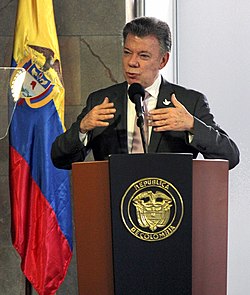
Juan Manuel Santos was officially elected President on June 20, 2010, and inaugurated on August 7, 2010. His presidency began amidst a diplomatic crisis with Venezuela, which was resolved shortly after his taking office.
The defining achievement of his presidency was the negotiation of a peace agreement with the FARC (Revolutionary Armed Forces of Colombia). This conflict had lasted over 50 years, resulting in at least 220,000 deaths and the displacement of nearly six million people. His commitment to this peace process was recognized globally, culminating in the 2016 Nobel Peace Prize.
International Relations and Challenges
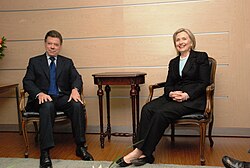
Santos maintained strong ties with the United States. In May 2017, during a joint news conference at the White House, President Donald Trump praised Colombia's efforts to end its civil war. Beyond the U.S., Santos played a key role in the Pacific Alliance, serving as its President pro tempore.
However, his administration faced controversies. In March 2017, Santos acknowledged that his 2010 campaign had received illegal payments from the Brazilian conglomerate Odebrecht. He was also mentioned in the Paradise Papers regarding offshore firms, though he stated he had left the firm listed in those documents.
Summary of Political Tenure
| Role | Period | Appointing President / Context |
|---|---|---|
| Minister of Foreign Trade | 1991–1994 | César Gaviria |
| Presidential Designate | 1993–1994 | César Gaviria |
| Minister of Finance and Public Credit | 2000–2002 | Andrés Pastrana Arango |
| Minister of National Defence | 2006–2009 | Álvaro Uribe |
| President of Colombia | 2010–2018 | Elected |
Frequently Asked Questions
Why did Juan Manuel Santos win the Nobel Peace Prize?
He was awarded the prize in 2016 for his resolute efforts to bring Colombia's more than 50-year-long civil war to an end, a conflict that cost the lives of at least 220,000 people.
What was Santos's military background?
Santos served in the Colombian Navy from 1967 to 1971, graduating from the Admiral Padilla Naval Cadet School in 1969.
Which political parties was he affiliated with?
Santos was affiliated with the Liberal Party until 2005, after which he joined the Social Party of National Unity.
What academic institutions did he attend?
He holds a BA from the University of Kansas, an MSc from the London School of Economics, and an MPA from Harvard University.
Did Juan Manuel Santos face any legal or ethical controversies?
Yes, he acknowledged that his 2010 presidential campaign received illegal payments from the Brazilian company Odebrecht and was linked to offshore firms in the Paradise Papers.