President of Malta
The President of Malta (Maltese: President ta' Malta) serves as the constitutional head of state for the Republic of Malta. While the president presides over the three branches of state and holds nominal executive authority, practical executive power is exercised by the prime minister. The office is designed to ensure stability and the preservation of the nation's legal framework.
Key Facts
- Incumbent: Myriam Spiteri Debono (since 4 April 2024).
- Term Length: Five years, non-renewable.
- Appointment: Indirectly elected by the House of Representatives.
- Official Residence: San Anton Palace.
- Annual Salary: €88,218.
- Established: 13 December 1974.
Establishment and Qualifications
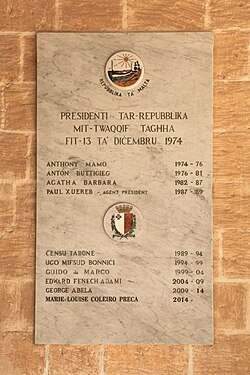
The office was created on 13 December 1974, marking Malta's transition to a republic within the Commonwealth of Nations. This change ended the reign of Queen Elizabeth II as the head of state. Sir Anthony Mamo, the final governor-general, became the inaugural president.
To be eligible for appointment, a candidate must meet specific constitutional criteria. A person is disqualified if they are not a citizen of Malta, if they have served as the Chief Justice or any other judge of the Superior Courts, or if they are ineligible for other specific public offices as defined by Articles 109, 118, and 120 of the Constitution.
Assumption of Office
Before taking office, the nominee must swear an oath before the House of Representatives. They pledge to faithfully execute their functions and to "preserve, protect and defend" the Constitution of Malta.
Roles and Responsibilities
The president's duties are a blend of ceremonial leadership and constitutional oversight. While many actions require the assent of the prime minister, the president remains a critical figure in the state's operation.
Constitutional and Executive Powers
- Legislative: The president promulgates laws and may dissolve the House of Representatives upon the prime minister's request or following a no-confidence motion.
- Appointments: The president appoints the prime minister based on the composition of the House of Representatives and appoints most members of constitutional bodies with the prime minister's assent.
- Judiciary: The president is responsible for appointing members of the judiciary.
- Diplomacy: The president receives foreign ambassadors and represents the state.
- Legal Mercy: Acting on the advice of the Cabinet or a delegated minister, the president may grant pardons (though not amnesties) or remit sentences.
Ex Officio Roles
The president holds several automatic (ex officio) positions, including chairman of the Commission for the Administration of Justice of Malta and head of the Maltese honours system. Additionally, the president chairs the Malta Community Chest Fund, a charitable NGO, with their spouse serving as deputy chairperson.
The president also controls the recognition of all honours, awards, and decorations within Malta; no such title may be used unless authorized by the president and published in the Government Gazette.
Official Residences and Symbols
The president maintains several official locations. The Grandmaster's Palace in Valletta serves as the official office, while San Anton Palace in Attard is the official residence and de facto office. For summer stays, the president uses Verdala Palace at Buskett.
The presidential standard, a specific flag established on 12 December 1988, is flown at these residences and wherever the president is present. Prior to this date, the national flag served as the standard.
Constitutional Nuances and Vacancies
The Veto Anomaly
Under the Constitution of Malta, the president does not possess a formal legislative veto. They are expected to signify assent to bills without delay to ensure that a democratically elected government is not hindered by an official without a democratic mandate. However, a "veto anomaly" can occur if a president threatens resignation or refuses assent, potentially creating a constitutional crisis if the government lacks the two-thirds majority in Parliament required to remove the president.
Vacancies and Succession
If the president is absent, on leave, or unable to perform their duties, the prime minister appoints a substitute after consulting the leader of the opposition. If no such person is appointed, the speaker of the House of Representatives assumes the duties.
The office becomes vacant upon the president's resignation, death, the expiration of the five-year term, or removal by a two-thirds resolution of the House of Representatives due to misbehaviour or inability to perform duties. Notably, the office does not automatically become vacant after five years; the incumbent remains until a two-thirds majority resolution is passed in the House.
| Feature | Detail |
|---|---|
| Appointing Body | House of Representatives |
| Term | 5 Years (Non-renewable) |
| Primary Residence | San Anton Palace |
| Key Duty | Preserve, protect and defend the Constitution |
| Salary | €88,218 per annum |
Frequently Asked Questions
How is the President of Malta chosen?
The president is indirectly elected by the House of Representatives of Malta.
Can the President of Malta veto a law?
Constitutionally, the president has no legislative veto and is expected to assent to bills without delay. However, in practice, some presidents have used the threat of resignation to influence legislation, which can create a constitutional anomaly.
What happens if the President is unable to perform their duties?
The prime minister, after consulting the leader of the opposition, appoints an individual to perform the functions. If no one is appointed, the speaker of the House of Representatives takes over.
Who was the first President of Malta?
Sir Anthony Mamo became the first president on 13 December 1974, following Malta's transition to a republic.
Is the presidential term renewable?
No, the term length is five years and is non-renewable.