Eddie Fenech Adami: The Architect of Modern Malta
Edoardo "Eddie" Fenech Adami was a towering figure in Maltese politics, a lawyer by profession who transitioned from the courtroom to the highest offices of state. His career spanned several decades, during which he served as the 10th Prime Minister of Malta across two separate terms and later as the 7th President of the Republic. A staunch advocate for democratic principles and European integration, Fenech Adami is widely credited as the primary catalyst for Malta's entry into the European Union.
Key Facts
- Roles: Served as Prime Minister (1987–1996, 1998–2004) and President of Malta (2004–2009).
- Party Leadership: Led the Nationalist Party from 1977 to 2004, winning four general elections.
- EU Accession: Fundamental in securing Malta's membership in the European Union.
- Education: Studied economics, classics, and law at the Royal University of Malta.
- Legacy: Longest-serving Prime Minister since Malta's independence.
Early Life and Legal Career
Born on February 7, 1934, in Birkirkara, Edoardo Fenech Adami began his academic journey at St Aloysius' College. He later attended the Royal University of Malta, where he pursued a diverse curriculum of economics and classics before specializing in law. After being called to the bar in 1959, he established himself in the law courts, providing a professional foundation for his subsequent entry into public service.
Rise in the Nationalist Party
Fenech Adami joined the Nationalist Party in the early 1960s, climbing the ranks through various administrative roles, including serving as the editor of the party newspaper, Il-Poplu. He entered Parliament in 1969 as a co-opted Member of Parliament (MP), a move facilitated by Prime Minister Giorgio Borġ Olivier.
By 1977, Fenech Adami was elected leader of the Nationalist Party with a two-thirds majority. He immediately set about modernizing the party to appeal to a more socially aware and younger electorate. During the late seventies and eighties, he led the opposition in a campaign of civil disobedience against the administrations of Dom Mintoff and Karmenu Mifsud Bonnici, championing human rights and democratic renewal.
The First Premiership (1987–1996)
Following constitutional changes that ensured the party with the most votes gained a parliamentary majority, Fenech Adami led the Nationalist Party to victory in 1987. His first term was marked by a shift toward a pro-Western foreign policy and a comprehensive overhaul of the Maltese economy.
His administration focused on deregulation (the reduction of government power in a particular industry), the privatization of state-owned companies, and the liberalization of trade. He also sought to distance Malta from the military obligations of the Gaddafi regime in Libya. While he was re-elected in 1992, the introduction of Value Added Tax (VAT) to stabilize public finances proved unpopular, contributing to his electoral defeat in 1996.
Return to Power and EU Accession (1998–2004)
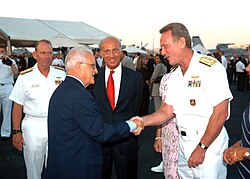
After a brief period as Leader of the Opposition, Fenech Adami returned to the premiership in September 1998 following a snap election. His second tenure was defined by a singular goal: bringing Malta into the European Union. He reactivated the membership application that had been paused by the previous government and successfully led the pro-EU campaign during the 2003 referendum.
On April 16, 2003, he signed the Accession Treaty, a milestone that earned him the "European of the Year 2003" award from the European Voice. He resigned from the premiership and party leadership in March 2004, marking the end of his tenure as the longest-serving Prime Minister since independence.
Presidency and Final Years
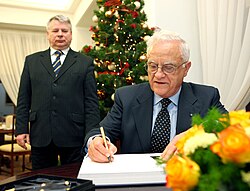
On April 4, 2004, Fenech Adami was appointed the 7th President of Malta. In this ceremonial role, he served a five-year term, providing a sense of stability and continuity to the nation. He remained in office until April 4, 2009, when he was succeeded by George Abela.
Summary of Political Career
| Position | Term Start | Term End | Preceded By | Succeeded By |
|---|---|---|---|---|
| Prime Minister (1st Term) | 12 May 1987 | 28 October 1996 | Karmenu Mifsud Bonnici | Alfred Sant |
| Leader of the Opposition | 28 October 1996 | 6 September 1998 | Alfred Sant | Alfred Sant |
| Prime Minister (2nd Term) | 6 September 1998 | 23 March 2004 | Alfred Sant | Lawrence Gonzi |
| President of Malta | 4 April 2004 | 4 April 2009 | Guido de Marco | George Abela |
Frequently Asked Questions
What was Eddie Fenech Adami's primary contribution to Malta?
His most significant contribution was leading Malta's successful application and accession to the European Union, which fundamentally reshaped the country's political and economic trajectory.
How did Fenech Adami change the Maltese economy?
He implemented policies of national reconciliation and economic reform, including the privatization of state companies, trade liberalization, and the deregulation of the banking and financial services sectors.
Why was the 1981 election controversial?
Although Fenech Adami's Nationalist Party won the majority of the votes, gerrymandered districts allowed the Labour Party to retain a majority of seats in Parliament, leading to years of political struggle.
What was the "European of the Year" award?
Fenech Adami received this award in 2003 from the Brussels-based newspaper European Voice in recognition of his persistent efforts to integrate Malta into the European Union.
Who succeeded him as President of Malta?
Eddie Fenech Adami was succeeded by George Abela on April 4, 2009.