Presbyterian Church in the United States of America
The Presbyterian Church in the United States of America (PCUSA) represents a significant pillar of the American Protestant tradition. Rooted in the Reformed tradition of the 16th-century Reformation, the church evolved from the teachings of John Calvin and the leadership of John Knox, who established the Scottish Reformation in 1560. This legacy of presbyterian polity—a system of church governance by elders—traveled from Scotland to Ireland and eventually to the American colonies.
Throughout its history, the PCUSA has been characterized by a dynamic tension between conservative adherence to traditional Calvinism and the influence of evolving theological movements, including Arminianism, liberal theology, and neo-orthodoxy.
Key Facts
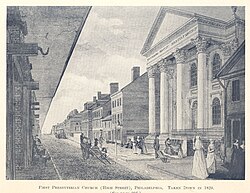
- Origin: Formally organized in Philadelphia, Pennsylvania, in 1789.
- Theological Roots: Branched from the Church of Scotland and the Synod of Ulster.
- Peak Mid-Century Size: By 1957, the church had 8,351 congregations, 2.8 million members, and 10,261 ministers.
- Major Mergers: Merged with the United Presbyterian Church of North America in 1958 to form the UPCUSA.
- Key Conflicts: Defined by the Old School–New School split and the Fundamentalist–Modernist Controversy.
Foundations and American Independence
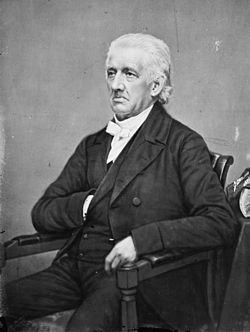
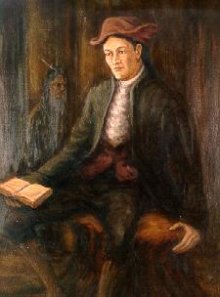
While early American Presbyterians were initially hesitant regarding independence, many eventually became staunch supporters of the Revolutionary War. John Witherspoon, president of Princeton, was a pivotal figure who argued that the American cause was one of justice and liberty. Witherspoon and 11 other Presbyterians signed the Declaration of Independence.
The first General Assembly of the Presbyterian Church in the United States of America convened in May 1789 in Philadelphia. At its inception, the denomination consisted of four synods, 16 presbyteries, 177 ministers, and approximately 18,000 members.
Growth and the Second Great Awakening
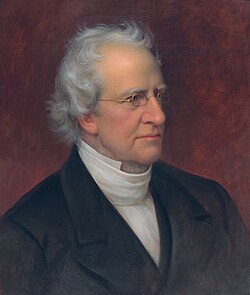
The 19th century was a period of rapid expansion and missionary zeal. The church established various local and independent mission societies, eventually forming the Board of Missions in 1816. This growth was further accelerated by the Second Great Awakening (c. 1790–1840), a series of religious revivals that began at Hampden–Sydney College in Virginia.
One of the most notable events of this era was the Cane Ridge Revival in Kentucky, led by Barton W. Stone, which drew over 10,000 attendees. However, this growth also led to friction. The Cumberland Presbytery, facing a shortage of ministers, began licensing clergy who were less formally educated and did not fully subscribe to the Westminster Confession. This led to the formation of the Cumberland Presbyterian Church in 1810, which rejected the Calvinist doctrines of limited atonement and double predestination.
The Old School–New School Controversy
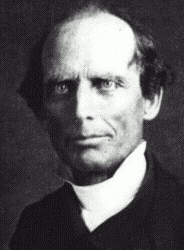
By the 1830s, the church split into two factions: the Old School and the New School. The Old School believed that the Plan of Union with Congregational churches had compromised Presbyterian doctrine. In 1837, the Old School majority excluded several synods and presbyteries, resulting in a loss of roughly one-fifth of the church's membership. The New School responded with the Auburn Declaration to defend their version of Calvinist orthodoxy.
Social Conflict and the Civil War
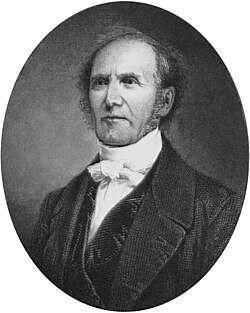
The issue of slavery created deep fractures within the denomination. While the General Assembly officially described slavery as a "gross violation" of human rights, it was slow to take disciplinary action against slaveholders. In 1818, abolitionist minister George Bourne was defrocked by his Southern presbytery for criticizing Christian slaveholders. These tensions, combined with the Old School–New School divide, contributed to the church's fragmentation during the American Civil War.
The 20th Century: Modernism and Neo-Orthodoxy
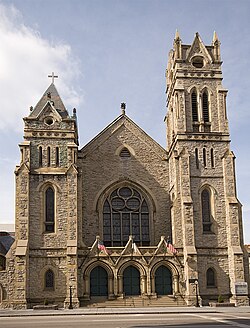
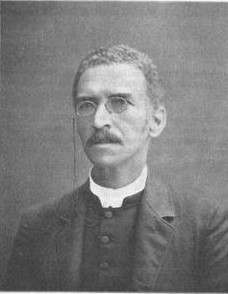
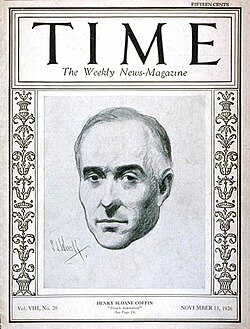
In the early 1900s, the Social Gospel movement gained traction, emphasizing social salvation alongside individual salvation. Figures like Henry Sloane Coffin and Charles Stelzle pushed the church to address child labor laws, housing, and workers' compensation through the Workingmen's Department.
The Fundamentalist–Modernist Controversy
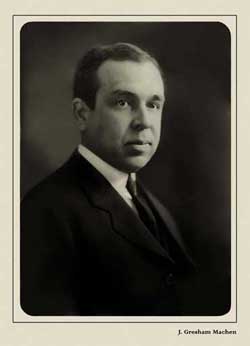
Between 1922 and 1936, the PCUSA was rocked by the Fundamentalist–Modernist Controversy. The conflict centered on five essential tenets: biblical inerrancy, the virgin birth, substitutionary atonement, the bodily resurrection, and the miracles of Christ. When the General Assembly adopted a more moderate approach in 1926 and approved the ordination of women as lay elders in 1929, conservative members felt alienated. This led John Gresham Machen and others to form the Orthodox Presbyterian Church in 1936.
Following the Great Depression, many theologians shifted toward neo-orthodoxy, which emphasized divine transcendence and human sinfulness over the optimism of liberal theology. This intellectual shift dominated Presbyterian seminaries from the 1940s through the 1950s.
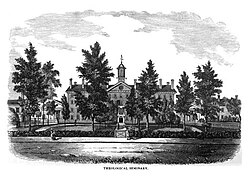
Denominational Evolution and Merger
In 1956, the PCUSA began ordaining women to the office of minister. Despite some conservative reservations, the PCUSA merged with the United Presbyterian Church of North America (UPCNA) in 1958, forming the United Presbyterian Church in the United States of America (UPCUSA).
| Year | Estimated Membership |
|---|---|
| 1789 | 18,000 |
| 1830 | 173,327 |
| 1870 | 446,560 |
| 1925 | 1,828,916 |
| 1957 | 2,775,464 |
Frequently Asked Questions
What is Presbyterian polity?
Presbyterian polity is a form of church governance where the church is led by elected elders (presbyters) rather than a single bishop or a purely congregational vote.
What caused the Old School–New School split?
The split was caused by disagreements over church order and doctrine, specifically the Old School's belief that the Plan of Union with Congregational churches had undermined traditional Presbyterian standards.
What were the five fundamental tenets of the 1910 General Assembly?
The five tenets were biblical inerrancy, the virgin birth of Jesus, substitutionary atonement, the bodily resurrection, and the miracles of Christ.
How did the Social Gospel influence the PCUSA?
The Social Gospel movement shifted the church's focus toward addressing systemic social issues, such as labor laws and poverty, as a means of advancing the kingdom of God on earth.
When did the PCUSA begin ordaining women?
The church began ordaining women as lay elders in 1929, as deacons in 1922, and as ministers in 1956.