Jonathan Edwards: The Philosopher and Preacher of the Great Awakening
Jonathan Edwards (1703–1758) stands as one of the most influential figures in American religious and philosophical history. A powerhouse of the colonial era, Edwards was a revivalist preacher, a Congregationalist theologian, and a philosopher whose work bridged the gap between strict Puritan heritage and the emerging intellectual currents of the Age of Enlightenment.
Regarded as one of America's most original philosophical theologians, Edwards is best known for his role in the First Great Awakening—a period of intense religious revival that swept through the British American colonies. His approach combined a deep commitment to the Westminster and Savoy Confessions of Faith with a sophisticated focus on beauty, harmony, and ethical aptness.
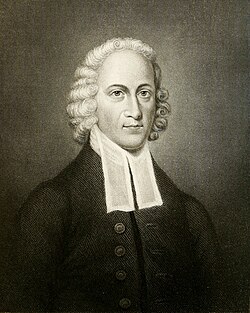
Key Facts
- Born: October 5, 1703, in East Windsor, Connecticut.
- Notable Work: Author of the famous sermon "Sinners in the Hands of an Angry God" (1741).
- Academic Leadership: Served as the 3rd President of the College of New Jersey (now Princeton University).
- Theological Tradition: An Evangelical Calvinist and proponent of New England theology.
- Education: Alumnus of Yale College.
Early Life and Academic Foundations
Edwards's early career was marked by academic rigor and a deep devotion to study. Between 1722 and 1723, he served as an un-ordained "supply" pastor—a temporary clergyman—at a Presbyterian church in New York City. Following this, from 1724 to 1726, he served as one of two tutors at Yale College, helping lead the institution during a period when it lacked a rector.
In 1727, Edwards was ordained as a minister in Northampton, Massachusetts, where he served as an assistant to his grandfather, the noted minister Solomon Stoddard. Edwards was a scholar-pastor who famously dedicated 13 hours a day to his studies. That same year, he married Sarah Pierpont, a woman of profound spiritual devotion from a prominent clerical family. Together, they had 11 children, including Esther Edwards.
The First Great Awakening and Theological Contributions
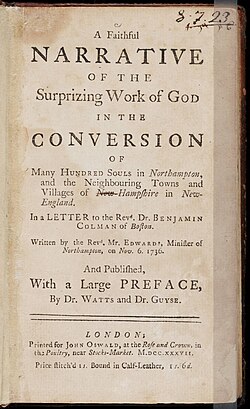
Edwards became a central figure in the First Great Awakening, beginning with a spiritual revival in Northampton between 1733 and 1735. The intensity of this movement was so great that it occasionally disrupted local business; within six months, nearly 300 of the town's 1,100 youths joined the church.
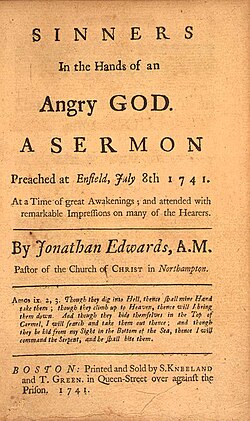
His theological contributions were often defined by his opposition to Arminianism (the belief that humans have free will in choosing salvation). In his 1731 "Public Lecture," Edwards emphasized God's absolute sovereignty, arguing that salvation is granted by "mere and arbitrary grace." This conviction is most famously captured in his 1741 sermon, "Sinners in the Hands of an Angry God," which used vivid imagery to warn listeners of the peril of divine judgment.
To provide a more philosophical framework for these experiences, Edwards published Religious Affections (1746), where he sought to identify the "distinguishing marks" of true spiritual conversion. He also took a keen interest in missionary work, publishing a memoir of David Brainerd in 1749, using Brainerd's ministry as a case study for his theories on conversion.
Conflict, Dismissal, and Later Years
Despite his success, Edwards eventually clashed with his congregation over the Half-Way Covenant. This colonial-era agreement allowed baptism alone to grant civil church membership, though not participation in the Lord's Supper. Edwards disagreed with the liberal view held by his grandfather, Solomon Stoddard, who believed the Lord's Supper could act as a converting ordinance.
This theological divide led to a crisis in 1750. After a vote of more than 200 to 23, the church ratified a council's decision to remove him. Although he continued to preach by request until October 1751, he eventually delivered a "Farewell Sermon" and left Northampton.
In 1758, Edwards was persuaded to become the president of the College of New Jersey (Princeton University), replacing his son-in-law, Aaron Burr Sr. His tenure was brief; he was installed on February 16, 1758, and died shortly thereafter on March 22, 1758, at the age of 54.
Complexities of His Legacy: Slavery
Historical records indicate that Edwards owned several enslaved people during his life. In 1731, he purchased a teenager named Venus. He later acquired others, including Joab and Rose Binney, Titus, Joseph, and Sue. While Edwards defended the institution of slavery for those who were debtors, war captives, or born into it in North America, he explicitly rejected the Atlantic slave trade, describing it as cruel and inhumane.
Summary of Jonathan Edwards's Life and Work
| Category | Details |
|---|---|
| Primary Roles | Pastor, Theologian, Philosopher, Missionary, University President |
| Key Theological Focus | Divine Sovereignty, New England Theology, Calvinism |
| Major Publications | Religious Affections, The Freedom of the Will, The Life of David Brainerd |
| Key Institutions | Yale College, Northampton Church, Princeton University |
| Historical Impact | Shaped the First Great Awakening and American philosophical theology |
Frequently Asked Questions
What was Jonathan Edwards's most famous sermon?
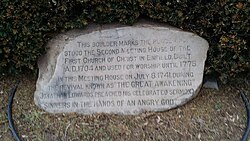
His most famous sermon is "Sinners in the Hands of an Angry God," preached in 1741 in Enfield, Connecticut. It is renowned for its stark warnings about the necessity of salvation and the sovereignty of God.
What was the "First Great Awakening"?
The First Great Awakening was a series of religious revivals that occurred in the American colonies during the 18th century, characterized by an emphasis on personal conversion and emotional spiritual experiences.
Why was Jonathan Edwards dismissed from his church in Northampton?
He was dismissed due to a dispute over the Half-Way Covenant. Edwards believed that the Lord's Supper should be reserved for professing Protestants who had experienced regeneration, rather than anyone who had simply been baptized.
What was Edwards's relationship with Princeton University?
Jonathan Edwards served as the 3rd President of the College of New Jersey, which is now known as Princeton University, starting in February 1758.
How did Edwards view the slave trade?
While Edwards owned enslaved people and defended the legality of slavery for debtors and captives, he condemned the Atlantic slave trade as inhumane and cruel.