Prague 1945: The Final Strategic Struggle of World War II
By early May 1945, the Third Reich was in its final death throes. With Berlin on the verge of capitulation under a massive Soviet assault, the vast majority of Germany had been conquered. However, a significant pocket of resistance remained in southeastern Germany, Austria, and Czechoslovakia. This region became the stage for one of the final military maneuvers of the European theater, as German forces attempted to avoid Soviet captivity by seeking a surrender to the Western Allies.
The Nazi regime had envisioned Czechoslovakia and its surrounding territories as a final bastion. Consequently, they concentrated a formidable array of military units in the area, including elements of the 6th SS Panzer Army and several other combined and Panzer armies. The goal was not merely military resistance but the preparation of a new administrative center for the German High Command.
Key Facts
- Strategic Goal: Generaloberst Alfred Jodl ordered German forces to avoid Soviet capture to facilitate separate negotiations with the Western Allies.
- Soviet Objective: Joseph Stalin sought a strong Soviet presence in western Czechoslovakia to influence the postwar political landscape.
- German Defense: Army Group Centre formed a "horseshoe" deployment across Bohemia and Moravia.
- Allied Demarcation: U.S. forces adhered to an irregular demarcation line passing through Leipzig, Karlovy Vary, and Plzen.
- The Blumen-Operation: Field Marshal Schörner's plan for a fighting withdrawal to the west to surrender to U.S. forces.
Political and Military Tensions
The atmosphere in Prague was volatile. SS Senior Group Leader Karl Hermann Frank threatened to drown any local uprising in a "sea of blood," even as Soviet fronts closed in. Adding to the complexity was the arrival of the Russian Liberation Army (KONR), whose two divisions positioned themselves north and south of the city with shifting allegiances.
For the Allied leaders, Prague was a high-stakes prize. Winston Churchill and Joseph Stalin both recognized that the city's capture would dictate the political future of postwar Czechoslovakia. To ensure Soviet dominance, Stalin redirected the 1st Belorussian Front to relieve the 1st Ukrainian Front in Berlin, allowing the latter to pivot south toward Prague. Simultaneously, the 2nd Ukrainian Front was ordered to drive in from the southeast.
The Challenge of Terrain
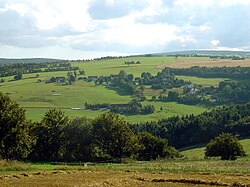
The geography of the region played a critical role in the speed and direction of the advance. The Soviet forces faced a landscape dominated by dense forests and rugged mountains. While the 2nd Ukrainian Front enjoyed a less arduous route through lower elevations, the 1st Ukrainian Front faced a grueling perpendicular crossing of mountain ridges.
A primary obstacle for the 1st Ukrainian Front was the Ore Mountains, which they had to traverse to reach Prague from the north. Beyond the natural geography, the Soviets had to navigate the dense urban environments of Dresden and Prague.
Military Deployment and Force Strength
German Forces (Army Group Centre and Ostmark)
The German defense was structured as a horseshoe straddling Bohemia and Moravia. To the west, the 7th Army—consisting of a mix of Panzer, Volksgrenadier, and replacement units—faced the U.S. Army. To the northeast, the 4th Panzer Army defended the area north of Dresden and Bautzen, fresh from a victory at the Battle of Bautzen. The 17th Army held an arc from Breslau to Ostrava, while the 1st Panzer Army maintained a salient around Olomouc. In the south, Army Group Ostmark's 8th Army linked with the 6th SS Panzer Army near Vienna.
Soviet Forces
The Soviet offensive was characterized by massive numbers of rifle divisions supported by powerful tank armies and Stavka Reserve (Supreme High Command) artillery. The 1st Ukrainian Front was the most formidable, boasting 71 rifle divisions and nine tank/mechanized corps. The 2nd Ukrainian Front, led by the 6th Guards Tank Army, moved through easier terrain, while the 4th Ukrainian Front struggled with a lack of direct road connections from Olomouc to Prague.
U.S. Forces
The U.S. VIII, V, and XII Corps exerted pressure on the German 7th Army in western Bohemia. While they did not advance on Prague due to the agreed demarcation line, their presence encouraged Czech resistance against the Nazi occupation.
| Force/Front | Primary Objective/Sector | Key Components | Terrain Obstacles |
|---|---|---|---|
| 1st Ukrainian Front | Prague (from North) | 71 Rifle Divs, 9 Tank Corps | Ore Mountains, Dresden |
| 2nd Ukrainian Front | Prague (from Southeast) | 37 Rifle Divs, 6 Guards Tank Army | Lower elevations (easier) |
| 4th Ukrainian Front | Olomouc to Prague | 34 Rifle Divs, 1 Tank Corps | Hill ranges, poor roads |
| Army Group Centre | Bohemia and Moravia | 4th Panzer, 1st Panzer, 7th, 17th Armies | Urban centers, mountains |
| U.S. III & IX Armies | Western Bohemia | VIII, V, and XII Corps | Demarcation line limits |
The Blumen-Operation
Recognizing the inevitability of the Soviet onslaught, Field Marshal Schörner developed the Blumen-Operation (Flower Operation). This plan detailed a fighting withdrawal toward the west, using specific phase lines named after flowers. The strategy relied on the 4th Panzer Army to act as a shield, holding back the 1st Ukrainian Front long enough for other units to escape Soviet capture and surrender to the Americans.
Frequently Asked Questions
Why did the German forces try to avoid the Soviet Union?
Generaloberst Alfred Jodl ordered forces to avoid Russian capture to facilitate separate negotiations with the Western Allies, as the conditions of surrender to the U.S. and UK were perceived as more favorable than those of the USSR.
What was the significance of the Ore Mountains?
The Ore Mountains served as a major geographical barrier that the Soviet 1st Ukrainian Front had to cross to advance on Prague from the north, slowing their progress compared to the 2nd Ukrainian Front.
What was the role of the Russian Liberation Army (KONR)?
The KONR consisted of two divisions positioned north and south of Prague. Although ostensibly allied with the Germans, their loyalty was inconsistent and varied based on the immediate tactical situation.
What was the Blumen-Operation?
It was a strategic withdrawal plan devised by Field Marshal Schörner to move Army Group Centre westward, allowing them to surrender to U.S. forces rather than the Soviet Army.
How did the U.S. Army influence the situation in Prague?
While U.S. forces did not advance into Prague due to a demarcation agreement with the Soviets, their presence in western Bohemia stimulated the local Czech population to rise up against the German occupation.