Post-Punk Revival: The Evolution of Modern Indie and Garage Rock
The post-punk revival—also frequently referred to as the indie rock or garage rock revival—was a seismic shift in the musical landscape of the early 2000s. Emerging as a stripped-down, "back-to-basics" approach to guitar music, the movement sought to recapture the raw energy and artistic experimentation of the late 1970s and early 1980s. By blending the aesthetics of post-punk, new wave, and garage rock, these artists created a sound that felt both nostalgic and urgently modern.
This movement was more than just a sonic preference; it was a cultural reaction. Many artists and fans viewed the scene as a quest for "rock authenticity," pushing back against the polished commercialism of MTV-driven nu metal, hip hop, and the perceived blandness of post-Britpop bands.
Key Facts
- Origins: Emerged in the late 1990s and early 2000s across the US, Europe, and Australia.
- Core Influences: 1960s garage rock, late 70s post-punk, new wave, and traditional blues.
- Breakthrough Era: 2001 marked a turning point with the release of Is This It (The Strokes) and White Blood Cells (The White Stripes).
- Visual Style: Characterized by "skinny ties, white belts, and shag haircuts," mirroring 1950s and 60s fashion.
- Modern Evolution: The scene has evolved into newer forms like "crank wave" and the "Post-Brexit New Wave."
Defining the Sound and Aesthetic
To understand the revival, one must first understand post-punk: a term coined for groups that took the raw energy of punk and applied it to more challenging musical structures, art-based imagery, and complex lyrical themes. The revivalists of the 2000s adopted this iconoclastic stance but focused on a leaner, more energetic live performance style.
While the movement is often grouped together, critics have debated its unity. Some historians argue that diverse bands simply used the "garage" label to gain credibility, while others see the era as a continuum of post-punk that never truly disappeared, citing mid-90s acts like Elastica and Brainiac as bridges to the new millennium.
Music critics have noted specific influences within the scene. For instance, bands like Franz Ferdinand and the Rapture drew from the "angular" strain of post-punk, specifically the work of Wire and Gang of Four.

The Rise and Commercial Peak (2001–2007)
The movement's commercial explosion began in the UK, led by a cohort of bands often dubbed "The" bands. The Strokes' 2001 debut, Is This It, and The White Stripes' White Blood Cells provided the blueprint for the era's success. Other early pioneers included the Swedish group The Hives and Australia's The Vines.
By the mid-2000s, the movement reached its zenith. A second wave of internationally recognized acts emerged, including the Killers, Interpol, and the Yeah Yeah Yeahs in the US, alongside Bloc Party and Franz Ferdinand in the UK.

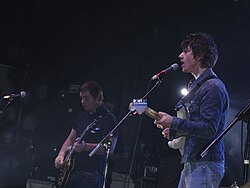
One of the most significant shifts occurred with the Arctic Monkeys. They became the first major act to leverage internet social networking for commercial success, resulting in the fastest-selling debut album in British chart history in 2006.

The "Landfill Indie" Era and Decline
As the sound became more mainstream, it also became more formulaic. In Britain, a proliferation of derivative bands led critics to coin the term landfill indie. This label described radio-friendly guitar bands that lacked the innovation of their predecessors, creating a sense of monotony in the indie scene.
By 2008, the phenomenon began to subside. Listeners shifted toward more emotionally and musically complex indie rock, such as the work of Arcade Fire and Death Cab for Cutie. Many of the original revival bands either broke up or evolved their sound to stay relevant.
Modern Iterations: Crank Wave and Beyond
Post-punk did not disappear; it evolved. In the 2010s and 2020s, a new wave of artists like Parquet Courts and Viagra Boys kept the spirit alive. In the UK and Ireland, a specific scene emerged around The Windmill venue in Brixton, London.
This contemporary movement has been described as crank wave or the "Post-Brexit New Wave." These bands, including Black Midi, Squid, and Fontaines D.C., often feature a "talk-singing" vocal style over post-rock or post-punk instrumentation. However, similar to the 2000s, some critics have already begun using the term "landfill post-punk" to describe the less innovative acts of this new era.

| Era | Key Characteristics | Notable Artists |
|---|---|---|
| Early Breakthrough (2001-2004) | Stripped-down garage rock, "rock authenticity" | The Strokes, The White Stripes, The Hives |
| Mainstream Zenith (2005-2007) | Angular sounds, internet-driven fame | Arctic Monkeys, Franz Ferdinand, Bloc Party |
| Landfill Indie (Late 2000s) | Formulaic, radio-friendly derivatives | The Wombats, Scouting for Girls |
| Modern Wave (2010s-Present) | Talk-singing, experimental, "Crank Wave" | Black Midi, Idles, Fontaines D.C. |
Frequently Asked Questions
What is the difference between post-punk and post-punk revival?
Post-punk refers to the original movement of the late 1970s and early 80s that experimented with punk's energy. Post-punk revival is the early 2000s movement that sought to bring those sounds and aesthetics back into the mainstream.
What does "landfill indie" mean?
It is a critical term used to describe the wave of formulaic, derivative indie rock bands in the late 2000s that lacked the originality of the movement's pioneers.
Which bands were considered the "saviours of rock 'n' roll"?
The media applied this label to a cohort of "The" bands, most notably The Strokes, The White Stripes, and The Hives, during the early 2000s.
What is "crank wave"?
Crank wave is a term used to describe a contemporary scene of British and Irish post-punk bands, often associated with The Windmill venue in London, characterized by a distinct talk-singing vocal style.
How did the Arctic Monkeys change the music industry?
They were among the first major acts to achieve massive commercial success through the use of internet social networking, bypassing traditional promotional routes to reach their audience.