Port of Suape: A Strategic Hub for Brazilian Trade and Industry
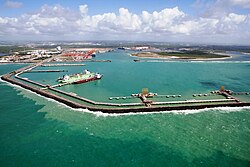
The Port of Suape stands as one of the most critical maritime gateways in Brazil and Latin America. Located in the state of Pernambuco, specifically within the municipalities of Ipojuca and Cabo de Santo Agostinho, this massive industrial complex serves as the largest public port in Brazil's Northeast Region and ranks fifth nationally. Situated approximately 40 kilometers south of Recife, Suape is a cornerstone of the regional economy and a primary driver of development for the state.
Unlike many coastal ports, Suape is a non-tidal harbor, meaning it can service ships 365 days a year regardless of tide schedules. This operational reliability makes it an indispensable link in the global supply chain.
Key Facts
- Location: Ipojuca and Cabo de Santo Agostinho, Pernambuco, Brazil.
- Annual Cargo: 23.6 million tonnes (as of 2017).
- Ownership: APM Terminals.
- Specialization: Leader in liquid bulk and cabotage (coastal shipping).
- Capacity: Can accommodate ships up to 170,000 DWT.
- Operational Status: Non-tidal, operating 365 days per year.
Origins and Strategic Design
The vision for the port was conceived by Governor Francisco de Moura, who designed it based on a Port-Industry integrated system. This model ensures that the port does not merely act as a transit point but as a hub for industrial production and processing. While the name is derived from Suape beach in Cabo de Santo Agostinho, the actual facilities are located in Ipojuca.
Established by state law on November 7, 1978, the Suape Industrial Port Complex was created to replace the Recife Port for the transportation of bulk cereals and fuels. Today, it is recognized as one of the most technologically advanced ports in the country, serving not only Pernambuco but also significant portions of the neighboring states of Alagoas and Paraíba.
Port Structure and Technical Capabilities
Suape utilizes a sophisticated monitoring and laser ship docking system to ensure secure and effective vessel control. The port's infrastructure is designed for high-capacity throughput, featuring an access canal 5,000 meters long, 300 meters wide, and 15.5 meters deep.
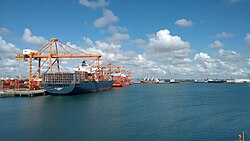
The port offers different draft depths to accommodate various vessel sizes: an operational draft of 15.5 meters in the internal port and up to 20 meters in the external port. With 27 kilometers of backport area, the facility can support massive ships and extensive land-based operations.
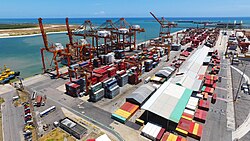
Industrial Integration
The complex hosts over 96 companies, integrating heavy industry directly with maritime logistics. Key installations include a Petrobras refinery and a large petrochemical company. Notably, it is home to the Atlântico Sul Shipyard, the largest shipbuilder in South America.
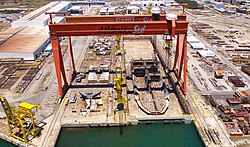
Cargo and Logistics Performance
In 2018, the port handled 23.6 million tons of products. It holds the national record for the movement of liquid bulk (17.5 million tons)—including petroleum derivatives, ethanol, vegetable oils, and chemical products—and cabotage (15.3 million tons). Other major exports include automobiles, soybeans, sugar, and iron ore. To improve sustainability, the port is currently converting its equipment to electric power.
Infrastructure and Connectivity
Suape is seamlessly connected to the broader Brazilian transport network. Road access is provided via federal highway BR-101 and state road PE 060, with a connection to BR-232 located 35 kilometers northwest, facilitating east-west transit across the state.
Air connectivity is robust, with the Guararapes International Airport in Recife just 25 kilometers to the north. The port is also linked to other regional airports in Maceió, João Pessoa, Caruaru, and Petrolina. For rail transport, the Transnordestina—a 1,800 km goods line connecting seven states—crosses the region. Additionally, the South Train provides diesel-powered passenger service between Cabo de Santo Agostinho and Recife.
The Recife Logistics Hub
The synergy between the Port of Suape, the international airport, and Recife's central location has transformed the city into one of Brazil's premier logistics centers. This economic specialization is evident in the workforce; employees in logistics, communications, and the financial sector make up 4% of Recife's workforce and over 9% of the wider Metropolitan Area.
Environmental Impact: Shark Habitats
The construction of the port had an unforeseen ecological consequence by disturbing local shark habitats. This forced shark populations to migrate north toward the coastal regions of Recife. Since the first verified attack in 1992, there have been 60 recorded attacks and 24 fatalities, primarily affecting surfers who venture beyond the protective barrier reefs of Recife's beaches.
Summary of Port Specifications
| Feature | Specification |
|---|---|
| Annual Cargo Tonnage (2017) | 23.6 million tonnes |
| Max Vessel Capacity | 170,000 DWT |
| External Port Draft | Up to 20 meters |
| Access Canal Dimensions | 5,000m (L) x 300m (W) x 15.5m (D) |
| Primary Cargo Types | Liquid bulk, containers, automobiles, iron ore, soybeans, sugar |
Frequently Asked Questions
What makes the Port of Suape different from other ports?
Suape is a non-tidal port, allowing it to operate 365 days a year without being restricted by tide schedules. It also utilizes a Port-Industry integrated system, combining shipping with on-site industrial production.
Which industries are most prominent at the port?
The port is a leader in liquid bulk (petroleum derivatives, chemicals, and oils) and cabotage. It also hosts the Atlântico Sul Shipyard, the largest in South America, and a Petrobras refinery.
How is the port connected to the rest of Brazil?
It is connected via the BR-101 and PE 060 highways, the Transnordestina railway line, and is located near the Guararapes International Airport in Recife.
What is the relationship between the port and the shark attacks in Recife?
The construction of the port disturbed natural shark habitats, driving the animals north toward the beaches of Recife, which led to an increase in shark attacks starting in 1992.
Who currently owns and manages the port?
The port is owned by APM Terminals.