Port of Paranaguá: A Hub of Brazilian and Latin American Trade
The Port of Paranaguá stands as a cornerstone of international trade for Brazil and Latin America. Located in the city of Paranaguá within the state of Paraná, this massive seaport serves as a critical gateway for agricultural exports and industrial imports, connecting the heart of South America to global markets in the United States, China, Japan, and South Korea.
As the second largest port in Brazil by tonnage and the third largest in container shipping, Paranaguá is an essential engine for the regional economy, facilitating the movement of millions of tonnes of cargo annually.
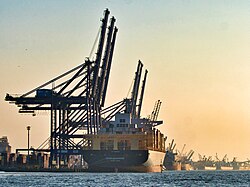
Key Facts
- Location: Paranaguá, Paraná, Brazil.
- Annual Cargo Tonnage: 56 million tonnes (2021).
- Specialization: Largest bulk port in Latin America and Brazil's leading grain export port.
- Key Exports: Soy flour, vegetable oil, sugar, and soybeans.
- Key Imports: Fertilizers (representing 34% of Brazil's total imports).
- Management: Operated by the Administração dos Portos de Paranaguá e Antonina (APPA).
Historical Evolution
The origins of the port date back to 1872, when it began as a privately owned wharf. The State of Paraná assumed control of the concession in 1917, initiating a series of expansions that led to the opening of the modern port in 1935. To oversee operations, the Administração dos Portos de Paranaguá (APP) was founded in 1947. By 1971, the organization expanded its remit to include the Port of Antonina, rebranding as the Administração dos Portos de Paranaguá e Antonina (APPA).
The growth of the port is staggering. In its first year of operation in 1935, the port measured only 400 metres and handled 91,500 tons of cargo—primarily mate and coffee. By its 85th anniversary, the port was handling 500 times that volume. The scale of operations has shifted so dramatically that a single ship embarking in 2020 for a soybean meal operation handled as much cargo as the port's entire first year of operation.
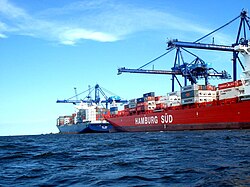
Infrastructure and Logistics
The Port of Paranaguá is supported by a robust multimodal transport network. Land access is provided via several key highways, including BR-277, PR-401, PR-411, PR-410, and PR-412. Rail access is managed through the Sul-Atlântico S/A railway (Red Sur), formerly part of the Regional Superintendency Curitiba (SR 5) under Rede Ferroviária Federal SA (RFFSA). Notably, the Paranaguá container terminal is the only one in southern Brazil featuring direct rail access.
To accommodate larger modern vessels, the port has undergone significant dredging—the process of excavating the seabed to increase water depth. While dredging began in 1936, major depth increases along the wharf and evolution basin were completed in 1948. This allowed the port to transition from hosting small boats in the 1930s to accommodating massive ships today that exceed 330 metres in length and 42 metres in width.
Economic Impact and Cargo Specialization
The port's area of influence is vast, spanning the Brazilian states of Paraná, Mato Grosso, Mato Grosso do Sul, Santa Catarina, Rio Grande do Sul, Minas Gerais, and parts of São Paulo, as well as the neighboring country of Paraguay.
Over the decades, the types of goods handled have evolved. In 1965, Paranaguá was the world's largest coffee exporter. Later, it exported specialized items such as crystallized menthol, soy lecithin, sassafras oil, and noble woods like pine, cinnamon, and guatambu (ivory wood). Today, the port is a global leader in agricultural commodities.
| Category | Ranking/Statistic | Key Products |
|---|---|---|
| Export Leadership (1st in Brazil) | Leader | Soy flour, Vegetable oil |
| Export Leadership (2nd in Brazil) | High Volume | Sugar, Paper (coil), Frozen products, Alcohol, Vehicles |
| Export Leadership (3rd in Brazil) | High Volume | Soybeans, Wood |
| Import Leadership | 34% of National Total | Fertilizers |
| 2020 Volume | 57+ Million Tonnes | Soybeans (14.2M), Soybean meal (5.4M), Corn (2.5M) |
Frequently Asked Questions
Who manages the Port of Paranaguá?
The port is owned and managed by the Administração dos Portos de Paranaguá e Antonina (APPA).
What is the port's primary role in Brazil's economy?
It is the largest port in Brazil for the export of grains and the largest bulk port in Latin America, playing a critical role in the distribution of soybeans, corn, and soy flour.
How does the port handle imports?
While heavily focused on exports, the port is a leader in importing fertilizers, accounting for 34% of all fertilizer imports into Brazil.
What makes the Paranaguá container terminal unique in southern Brazil?
It is the only container terminal in the southern region of Brazil that possesses direct rail access, enhancing its logistical efficiency.
How has the port's capacity changed since 1935?
The port has grown from a 400-metre wharf handling 91,500 tons in its first year to a massive facility handling over 50 million tons annually, representing a 500-fold increase in load capacity.