Port of Itajaí: A Strategic Hub for Brazilian Trade
The Port of Itajaí stands as one of the most critical maritime gateways in Brazil and across Latin America. Situated on the Itajaí-Açu river in the city of Itajaí, within the state of Santa Catarina, this seaport serves as a vital artery for international commerce, connecting the interior of Brazil to global markets.
Renowned for its efficiency in container handling, it currently ranks as the second-largest port in Brazil for this category. It is particularly dominant in the export of frozen products, maintaining a leading position in the national ranking for these goods.
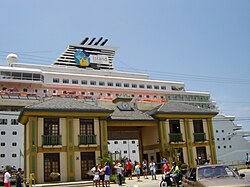
Key Facts
- Location: Itajaí, Santa Catarina, Brazil.
- Annual Cargo Tonnage: 18.9 million tonnes (as of 2021).
- Specialization: Leading Brazilian port for frozen product exports.
- Container Rank: 2nd largest container port in Brazil.
- Infrastructure Size: 152,000 m.
- Primary Imports: Machinery, engines, and equipment.
Historical Development
The foundations of trade in Itajaí date back to the mid-19th century, when the city first established warehouses for the movement of goods. By 1905, formal studies began to determine the best locations for expanded port facilities.
Construction of a wharf at the southern mouth of the Itajaí-Açu river commenced on July 17, 1912. The port officially opened in 1938 following the construction of a 233-meter wharf. This infrastructure grew significantly through extensions in 1950 and 1956, adding 470 meters to the wharf. Between 1950 and 1964, four warehouses were added, including a specialized facility for refrigerated freight.
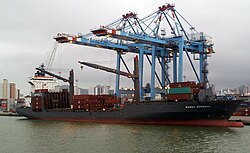
Administrative Evolution
The governance of the port has transitioned through several entities to optimize its operation:
- 1966: The Board of Directors of the Port of Itajaí was established by Decree No. 58,780.
- 1975: The Port Authority of Itajaí was created under the Empresa de Portos do Brasil S.A. (Portobrás).
- 1990: Administration shifted to the Companhia Docas do Estado de São Paulo (Codesp) following the extinction of Portobrás.
- 1995: Control was transferred to the municipality of Itajaí via a decentralization agreement.
- 1998: The Municipality of Itajaí was confirmed as the exploration authority through the Administracao Hidroviária Docas Catarinense (ADHOC).
- 2000: Municipal law n° 3,513 transformed the body into a municipal autarchy known as the Superintendency of the Port of Itajaí.
Logistics and Economic Impact
The port's operational reach extends far beyond the city limits. Its area of influence encompasses several Brazilian states, including Santa Catarina, Rio Grande do Sul, Paraná, Mato Grosso, Mato Grosso do Sul, and São Paulo.
To facilitate the movement of goods, the port is integrated into a robust land access system comprising three major highways: BR-470, BR-101, and BR-486.
Cargo Profile
The Port of Itajaí handles a diverse array of commodities. While it is the largest export port in Brazil for frozen chickens, its portfolio includes:
- Exports: Wood and derivatives, ceramics, kraft paper, tobacco, sugar, and frozen meat.
- Imports: Vehicles, textiles, and industrial machinery/accessories.
| Feature | Detail |
|---|---|
| Coordinates | 26°55′00″S 48°38′00″W |
| Opening Year | 1938 |
| Total Size | 152,000 m |
| 2021 Cargo Volume | 18.9 million tonnes |
| Current Administrator | Superintendency of the Port of Itajaí |
Frequently Asked Questions
What is the Port of Itajaí's primary specialization?
The port is the leading exporter of frozen products in Brazil, specifically ranking as the largest export port for frozen chickens.
Which Brazilian states are within the port's area of influence?
The port serves the states of Santa Catarina, Rio Grande do Sul, Paraná, Mato Grosso, Mato Grosso do Sul, and São Paulo.
How is the port accessed by land?
Land access is provided through three main highways: BR-470, BR-101, and BR-486.
Who currently manages the Port of Itajaí?
The port is administered by the Superintendency of the Port of Itajaí, which is a municipal autarchy of the prefecture of Itajaí.
What are the main products imported through the port?
The primary imported goods include machinery, engines, equipment, vehicles, and textiles.