Pompey the Great: The Rise and Fall of a Roman Titan
Gnaeus Pompeius Magnus, known to history as Pompey the Great, was one of the most formidable military commanders and political figures of the final decades of the Roman Republic. A man of immense ambition, Pompey rose from a provincial noble to a three-time consul, carving out a legacy of conquest that spanned from the shores of Hispania to the deserts of Judea.
His career was defined by a unique ability to bypass the cursus honorum—the traditional sequence of public offices required for political advancement—through sheer military success. While he was admired by the masses and granted the title "Magnus" (the Great) by the dictator Sulla, his ruthlessness earned him the darker nickname adulescentulus carnifex, or "teenage butcher," among his enemies.
Key Facts
- Full Name: Gnaeus Pompeius Magnus
- Lifespan: 106 BC – 48 BC
- Highest Office: Consul (elected in 70, 55, and 52 BC)
- Major Achievements: Three triumphs, defeat of the Mediterranean pirates, and reorganization of the Roman East.
- Final Conflict: Defeated by Julius Caesar at the Battle of Pharsalus.
- Death: Assassinated in Pelusium, Egypt.
Early Life and the Ascent to Power
Born on September 29, 106 BC, in Picenum, Italy, Pompey was the son of Gnaeus Pompeius Strabo, a provincial noble who had achieved senatorial status. Pompey's entry into public life was rapid; he began his military career serving his father during the Social War (91–87 BC) and later became a protégé of the dictator Sulla.
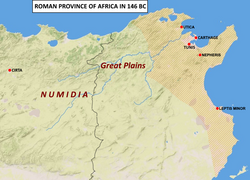
During Sulla's civil war (83–81 BC), Pompey proved his tactical brilliance by defeating the allies of Gaius Marius in Sicily and Africa. This early success established him as a powerhouse in Roman politics, allowing him to command armies and influence the Senate long before he had reached the traditional age for high office.
Military Campaigns and Global Influence
The Sertorian War
Between 76 and 71 BC, Pompey was dispatched to Hispania to suppress the rebellion of Sertorius. This campaign was a grueling test of his leadership. Despite an early defeat at the Battle of Lauron, where he lost a third of his army, Pompey eventually wore down the rebellion through a series of engagements, including the Battle of Sucro and the Battle of Saguntum.
Clearing the Seas and the East
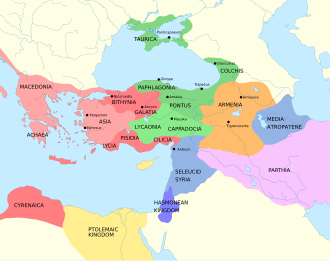
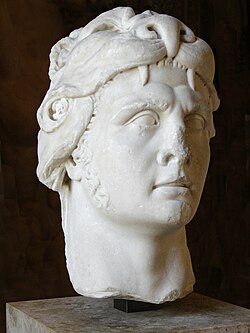
Pompey's versatility was further demonstrated when he was tasked with eliminating the Mediterranean pirates in 67 BC. His swift and decisive campaign secured Roman trade routes and paved the way for his involvement in the Third Mithridatic War. He successfully defeated King Mithridates of Pontus and reorganized the Eastern provinces, significantly increasing the Roman state's annual income from 200 million to 340 million sesterces.
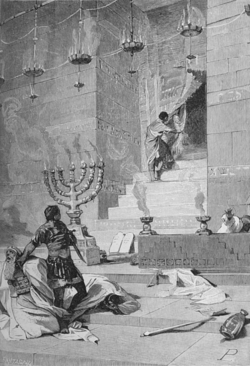
During this period, he also marched through Syria and the Levant, notably conducting the Siege of Jerusalem during the Hasmonean civil war.
![Aureus minted by Pompey for his second triumph in 71 BC, featuring the head of Africa on the obverse (celebrating his victory against Hiarbas). The reverse shows Pompey in his triumphal chariot, with his son Gnaeus seated before and Victory flying above.[52]](/images/a3/64/a36478f5b34cae487be9b867b1dcc85772f941649ffbc8f363979f1d96727e11.png)
![Denarius minted in 56 BC by Pompey's supporter Faustus Sulla[e][88][89]](/images/3b/86/3b86ca0189372a6383ef50e435798b95b10672d1703accda791edc20cc00d5a4.jpg)
The First Triumvirate and Political Rivalry
Upon his return to Rome in 62 BC, Pompey was a hero to the people. He used his vast personal fortune to construct the Theatre of Pompey, one of the city's most famous landmarks. To stabilize his political power, he entered into an informal political alliance known as the First Triumvirate, alongside Julius Caesar and Marcus Licinius Crassus.
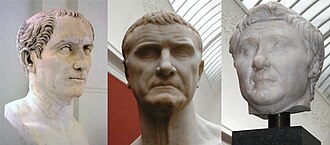
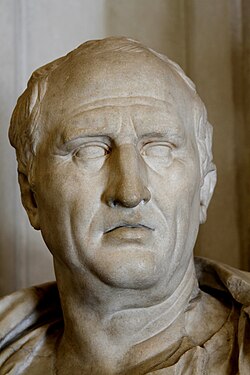
However, the alliance was fragile. The death of Julia (Caesar's daughter and Pompey's wife) in 54 BC severed a key personal tie between the two men. As Caesar's power grew in Gaul, the Roman Senate—and eventually Pompey himself—began to view him as a threat to the Republic.
The Road to Pharsalus and the End of an Era
The tension culminated in 49 BC when Caesar crossed the Rubicon river, sparking a civil war. Pompey retreated to Greece, gathering the support of the conservative factions of the Senate.
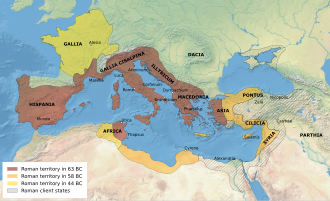
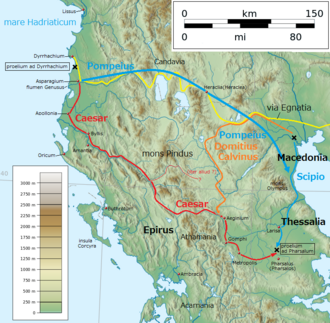
The decisive clash occurred at the Battle of Pharsalus on August 9, 48 BC. Although Pompey's forces outnumbered Caesar's—with approximately 38,000 men and 7,000 cavalry against Caesar's 22,000 men and 1,000 cavalry—Caesar's superior tactics repulsed the Pompeian cavalry. The resulting collapse of the infantry led to a total victory for Caesar.
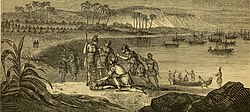
Defeated and fleeing, Pompey sought refuge in Egypt. However, upon his arrival at Pelusium on September 28, 48 BC, he was assassinated, ending the life of one of Rome's most influential statesmen.
Summary of Pompey's Career
| Period/Year | Key Event/Role | Outcome/Significance |
|---|---|---|
| 106 BC | Birth | Born in Picenum, Italy |
| 83–81 BC | Sulla's Civil War | Defeated Marian allies in Sicily and Africa |
| 76–71 BC | Sertorian War | Suppressed rebellion in Hispania |
| 70, 55, 52 BC | Consulships | Held the highest office in Rome three times |
| 67–61 BC | Eastern Campaigns | Defeated pirates and King Mithridates VI |
| 60–54 BC | First Triumvirate | Political alliance with Caesar and Crassus |
| 48 BC | Battle of Pharsalus | Defeat by Caesar and subsequent assassination |
Frequently Asked Questions
Why was Pompey called "The Great"?
The cognomen Magnus was granted to him by the dictator Sulla, reportedly because of Pompey's deep admiration for Alexander the Great and his own early military successes.
What was the First Triumvirate?
The First Triumvirate was an informal political alliance between Pompey, Julius Caesar, and Marcus Licinius Crassus, designed to bypass the Senate and consolidate power among the three men.
How did Pompey die?
After being defeated by Julius Caesar at the Battle of Pharsalus, Pompey fled to Egypt, where he was assassinated in Pelusium on September 28, 48 BC.
What was Pompey's role in the East?
Pompey ended the Third Mithridatic War by defeating King Mithridates of Pontus and reorganized the Eastern territories, which significantly increased the Roman treasury's annual revenue.
Who were Pompey's children?
Pompey had three children with his wife Mucia Tertia: two sons, Gnaeus and Sextus, and a daughter, Pompeia.