Gallic Wars: Julius Caesar's Conquest of Gaul and Britain
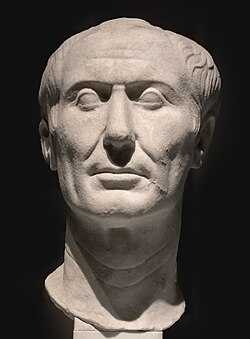
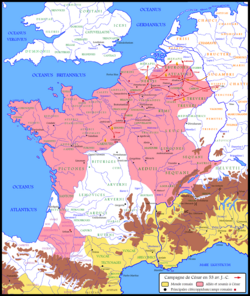
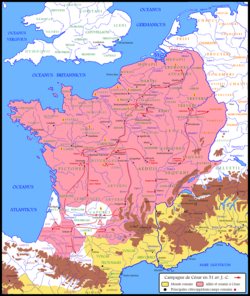
The Gallic Wars (58–50 BC) were a series of military campaigns led by Julius Caesar that fundamentally reshaped the map of Western Europe. What began as a series of interventions to protect Roman interests evolved into a systematic conquest of Gaul—comprising modern-day France, Belgium, Luxembourg, Switzerland, and parts of Germany—and daring expeditions into Britain.
These conflicts were not merely territorial acquisitions; they were the forge in which Caesar built his legendary reputation and immense wealth. By the end of the wars, Caesar had transformed from a rising politician into a military titan, providing him with the loyal army and prestige necessary to challenge the Roman Republic and eventually establish the Roman Empire.
Key Facts
- Timeline: 58 BC to 50 BC.
- Primary Result: Total Roman victory and the conquest of Gaul.
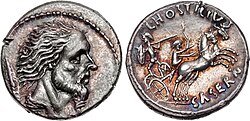
- Key Figures: Julius Caesar (Rome) and Vercingetorix (Gaul).
- Major Territorial Gains: Gaul became Roman territory; Britain became a source of tribute.
- Strategic Turning Point: The Siege of Alesia in 52 BC.
- Legacy: The wars provided the political and military leverage for Caesar to become dictator.
The Road to War: Sociopolitical Context
Rome's relationship with the Gallic tribes was defined by a mixture of respect and existential dread. This fear stemmed from 390 BC, when the Gauls sacked Rome, leaving a lasting psychological scar on the Roman psyche. While Rome had established the province of Transalpine Gaul in 121 BC, the northern territories remained a volatile frontier.
By 63 BC, instability grew as the Arverni and Sequani tribes, allied with the Germanic Suebi, attacked the Aedui—a key Roman ally. Rome initially ignored these conflicts, but the shifting tribal alliances created a vacuum that Julius Caesar would eventually fill.
The Early Campaigns (58–56 BC)
The Helvetii Migration
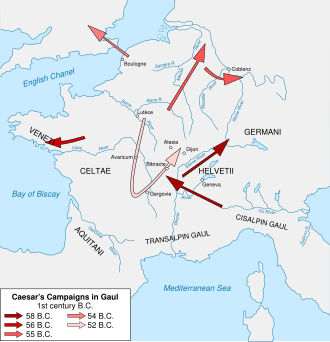
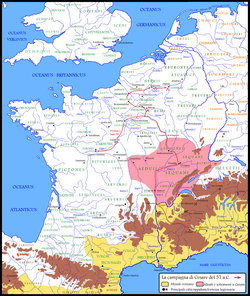
The conflict ignited in 58 BC when the Helvetii tribe attempted a mass migration. Caesar, acting swiftly, raised several legions and blocked their crossing of the river Saône. After a series of maneuvers and the Battle of Bibracte, the Helvetii surrendered. While Caesar claimed to have processed a census showing 368,000 people, modern historians suggest the actual number was likely between 20,000 and 50,000.
Expanding the Conquest
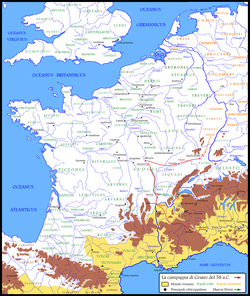
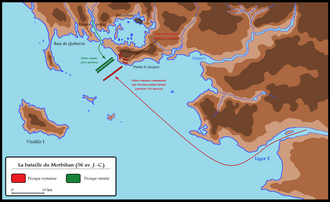
By 57 BC, Caesar's goals shifted from protection to total conquest. He campaigned in the east, facing a near-defeat during an ambush by the Nervii. In 56 BC, the focus shifted to the northwest, where Caesar engaged the Veneti in a significant naval battle at Morbihan, securing control over the Atlantic coast.
Prestige and Exploration: The Rhine and Britain (55–54 BC)
Seeking to outshine his political rivals, Pompey and Crassus, Caesar undertook two unprecedented expeditions. First, he constructed a bridge across the Rhine to strike at Germanic tribes, a feat of engineering that lasted only 18 days but sent a powerful message of Roman capability.
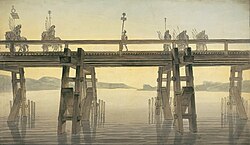
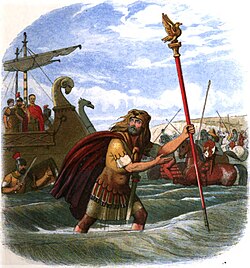
Following this, Caesar led the first Roman army across the English Channel into Britain. The first attempt in 55 BC achieved little due to a small force, but a second, larger expedition in 54 BC allowed Caesar to penetrate further inland and extract tribute from the Britonic tribes.
The Great Gallic Revolt and the Fall of Alesia (53–52 BC)
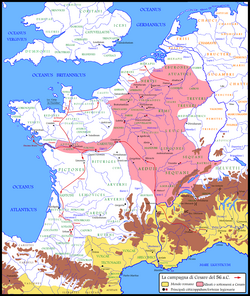
Roman control was challenged by a series of revolts, most notably the uprising led by Ambiorix in 54 BC, which resulted in a humiliating defeat for the Romans. In 53 BC, Caesar responded with a brutal pacification campaign, targeting civilians and burning villages to demoralize the population.
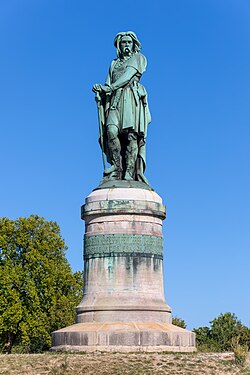
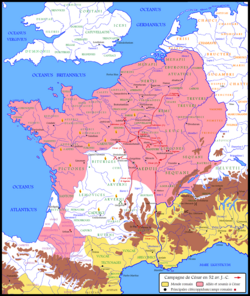
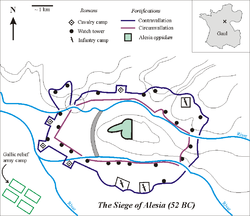
The climax of the war arrived in 52 BC when Vercingetorix united the Gallic tribes in a massive revolt. Although the Gauls won a victory at Gergovia, Caesar trapped Vercingetorix at Alesia. The Romans constructed an incredible system of fortifications—including a moat and walls—to besiege the city while simultaneously defending against a Gallic relief army.
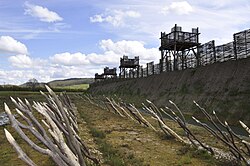
The fall of Alesia crushed the Gallic coalition. Vercingetorix surrendered, marking the effective end of organized Gallic resistance.
Final Pacification and Aftermath (51–50 BC)
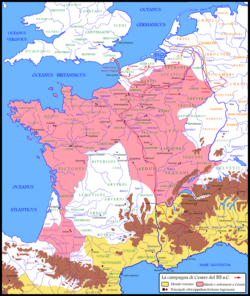
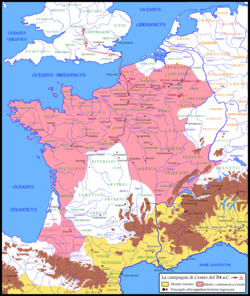
The final two years of the conflict consisted primarily of mop-up operations to eliminate remaining pockets of resistance in the southwest. By 50 BC, Gaul was fully conquered. Although it did not officially become a Roman province until 27 BC, the region was firmly under Roman control.
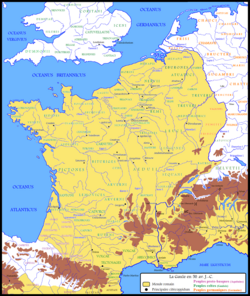
The wars ended not because of a treaty, but because of the impending Roman Civil War, which required the withdrawal of Caesar's legions.
| Phase | Key Events | Outcome |
|---|---|---|
| Early Phase (58-56 BC) | Helvetii migration, Battle of Morbihan | Control of East and Northwest Gaul |
| Expeditions (55-54 BC) | Rhine crossing, Invasions of Britain | Increased prestige; Britonic tribute |
| The Great Revolt (53-52 BC) | Ambiorix's revolt, Siege of Alesia | Defeat of Vercingetorix; Gaul subdued |
| Final Phase (51-50 BC) | Mop-up operations | Full Roman conquest of Gaul |
Frequently Asked Questions
![Gold stater of Vercingetorix, 53–52 BC.[80]](/images/a6/f0/a6f0ce9f6477b48b2fb5b6cd376b002331ced753bed0d5c0e11871f765f2723e.jpg)
How many people died in the Gallic Wars?
Estimates vary wildly. Ancient sources like Plutarch and Appian claim 1 million Celts were killed and another million enslaved. Caesar himself claimed 430,000 Germani were killed in one camp. Modern historians view these numbers as propaganda and suggest more credible, though still high, casualty figures.
Why did Caesar invade Britain?
The invasions were driven more by a need for political prestige than tactical necessity. By crossing the English Channel—a feat no Roman had achieved—Caesar aimed to enhance his public image and maintain his standing against rivals like Pompey and Crassus.
What was the significance of the Battle of Alesia?
Alesia was the decisive engagement of the war. Through superior engineering and siege tactics, Caesar defeated the united Gallic forces under Vercingetorix, effectively ending the possibility of a coordinated Gallic uprising.
Did Gaul become a province immediately after the war?
No. While the territory was conquered by 50 BC, Gaul did not officially become a Roman province until 27 BC. Some resistance continued in the region as late as 70 AD.
Who was Vercingetorix?
Vercingetorix was a Gallic chieftain who managed the rare feat of uniting various disparate tribes into a single coalition to fight against the Roman occupation, leading the final major resistance at Alesia.