Polyploidy: The Science of Whole-Genome Duplication
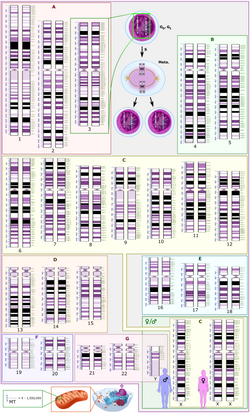
In the vast diversity of life, most complex organisms follow a standard genetic blueprint. Most eukaryotes—organisms with cells containing nuclei—are diploid, meaning they possess two complete sets of chromosomes, one inherited from each parent. These chromosomes are organized into pairs of homologous chromosomes, which carry the same types of genetic information.
However, nature frequently deviates from this rule through a condition known as polyploidy. Polyploidy occurs when an organism's cells contain more than two paired sets of homologous chromosomes. While this might seem like a genetic error, it is a powerful evolutionary mechanism, particularly common in the plant kingdom, that can lead to the creation of new species and enhanced biological traits.
Key Facts
- Definition: Polyploidy is the state of having more than two complete sets of chromosomes.
- Prevalence: It is exceptionally common in plants and multicellular algae, though it occurs in some animals, fungi, and bacteria.
- Causes: It typically results from whole-genome duplication due to abnormal cell division during mitosis or meiosis.
- Agricultural Impact: Many essential crops, including bread wheat and strawberries, are polyploid.
- Induction: Chemicals like colchicine and oryzalin can be used to induce chromosome doubling in cell cultures.
The Mechanics of Ploidy
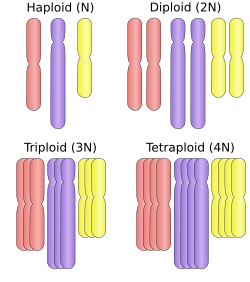
To understand polyploidy, one must first understand the different levels of ploidy (the number of sets of chromosomes in a cell):
- Monoploid (1x): An organism or cell with only one set of chromosomes. For example, males of bees and other Hymenoptera are monoploid.
- Diploid (2x): The standard state for humans and many other animals, featuring two sets of chromosomes.
- Polyploid: Any state beyond diploidy, such as tetraploid (4x), hexaploid (6x), or even higher.
Life Cycles and Gametes
In most eukaryotes, somatic (body) cells are diploid, while gametes (eggs and sperm) are haploid, containing only one set of chromosomes. This ensures that when fertilization occurs, the resulting zygote returns to a diploid state. Plants and multicellular algae differ by having alternating generations: a haploid gametophyte generation and a diploid sporophyte generation.
How Polyploidy Occurs
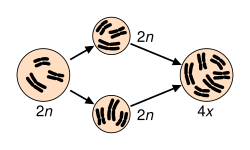
Polyploidy is the result of whole-genome duplication. This can happen through several biological pathways:
- Meiotic Failure: The most common cause is the failure of chromosomes to separate during meiosis, leading to diploid gametes. If these gametes self-fertilize, they produce a tetraploid zygote.
- Mitotic Errors: Abnormal cell division during mitosis can lead to genome doubling.
- Multiple Fertilization: An egg may be fertilized by more than one sperm cell.
- Chemical Induction: In laboratory or agricultural settings, chemicals such as colchicine or oryzalin can trigger chromosome doubling.
Types and Classifications
Autopolyploidy vs. Allopolyploidy
Polyploidy is generally categorized by the origin of the extra chromosome sets. Autopolyploidy occurs when an organism has more than two sets of chromosomes, all derived from a single species. In contrast, allopolyploidy occurs when the combined chromosome sets come from two or more different species, often through hybridization.
Endopolyploidy
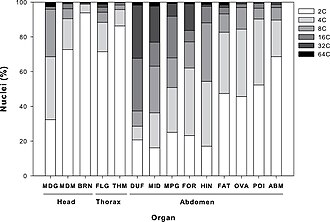
Unlike whole-organism polyploidy, endopolyploidy occurs when only specific tissues or organs within an organism undergo genome duplication. This is observed in certain animals, such as the giant ant Dinoponera australis, where different organs exhibit different ploidy levels (from 2x to 64x).
Temporal Classifications
- Neopolyploidy: Recently formed polyploids.
- Mesopolyploidy: Intermediate stages of polyploid evolution.
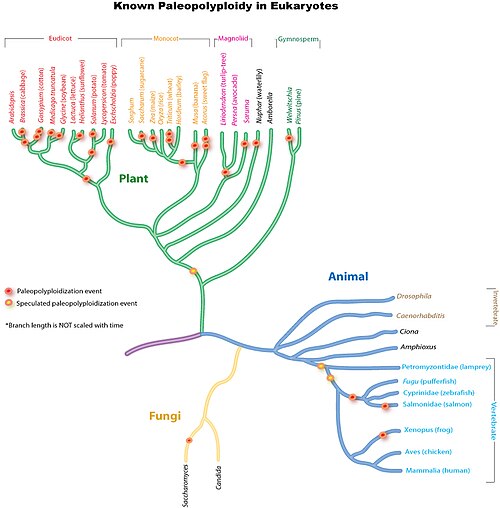
- Paleopolyploidy: Ancient genome duplication events that occurred millions of years ago, often leaving a trace in the evolutionary history of a lineage.
Examples Across the Tree of Life
Polyploidy manifests in a wide array of organisms, often resulting in larger cell sizes or increased robustness.
| Ploidy Level | Term | Examples |
|---|---|---|
| 1x | Monoploid | Male European fire ants |
| 2x | Diploid | Humans |
| 4x | Tetraploid | Plains viscacha rat, Salmonidae fish, Cotton (Gossypium hirsutum) |
| 5x | Pentaploid | Kenai Birch (Betula kenaica) |
| 6x | Hexaploid | Bread wheat, Kiwifruit, Chrysanthemum, Triticale, Oat |
| 8x | Octaploid | Strawberries, Dahlias, Sugar cane, Pansies, Acipenser (sturgeon) |
| 10x | Decaploid | Certain strawberries |
| 44x | Tetratetracontaploid | Black mulberry |
Beyond plants and animals, polyploidy is found in fungi, the Chromalveolata group, and even some bacteria and archaea. In the Chromalveolata, evolutionary history shows a mix of polyploidy and hybridization events.
![Schematic phylogeny of the Chromalveolata. Red circles indicate polyploidy, blue squares indicate hybridization. From Albertin and Marullo, 2012[93]](/images/0b/3e/0b3e0c1c83c805b80f4f9bf5c14c941a1f1afc0adc2020e50cc7b301feecebe0.png)
Frequently Asked Questions
Is polyploidy common in humans?
No. Humans are typically diploid. While triploidy (three sets of chromosomes) can occur, it is generally not viable and is often associated with maternal origin or second-trimester pregnancy loss.
How does polyploidy help plants?
Polyploidy can lead to speciation and is often associated with increased vigor, larger fruit or flower size, and greater adaptability to diverse environments, which is why it is so prevalent in crops.
What is the difference between a monoploid and a haploid?
While both have one set of chromosomes, the term monoploid is typically applied to organisms or cells that are normally diploid but possess only one set, such as male bees.
Can polyploidy be induced artificially?
Yes, in plants and cell cultures, chemicals like colchicine can be used to prevent chromosome separation during division, effectively doubling the chromosome count.
What is the difference between autopolyploidy and allopolyploidy?
Autopolyploidy involves genome duplication within a single species, whereas allopolyploidy involves the combination of genomes from two different species through hybridization.