Ploidy Levels: How Chromosome Sets Shape Life
In the complex blueprint of life, the number of chromosome sets within a cell is a fundamental characteristic known as ploidy. This value determines how many possible alleles—different versions of a gene—an organism can carry for its autosomal and pseudoautosomal genes. From the single set found in some specialized cells to the massive, multi-set genomes found in certain plants and insects, ploidy levels play a critical role in evolution, development, and species identity.
At its core, ploidy refers to the number of complete sets of chromosomes inherited from parents. These sets exist in homologous pairs, where one copy is maternal and the other is paternal. By understanding these levels, biologists can better grasp how organisms reproduce, how they evolve, and why certain genetic variations are vital for survival.
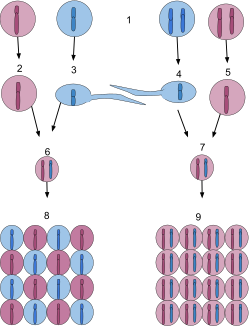
![A haploid set that consists of a single complete set of chromosomes (equal to the monoploid set), as shown in the picture above, must belong to a diploid species. If a haploid set consists of two sets, it must be of a tetraploid (four sets) species.[1]](/images/be/6c/be6cdf52a11e3da564514c7e0d66192c402603b7759ccbec1765ec0554abdbe5.webp)
Key Facts
- Ploidy is the number of complete chromosome sets in a cell.
- Diploid organisms (2n) carry two sets of chromosomes, common in humans.
- Polyploidy refers to organisms with three or more sets of chromosomes.
- Haploid cells (n) contain only one set, typically found in gametes like sperm and eggs.
- Aneuploidy occurs when an organism has an abnormal number of chromosomes that is not an exact multiple of the haploid set.
- Polyploidy is a major driver of speciation, particularly in plants and fungi.
Understanding Ploidy Levels
Cells and organisms are categorized by their "ploidy level," which describes the number of chromosome sets present. The terminology scales upward as more sets are added:
- Monoploid: 1 set
- Diploid: 2 sets
- Triploid: 3 sets
- Tetraploid: 4 sets
- Pentaploid: 5 sets
- Hexaploid: 6 sets
When an organism possesses three or more sets, it is broadly termed a polyploid. While polyploidy can be quite complex, some specialized systems exhibit extreme levels. For instance, the silk glands of the Bombyx mori silkworm can reach levels as high as 1,048,576-ploid.
Haploid vs. Monoploid
While often used interchangeably, haploid and monoploid numbers can differ depending on the organism's ploidy. The monoploid number (x) is the number of chromosomes in a single complete set. The haploid number (n) refers to the total chromosomes found in a gamete. In diploid organisms, these two numbers are equal. However, in a tetraploid organism like the common potato, the monoploid number might be 12, while the haploid number is 24.
Euploidy and Aneuploidy
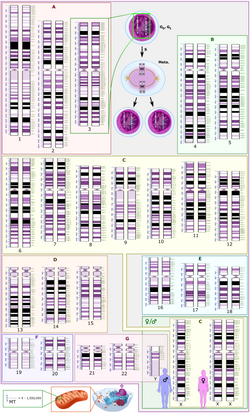
Biological systems generally aim for euploidy, where the total number of chromosomes is an exact multiple of the species' typical gametic number. When this balance is disrupted, the result is aneuploidy. Aneuploidy involves having an irregular number of chromosomes, such as in Turner syndrome, where an individual may have a 45,X karyotype instead of the standard 46,XX or 46,XY.
| Species | Ploidy Level | Chromosome Count |
|---|---|---|
| Banana (Musa spp.) | Triploid | 33 |
| Human | Diploid | 46 |
| Common Potato | Tetraploid | 48 |
| Sequoia sempervirens | Hexaploid | 66 |
| Opuntia ficus-indica | Octoploid | 88 |
Ploidy Across the Tree of Life
The prevalence of different ploidy levels varies significantly across different kingdoms of life. In the plant kingdom, polyploidy is incredibly common; half of all known plant genera contain polyploid species, and roughly two-thirds of all grasses are polyploid. For many plants and fungi, shifts in ploidy are essential drivers of evolution and the creation of new species.
In contrast, most animals are uniformly diploid. While polyploidy is observed in some invertebrates, reptiles, and amphibians, changes in ploidy are typically fatal in mammals and birds. However, some tissues within a diploid organism can be polyploid; for example, the mammalian liver can exhibit tissue-specific polyploidy.
Examples in Nature
Nature provides diverse examples of how ploidy manifests:
- African Toads (Xenopus): These species form a ploidy series, ranging from diploid (X. tropicalis) to dodecaploid (X. ruwenzoriensis).
- Wheat: Can exist in diploid, tetraploid, or hexaploid forms (14, 28, or 42 chromosomes).
- Social Insects: Ploidy levels can vary between different individuals within the same species.
Frequently Asked Questions
What is the difference between a haploid and a diploid cell?
A haploid cell contains a single complete set of chromosomes (n), whereas a diploid cell contains two complete sets (2n), one from each parent.
Why is polyploidy more common in plants than in animals?
While polyploidy is a major driver of speciation and evolutionary diversification in plants and fungi, it is often fatal in mammals and birds. Many plants successfully utilize polyploidy to adapt and evolve.
What does it mean if an organism is aneuploid?
Aneuploidy means the organism has a chromosome number that is not an exact multiple of the normal haploid set, such as having an extra or missing chromosome.
How do humans maintain a diploid state?
Humans maintain a diploid state through sexual reproduction. During meiosis, diploid germ cells divide to create haploid gametes (sperm or eggs). When these two haploid cells fuse during fertilization, they restore the full complement of 46 chromosomes.