Polyphyletic Groups: Understanding Mixed Evolutionary Origins in Taxonomy
In the study of biological classification, scientists strive to group organisms based on their actual evolutionary history. However, nature often produces deceptive similarities. A polyphyletic group is an assemblage of organisms that share similar characteristics but do not share a recent common ancestor. Instead, these groups have mixed evolutionary origins, meaning the members arrived at similar traits independently.
These similarities are known as homoplasies—traits that appear similar but evolved separately. This phenomenon is the result of convergent evolution, where different species evolve similar adaptations because they face similar environmental pressures or needs, rather than inheriting them from a shared ancestor.

Key Facts
- Definition: A group containing organisms from multiple ancestral sources without including their most recent common ancestor.
- Cause: Primarily driven by convergent evolution and the development of homoplasies.
- Contrast: Distinct from monophyletic groups (one ancestor and all descendants) and paraphyletic groups (one ancestor but missing some descendants).
- Taxonomic View: Many modern taxonomists avoid polyphyletic groupings because they lack predictive power regarding an organism's biology.
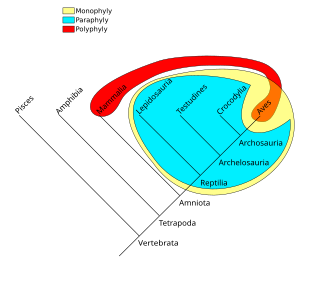
- Examples: "Warm-blooded animals" is a polyphyletic group because mammals and birds evolved endothermy independently.
Comparing Phylogenetic Groupings
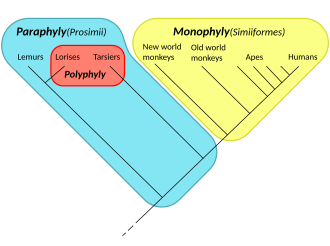
To understand polyphyly, it is helpful to compare it with the other two primary types of phylogenetic arrangements: monophyly and paraphyly.
Monophyly
A monophyletic group, or a clade, consists of a single common ancestor and all of its descendants. These are considered the only valid groupings by many schools of taxonomy because they are defined by synapomorphies (shared derived characteristics).
Paraphyly
A paraphyletic group includes the most recent common ancestor but excludes one or more descendant groups. This often happens when a subgroup evolves so differently that it is classified separately.
Polyphyly
A polyphyletic group is the most complex of the three, as it excludes the most recent common ancestor of all its members entirely. It is essentially a collection of separate clades grouped together by a shared trait.
| Group Type | Includes Common Ancestor? | Includes All Descendants? | Basis of Grouping |
|---|---|---|---|
| Monophyletic | Yes | Yes | Shared derived traits (Synapomorphies) |
| Paraphyletic | Yes | No | Shared ancestral traits |
| Polyphyletic | No | No | Convergent traits (Homoplasies) |
The Role of Polyphyly in Science and Taxonomy
The etymology of these terms reveals their meaning: polyphyly comes from the Greek polús (many) and phûlon (genus/species), reflecting the multiple ancestral sources involved. In contrast, monophyly uses mónos (alone/unique), and paraphyly uses pará (beside/near).
Why Taxonomists Avoid Polyphyletic Groups
From a practical standpoint, monophyletic groups allow for better scientific prediction. For example, if a new plant is identified as part of the monophyletic family Poaceae (true grasses), scientists can accurately predict its reproductive and developmental characteristics. However, grouping plants by a polyphyletic trait—such as Linnaeus' Diandria (plants with two stamens)—is useless for prediction because that trait evolved independently across many unrelated groups.
Exceptions and Special Cases
While systematists avoid polyphyly, researchers focused on ecology may find these groups useful. For instance, the fungus group Alternaria is regarded as a valid genus for ecological study despite being polyphyletic, because the members share similar activities.
Additionally, the concept of polyphyly extends to the species level. While species are usually assumed to be monophyletic, hybrid speciation (common in plants via polyploidy) can lead to the creation of polyphyletic species.
Frequently Asked Questions
What is the difference between a homoplasy and a synapomorphy?
A synapomorphy is a shared derived trait inherited from a common ancestor, which defines a monophyletic group. A homoplasy is a similar trait that evolved independently in different lineages through convergent evolution, often leading to polyphyletic groupings.
Why are "warm-blooded animals" considered polyphyletic?
Warm-bloodedness evolved separately in the ancestors of mammals and the ancestors of birds. Because they do not share a recent common ancestor that was also warm-blooded, grouping them together creates a polyphyletic group.
Can a polyphyletic group ever be useful?
Yes, particularly in ecology. When researchers are more interested in the function or activity of organisms (such as the shared behaviors in the Alternaria fungus) than in their evolutionary lineage, polyphyletic groups can serve as legitimate subjects of study.
How does hybrid speciation relate to polyphyly?
Hybrid speciation occurs when two different species mate to produce a new species. Because the resulting hybrid species has origins from two different ancestral lineages, it can be considered polyphyletic.
What are some other examples of polyphyletic groups?
Other examples include algae, worms, slime molds, trees, edentates, and plants that utilize C4 photosynthesis.